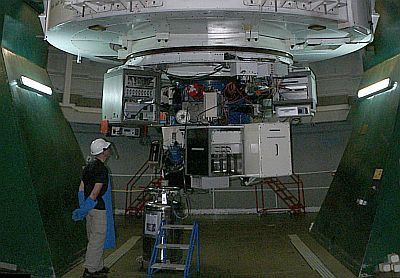
The Intermediate-dispersion Spectrograph and Imaging System (ISIS) is mounted at the ~f/11 Cassegrain focus of the
4.2m William Herschel Telescope.
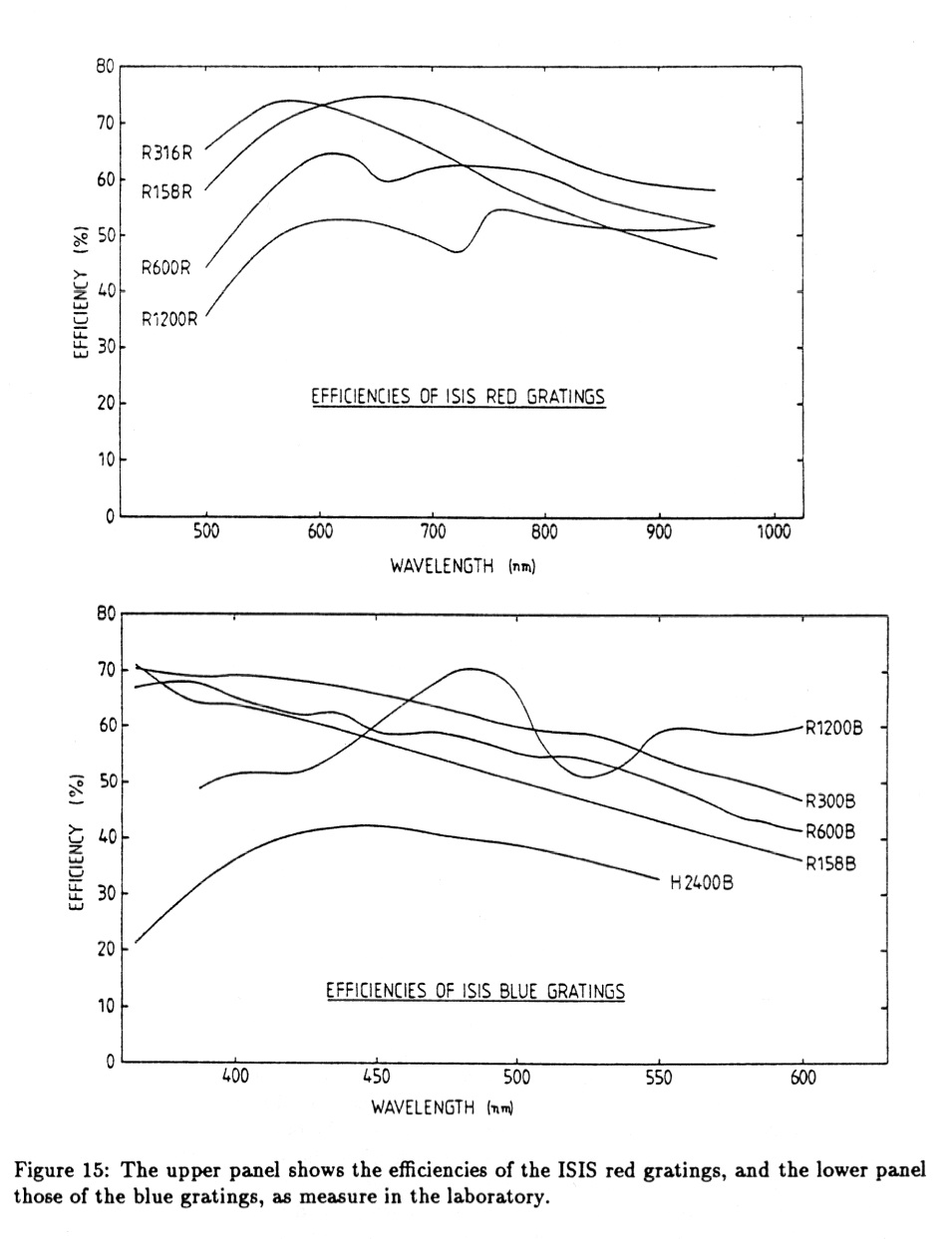
It is a high-efficiency, double-arm, medium-dispersion (8-121 Å/mm) spectrograph, capable of
observing in a long-slit of length up to ~4', ~3.7' unvignetted, and up to ~22" width. Use of dichroic filters permits
simultaneous observing in the blue and red arms, with a ~200Å wavelength range of reduced throughput at the dichroic cross over from reflection to transmission. The arms are optimised for their respective wavelength ranges, and specific wavelength ranges are set by rotating the grating cells.
Linear and circular spectropolarimetry, and imaging polarimetry, modes are also
available.
The default detector on the ISIS blue arm is EEV12, a
thinned, blue-sensitive array of 2048×4096 (13.5 micron) pixels.
The default detector on the ISIS red
arm is RED+,
a red-sensitive array of 2048×4096 (15.0 micron) pixels, with almost no fringing.
For fast or faint-object spectroscopy, two 1k×1k electron multiplying CCDs (EMCCDs),
QUCAM2 and
QUCAM3, are
available for both arms of ISIS. They provide high-speed spectroscopic
capability with very little dead time, and have essentially zero
read noise. EMCCDs have distinctive properties, and their use
depends
critically on the nature of the observations. These two detectors can also be used
as conventional, frame-transfer CCDs.
An image slicer is available on a shared risks basis. It limits loss
of light at the entrance slit of the spectrograph, allowing the maximum spectral resolution of the spectrograph to be attained with greater throughput in modest seeing conditions.
The ageing but venerated RGO 4.2m Microprocessor System (4MS) controllers were replaced
by a
Programmable Logic Controller (PLC) system in 2012, and this has enabled
faster movement of ISIS mechanisms with improved reliability.