ISIS Red Arm
The default chip for the ISIS red arm is Red+. It is a
red-sensitive array of 2048×4096 15.0µ pixels with almost no fringing.
- General information on the Red+ CCD
- Biases and the overscan region
- Wavelength coverage and spectral resolution
- Spatial scale
- Fringing and cosmetic defects
- Linearity measurements
- Shutter effect
- Bad pixel masks
- Atlas of arc lines in the red arm
Biases and the overscan region
The Red+ detector bias frames can be characterised as B(x,y,t) = f(x,y) + g(t), where f(x,y) represents the quasi-fixed pattern of pixel-to-pixel variation, and g(t) represents
the variation of the mean (over x,y) bias level with time. The time variability typically amounts to up to ~10-20 counts on the timescale of hours and days, and depends on environmental factors such as CCD and controller-electronics temperatures.
The quasi-fixed pattern function f(x,y) is measured from the median of the usual afternoon bias frames, and the time-variation function g(t) is measured from the overscan region of the detector
from each science observation.
The overscan strip of the Red+ detector extends over rows 4110 to 4190, and is defined in the FITS headers by the usual BIASSEC keyword.
Wavelength coverage and spectral resolution
The table below gives the dispersion provided by
each grating when mounted blaze to collimator (see the
ISIS
manual for more in depth details on gratings and their
properties), and the spectral range covered by the Red+ CCD. The Red+ detector is
mounted on the red arm with its 4096-pixel axis along the dispersion direction,
giving maximum utility of the beam width leaving the camera. However, the
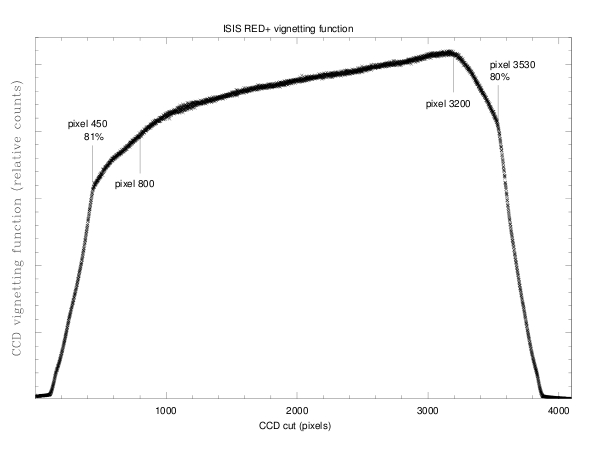
camera optics vignette the outer regions of the dispersed light beam such that
approximately 800 pixels at either end of the CCD are vignetted.
A plot of the CCD vignetting function across the
chip is shown below to illustrate this effect. This function was measured in
May 2011 from a flat-field exposure corrected by CCD quantum efficiency, grating
efficiency and tungsten lamp spectral emissivity functions.
The unvignetted region is from (spectral) pixel 800 to 3200 (calculated so that the
flux differences are within 5%), which is essentially the central 2400 pixels.
The unvignetted and 50% vignetted spectral ranges in Å are given in the table below.
The dispersions of the red-arm gratings in Å/mm are 121 (R158R), 62 (R316R),
33 (R600R) and 17 (R1200R). The pixel size of the Red+ detector is
15µ, and the corresponding grating dispersions
in Å/pixel are listed in the table, as are the
slit widths that project to four pixels (60µ) with the gratings set at blaze. The
spectral resolution elements, Δλ, in Å for a 1-arcsec slit are also listed. The corresponding
nominal spectral resolutions, λ/Δλ,
at 7000Å with a 1-arcec slit are approximately 909 (R158R), 1842 (R316R), 3867 (R600R) and 9333 (R1200R).
Note that the slit width projecting to four pixels increases with grating resolution. This is due to grating anamorphic de-magnification, which is parameterised by
cos(θ+φ/2)/cos(θ-φ/2), where θ is the grating tilt with respect to zero order and φ is the camera-collimator angle. This relation demonstrates why the slit size projecting to four pixels is larger for the higher resolution gratings; they are set to larger tilt angles for a given central wavelength, and so their de-magnification is greater.
See here for a discussion of this effect.
|
ISIS wavelength coverage and resolution with
Red+
|
|
Grating
|
Blaze
|
Total Spectral range (Å)
|
Unvignetted range 2400 pixels (Å)
|
50% unvignetted range 3285 pixels (Å)
|
Dispersion (Å/pixel)
|
Slit-width for 60µ at detector (arcsecs)
|
Resol. element with a 1" slit (Å)
|
|
R158R
|
6500
|
7530
|
4412
|
6038
|
1.81
|
0.94
|
7.70
|
|
R316R
|
6500
|
3858
|
2260
|
3094
|
0.93
|
0.98
|
3.80
|
|
R600R
|
7000
|
2054
|
1202
|
1646
|
0.49
|
1.08
|
1.81
|
|
R1200R
|
7200
|
1055
|
618
|
846
|
0.26
|
1.38
|
0.75
|
According to sampling theory a line as recorded on the detector is fully sampled if
it has at least two
dispersion elements across its FWHM, and so the detector oversamples the
resolution element when the slit width is set to 1-arcsec (e.g., to approximately
match seeing). In this configuration the detector can be binned ×2 spectrally to
increase the signal-to-noise in each wavelength bin, without
loss of spectral resolution. This can also be done at the reduction
stage, but binning on-chip reduces the readout noise contribution to the
resolution element.
It is also possible of course to improve spectral resolution by reducing
the slit width. This increases slit losses especially in moderate seeing, and in any case the slit should project to at least two pixels so that the resolution element remains fully sampled by the detector.
Spatial scale
The red (and blue) camera is a folded Schmidt design of focal length 500 mm and gives
a scale of 14.9 arcsec/mm at the detector. Hence the spatial scale
with Red+ is 0.22 arcsec/pixel. It is possible to bin in
the spatial
direction if one is not concerned with high spatial resolution
observations;
indeed the seeing conditions need to be excellent to allow full
advantage
to be taken of using an unbinned chip with this pixel scale. The
maximum
unvignetted slit-length usable with ISIS is 3.7 arcmin, corresponding
to
1010 spatial detector pixels in a window [533:1542,1:4200], centred on the
standard window.
Fringing and cosmetic defects
Red+ is a very low-fringing high-QE CCD. Fringing begins at
about 8000Å, and the ripples are visible at
about the 1% level at 9000Å (more information is available
here).
Shutter effect
The Prontor shutter opens the aperture radially symmetrically.
The same shutter effect as
for the blue
arm was measured for the red arm.
Bad pixel masks
Bad pixel masks for Red+ with different binning levels were created using
noao.imred.ccdred task in IRAF. All masks are created for the default CCD
window [585:1550,1:4200].
bad pixel mask bin 1 1
bad pixel mask bin 1 2
bad pixel mask bin 2 1
bad pixel mask bin 2 2
bad pixel mask bin 3 1
bad pixel mask bin 3 2
bad pixel mask bin 4 2
Atlas of arc lines in the red arm
An atlas of arc lines for a range of central wavelengths of the red arm gratings is available
here.