| |||
|

| Home > Astronomy > William Herschel Telescope |
|
| |||
|
| Home > Astronomy > William Herschel Telescope |

|
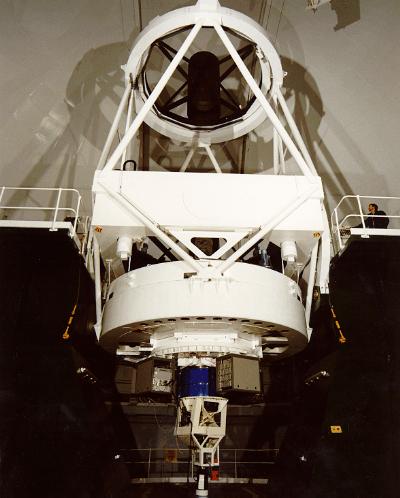
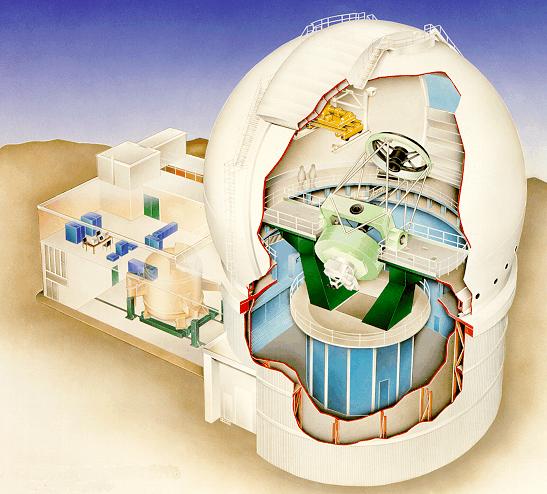
William Herschel Telescope
A powerful new fibre-fed multi-object spectrograph, WEAVE, has been mounted at the prime focus of the WHT. It offers three focal-plane modes:
The LIFU science surveys are ongoing. The MOS science surveys are expected to start ~ April 2026. Once the WEAVE commissioning and science verification are completed, 70% of the time on the telescope will be used to carry out the dedicated surveys with WEAVE. The remaining 30% of the time is open time, available to the community. During 2026 and 2027, open-time observations will be carried out with WEAVE only, and observations with older instruments (e.g. ISIS, ACAM) or visiting instruments will not be possible during this period. The application procedure for WEAVE open time (including LIFU target-of-opportunity) is documented here. The median seeing at the WHT is 0.8 arcsec during April - November. The dark-of-moon sky brightness at high ecliptic latitude is similar to that at other good dark sites, V ~ 21.9 mag arcsec2. News: 2026 February: All 3 WEAVE modes (MOS, LIFU, mIFU) offered for 2026B. 2025 July: End of standdown to address spectrograph misalignment. LIFU science and MOS commissioning observations resume. 2024 September 16: Stand-down for NOVA team to investigate spectrograph mis-alignment. 2023 October WEAVE (LIFU-mode) survey and open-time observations begin. Pre-commissioning tests of MOS mode continue. 2023 August: Commissioning of the LIFU (large integral-field unit) mode of WEAVE was completed early in 2023. This mode is offered in open time in 2023B and 2024A. Pre-commissioning and commissioning tests of the MOS and mIFU modes of WEAVE continue. 2022 September 29: On-sky commissioning of the LIFU mode of WEAVE begins, in parallel with pre-commissioning tests of the fibre-positioning system (for the MOS and mIFU modes). 2022 summer: WEAVE sub-systems assembled on the WHT, pre-commissioning tests begin. 2020 February 17: Start of pre-WEAVE standdown for preparation of telescope, and integration and testing of WEAVE components. This will be followed by on-sky commissioning and science verification. 2020 February 16: Last night of pre-WEAVE observing before standdown. For older/retired news items, click here. |
| Top | Back |
|