|
Bibliographies
Analysis
Miscellanea
Reports on use of observing time and scientific productivity
Scientific highlights
Bibliographies
ING paper database
The complete database of papers can be searched at the publications page, including a NASA/ADS interface to analysis the scientific productivity.
ING Annual Report
ING Technical Notes
- Technical Note No. 134, "ING Bibliography 2002-2011".
- Technical Note No. 129, "ING Bibliography 2000-2001".
- Technical Note No. 124, "ING Bibliography 1999"
- Technical Note No. 121, "ING Bibliography 1998"
- Technical Note No. 112, "ING Bibliography 1997"
- Technical Note No. 109, "ING Bibliography 1996"
- Technical Note No. 101, "ING Bibliography 1995"
- Technical Note No. 97, "ING Bibliography 1994"
- Technical Note No. 94, "ING Bibliography 1993"
- Technical Note No. 89, "ING Bibliography 1992"
- Technical Note No. 83, "ING Bibliography 1991"
- Technical Note No. 80, "ING Bibliography 1990"
- Technical Note No. 77, "ING Bibliography 1989"
- Technical Note No. 66, "ING Bibliography 1988"
- Technical Note No. 62, "ING Bibliography 1984-87"
Analysis
Paper counts
This table shows the refereed-paper counts per telescope and year.

|
Number of refereed papers per year [ PNG ].
|

|
Number of refereed papers since first-light year [ PNG ].
|

|
Number of refereed papers per year
[ PNG ].
|

|
Cumulative number of refereed published papers per year and telescope
[ PNG ].
|
Service, Override and Archival papers
Publications that make use of data obtained as part of the ING Service Programme, the ING Override Programme or from the ING Archive.

|

|
Left: Relative distribution of WHT refereed papers since first light and origin of the data (private instrument, archive, service or override). Right: same for the INT, including some surveys [ PNG | PNG ].
|
Papers in Nature and Science journals
A compilation of Nature and Science papers is available.

|
Cumulative number of papers (partly) based on ING data published in journals Nature or Science. If a paper makes use of data from more than one ING telescope, then it's counted once [ PNG ].
|
Paper citations
These tables show the refereed-paper citations per telescope and year.

Total number of citations per year. The dashed lines show median values of citations per year from the years of stable paper production and citations: 6353 citations/year (WHT, 1998-2019), 4048 citations/year (INT, 1995-2019), and 1484 citations/year (JKT, 1995-2004). The jump in 1999 is produced by the paper Perlmutter et al., 1999, ApJ, 517, 565 (13644 citations).

Median citations per year when papers per year are greater than or equal to 10. The dashed lines show the median values from the years of stable paper and citation production: 40 cit/paper (WHT, 1998-2019), 37 cit/paper (INT, 1995-2019), and 33 cit/paper (JKT, 1995-2004).

h index per year. The dashed lines show average values calculated in the years of stable paper production and number of citations: 43 (WHT, 1998-2019), 34 (INT, 1995-2019), and 21 (JKT, 1995-2004).
Top most cited papers
The top 25 most cited papers from every ING telescope are listed in the Top most cited papers web page.
Telescope performance
Time on sky:

|
Relative-to-night-length on-sky time defined as
100%-(weather downtime percentage)-(technical downtime percentage)-(standdown percentage) excluding from the calculation S/D/commissioning nights as well as nights when visiting instruments were used [ PNG ].
|
Technical downtime:

|
Percentage of technical downtime per semester excluding from the calculation S/D/commissioning nights as well as nights when visiting instruments were used
[ PNG ].
|
Weather downtime:

|
Relative-to-night-length percentage weather downtime per year (semesters A+B) excluding from the calculation S/D/commissioning nights as well as nights when visiting instruments were used. Blue: WHT, yellow: INT. The dotted lines show the average values
(WHT average: 21.0%, INT average: 21.9%)
[ PNG ].
|

|
Relative-to-night-length percentage weather downtime per semester excluding from the calculation S/D/commissioning nights as well as nights when visiting instruments were used.
[ PNG ].
|
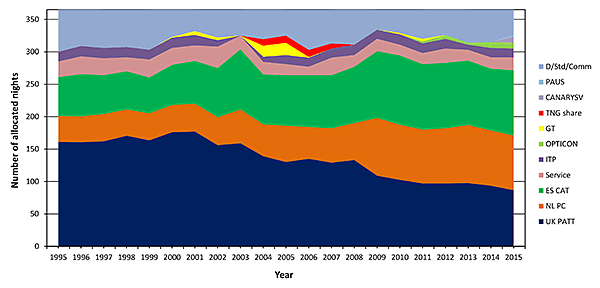
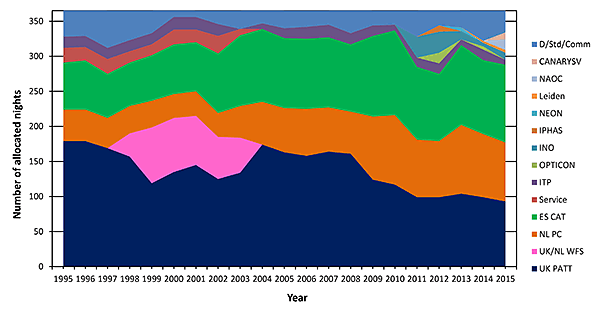
Telescope time allocation and paper authorship
|
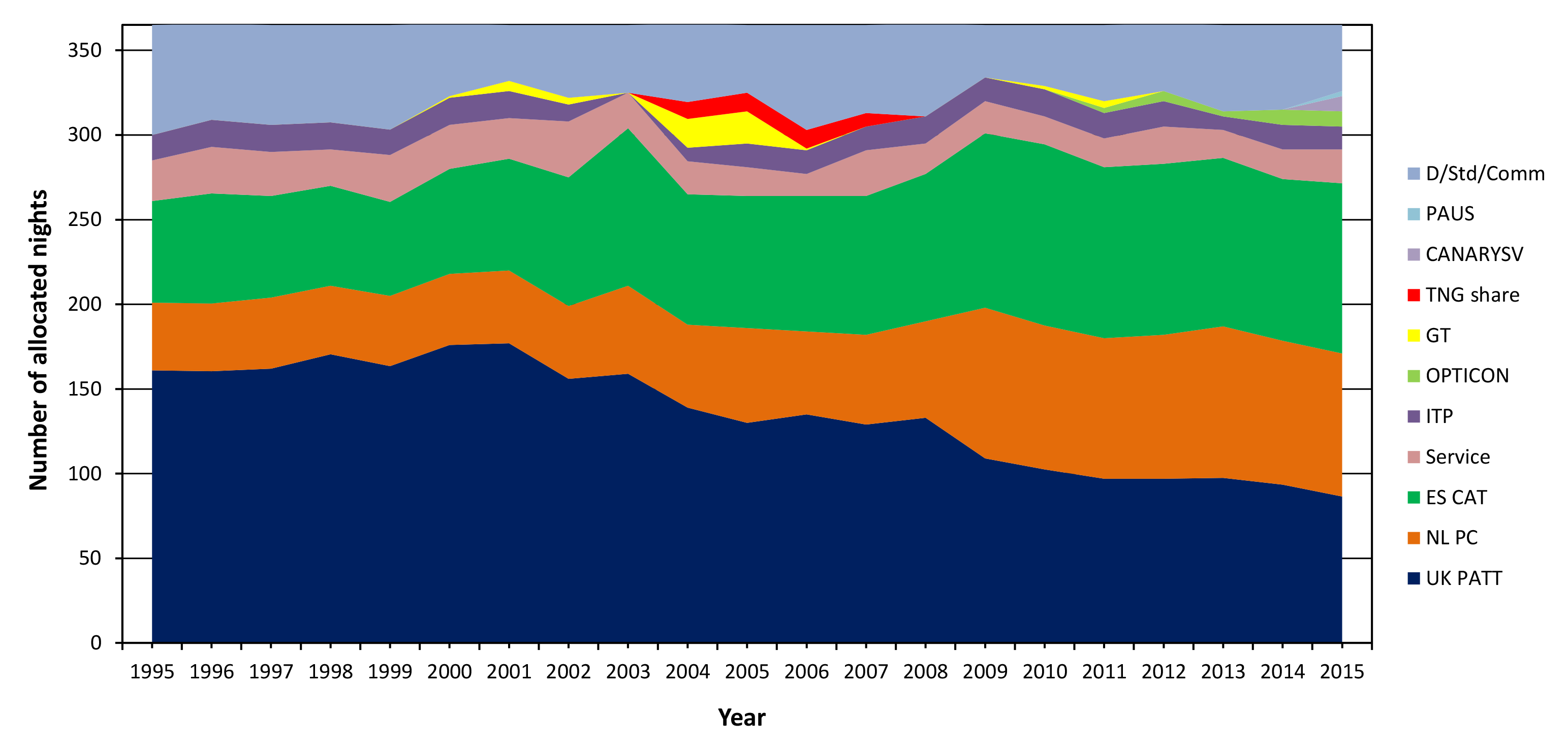
Number of allocated nights per type of allocation (time allocation committee, observing scheme, organisation, project)
[ PNG ].
|
|
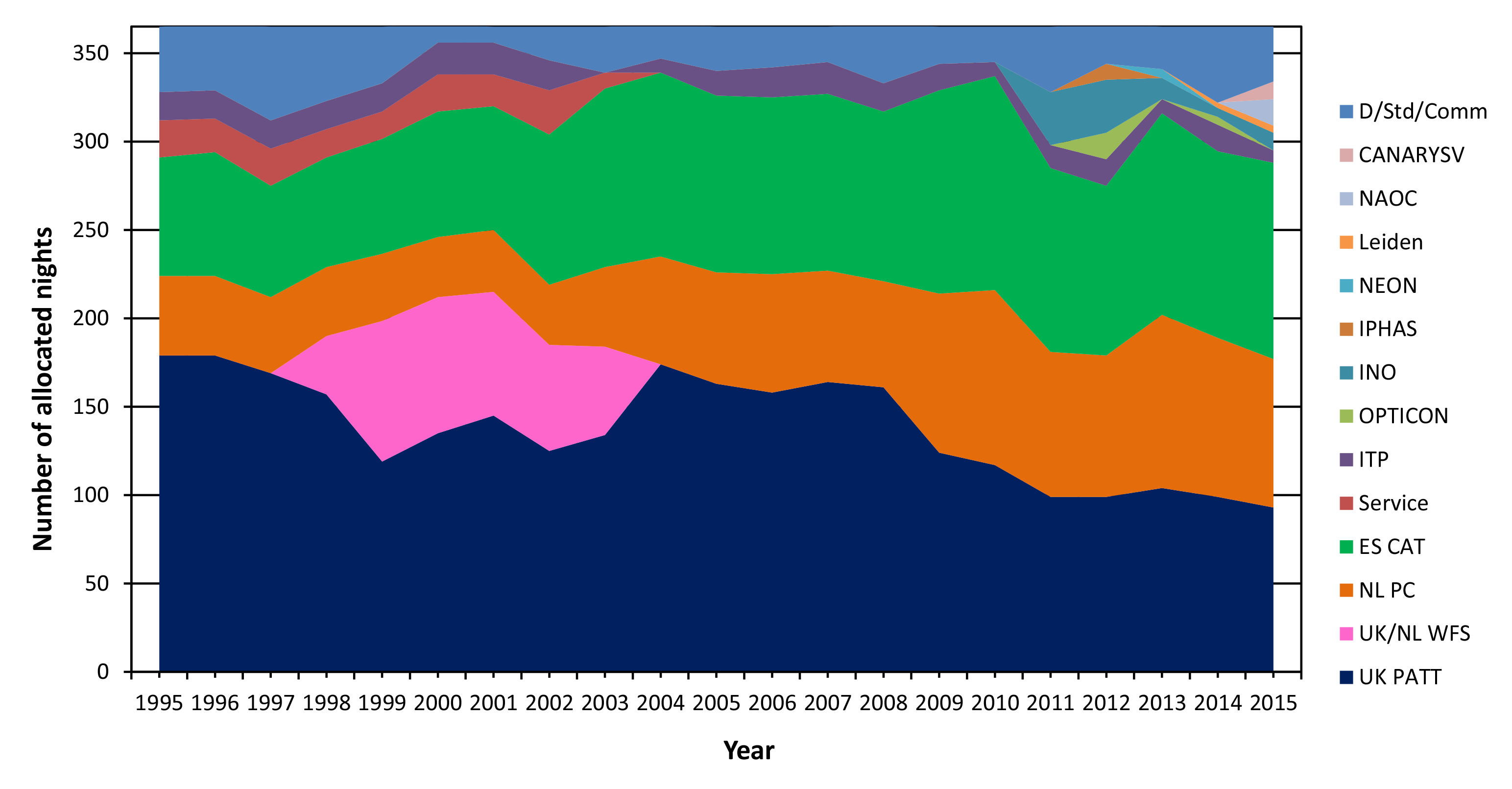
Number of allocated nights per type of allocation (time allocation committee, observing scheme, organisation, project)
[ PNG ].
|

|
Nationality of first author's first affiliation in refereed papers that used data from the ING telescopes since 1984.
[ PNG ].
|
Instrument time allocation and paper use
|
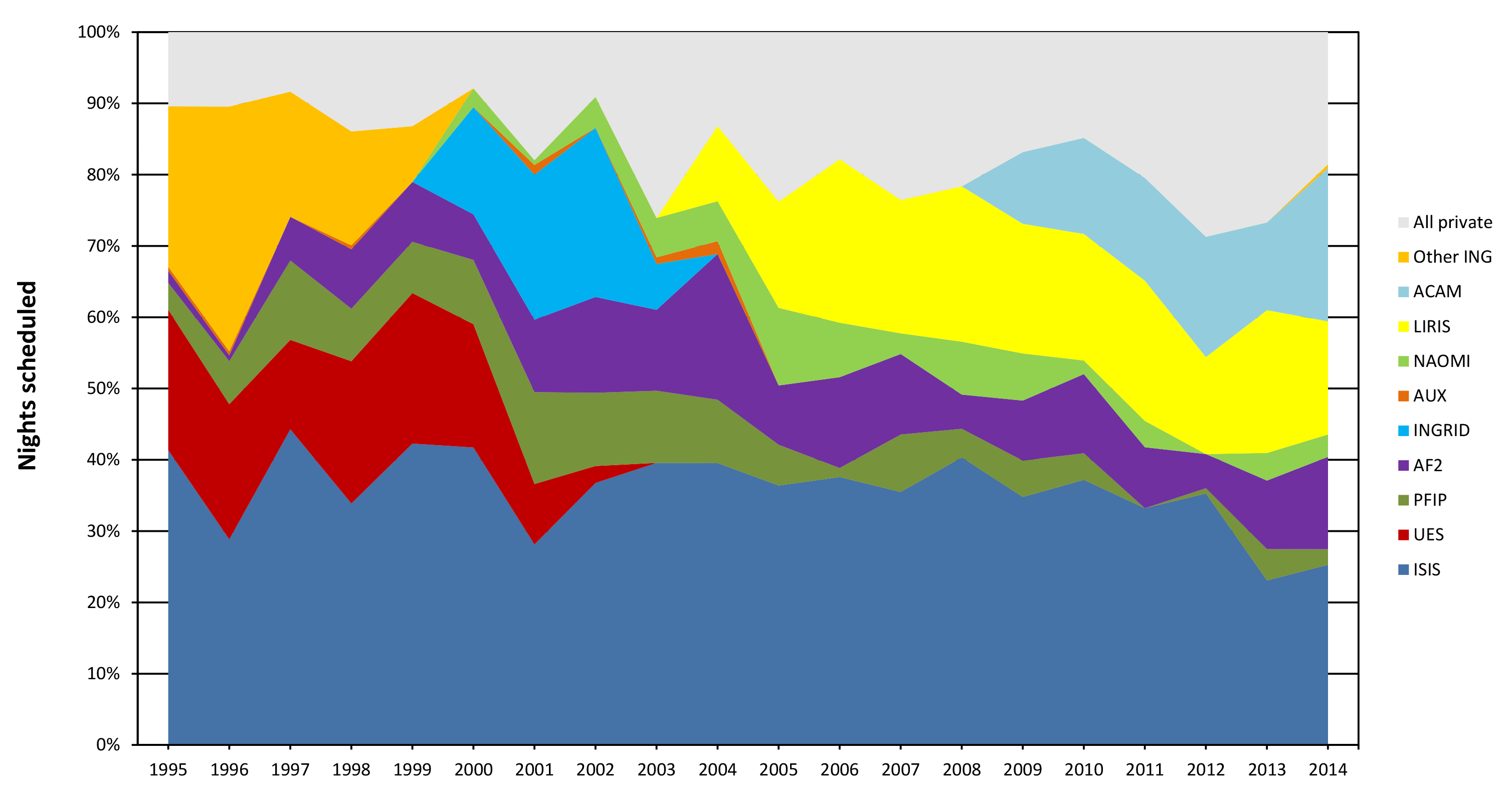
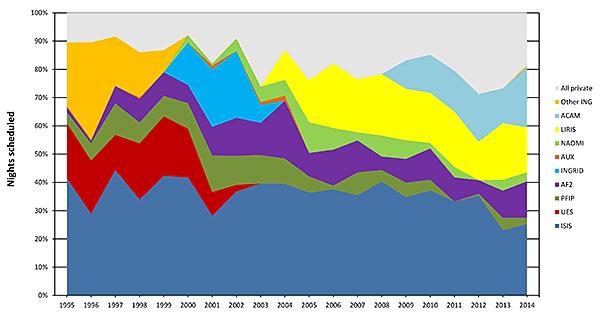
Allocated nights per instrument on the
WHT. Only science nights are considered. Every year comprises data from semesters A and B. INGRID refers to when it was used without adaptive optics. NAOMI includes INGRID, OASIS and OSCA in
combination with adaptive optics [ PNG ].
|

|
Instrument use in WHT refereed papers since first light [ PNG ].
|
|
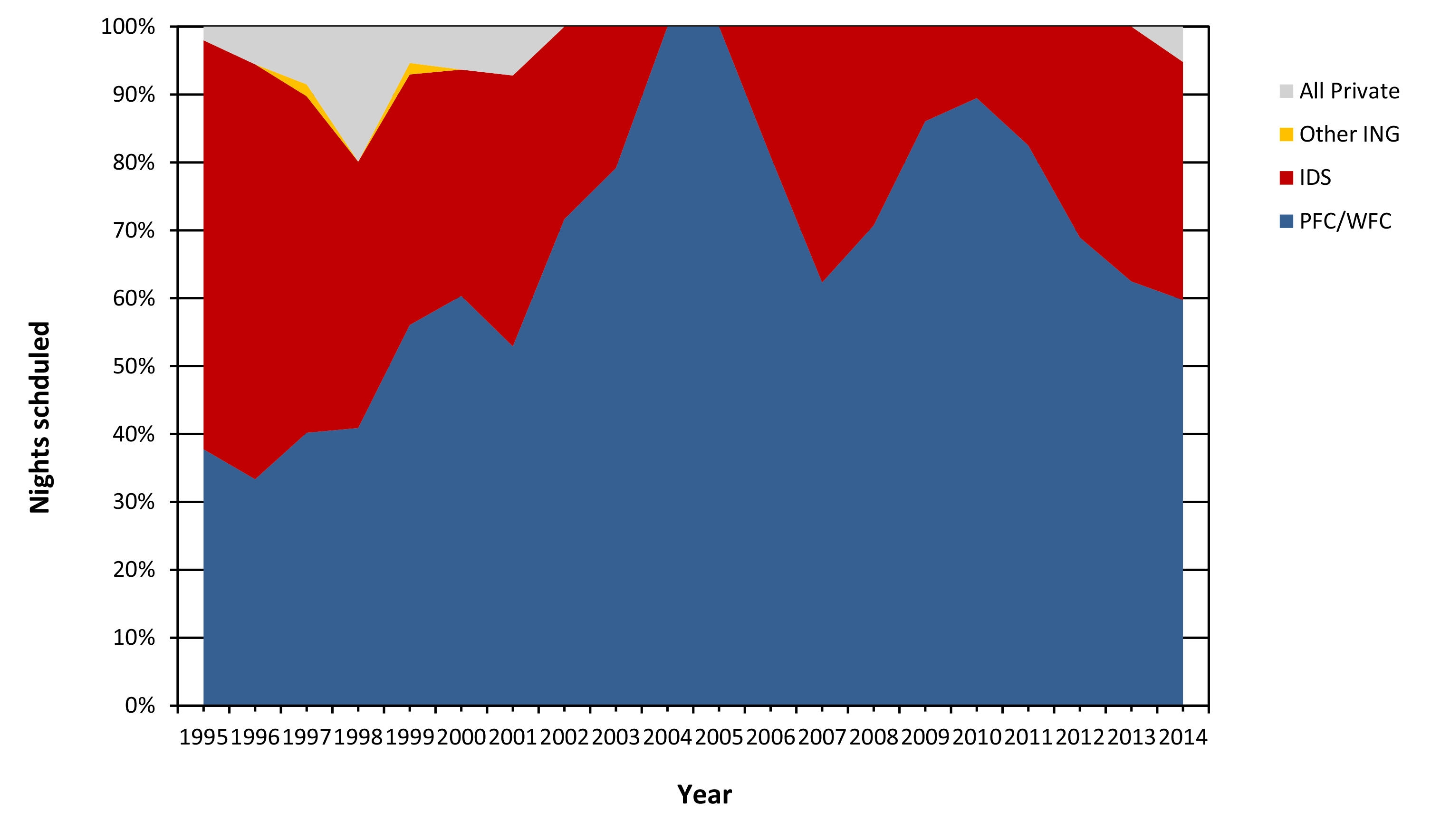
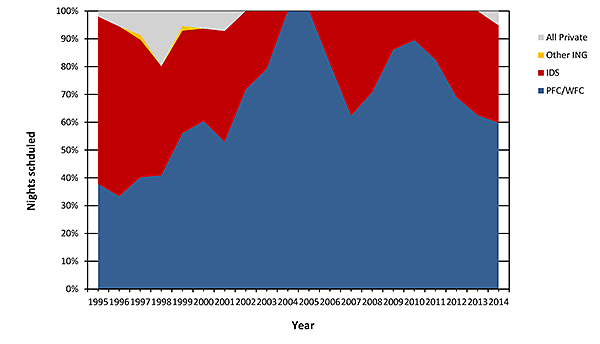
Allocated nights per instrument on the INT. Only science nights are considered.
Service nights are excluded. Every year comprises data from semesters A and B [ PNG ].
|

|
Instrument use in INT refereed papers since first light [ PNG ].
|
Journal publication

|
Paper distribution in the scanned refereed journals (since 1984) [ PNG ].
|
User feedback

|
WHT and INT user overall satisfaction rating as recorded in the observer feedbacks when they leave, since 1999 [ PNG ].
|
Miscellanea
Comparison with other telescopes
- Scientific impact of large telescopes 1991-1998.
- The WHT one of the most scientifically productive telescopes in the world:
C Benn and S Sánchez, 2001, "Scientific Impact of Large Telescopes", ING Newsl, 4, 15.
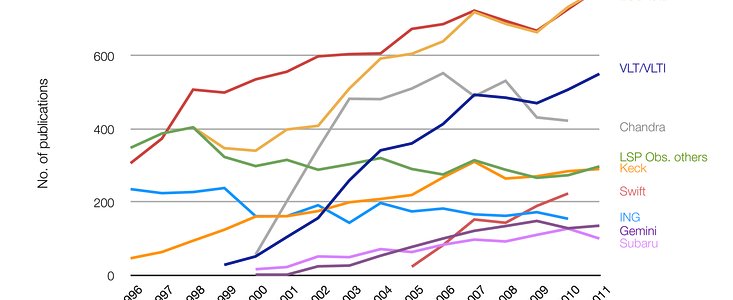
- Comparison of ESO telescopes with other observatories, including ING:
Article: http://www.eso.org/public/announcements/ann12025/.
Graph: http://www.eso.org/public/archives/images/newsfeature/ann12025a.jpg.
Report: Basic ESO Publication Statistics
- Reports from the Red de Infraestructuras de Astronomía.
- Trimble & Ceja, 2010, "Productivity and impact of astronomical facilities: A recent sample", Astr Nachr, 331, 338. Paper.
Count checks
|
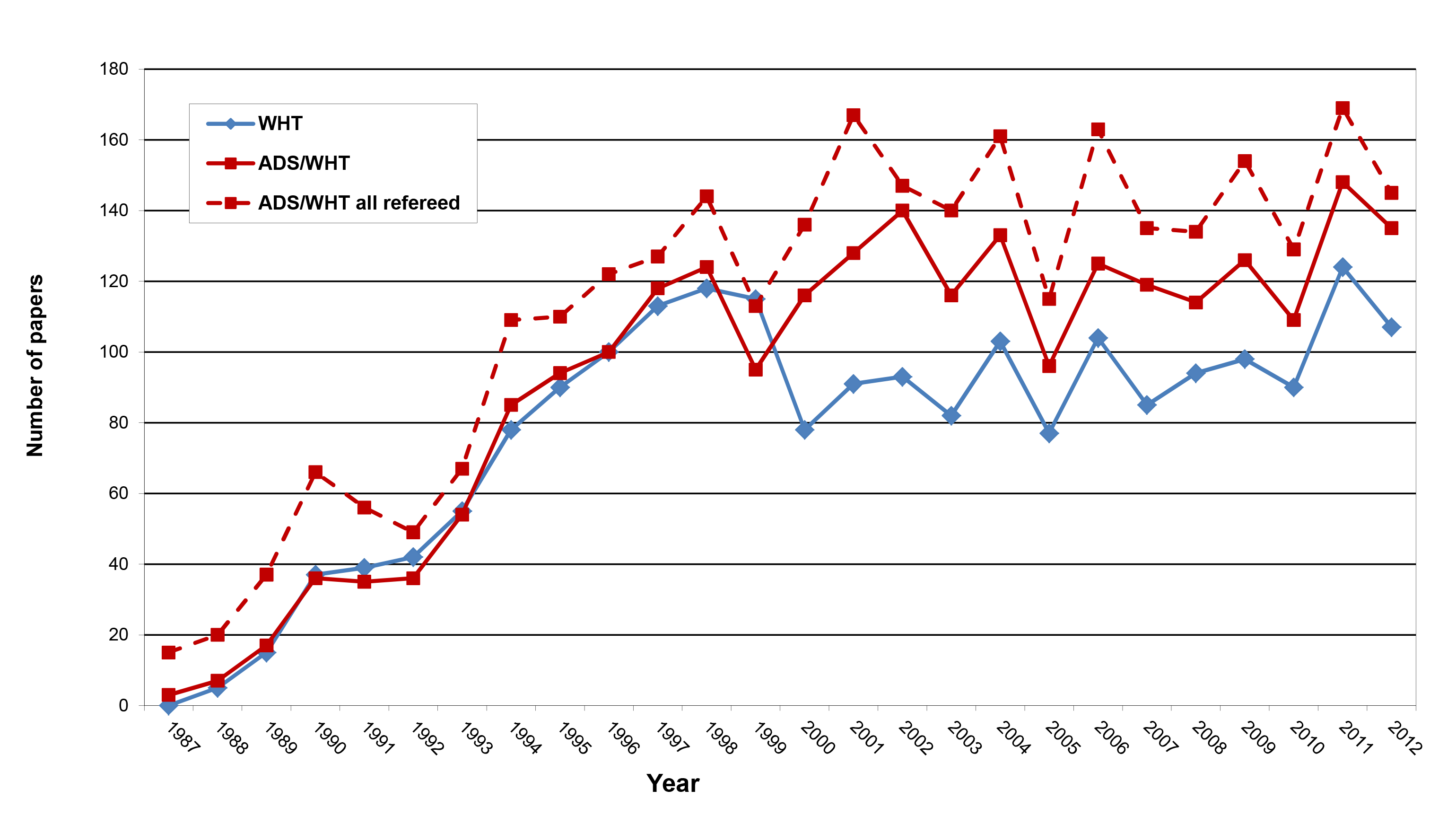
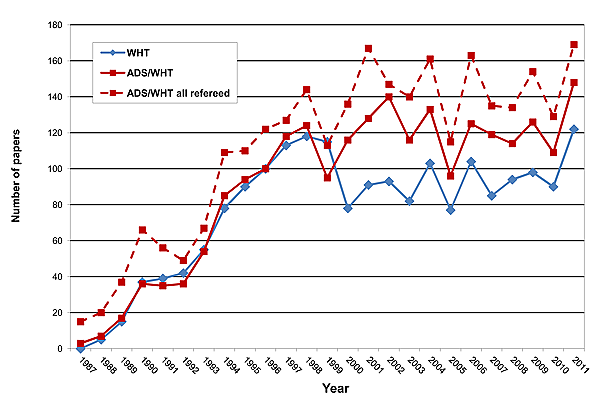
Paper counts by ING (blue) and retrieved from ADSLabs (red, http://labs.adsabs.harvard.edu/fulltext/) as a result of scanning the refereed journals listed below,
and searching for a list of specific keywords: "William Herschel Telescope" OR "William Herschel Telescopes" OR "WHT".
While the ING counts only include papers that make a direct use of the data, the ADS counts include all
the papers that contain the searched keywords. The dashed line shows the ADS paper count but including all the refereed journals in the ADS database [ PNG | TIFF ].
|
|
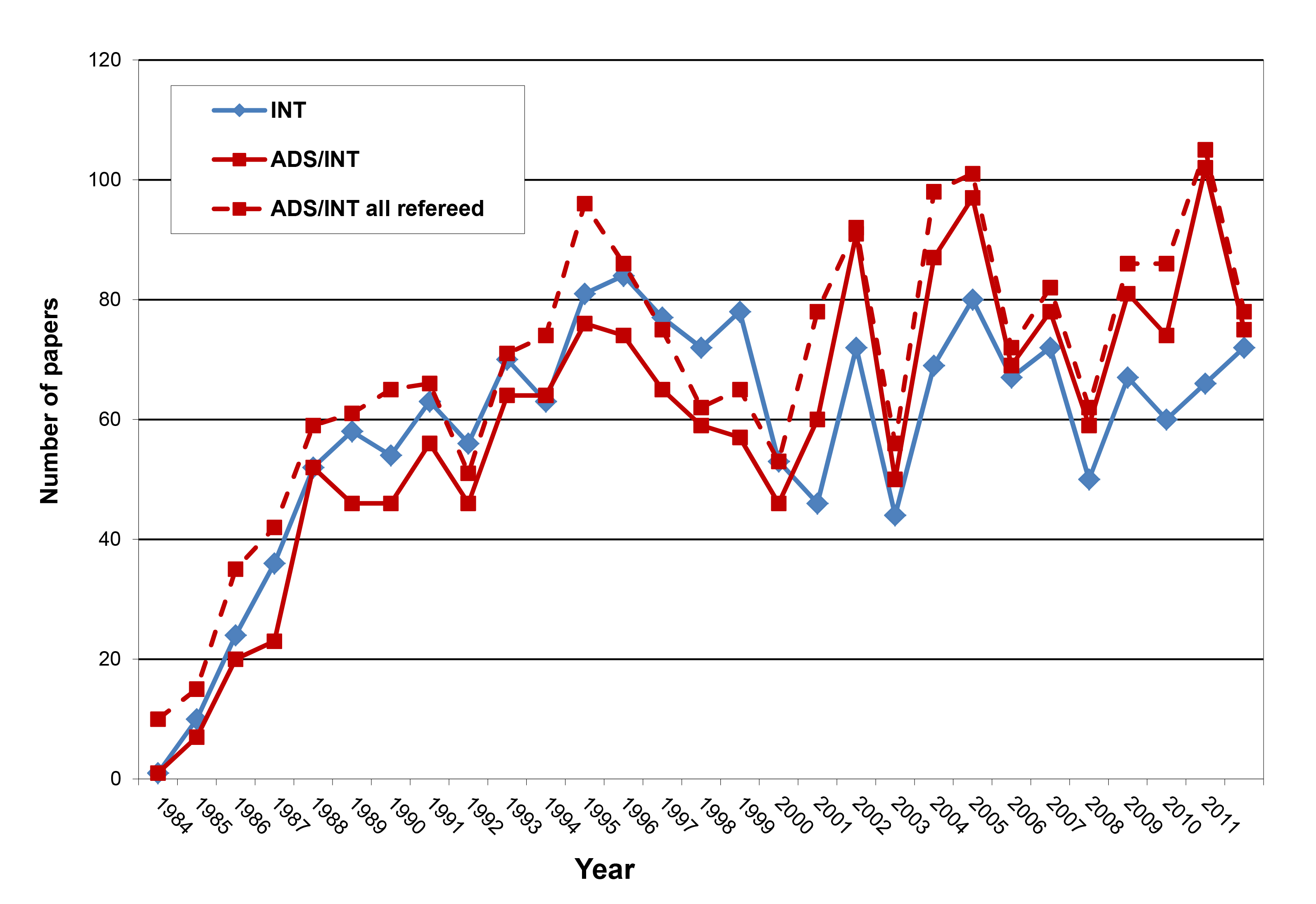
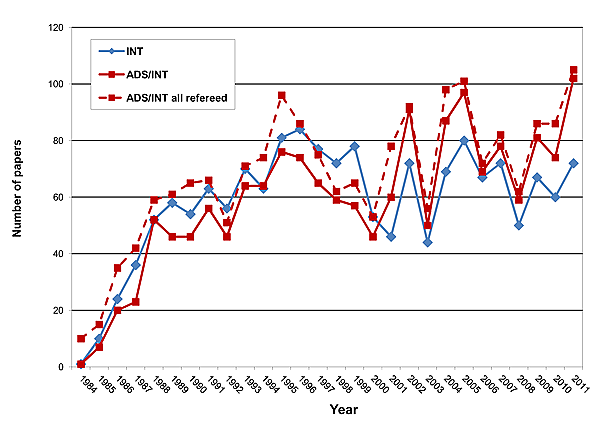
Paper counts by ING (blue) and retrieved from ADSLabs (red, http://labs.adsabs.harvard.edu/fulltext/) as a result of scanning the refereed journals listed below,
and searching for a list of specific keywords: "Isaac Newton Telescope" OR "Isaac Newton Telescopes" OR "INT telescope".
While the ING counts only include papers that make a direct use of the data, the ADS counts include all
the papers that contain the searched keywords. The dashed line shows the ADS paper count but including all the refereed journals in the ADS database [ PNG | TIFF ].
|
|
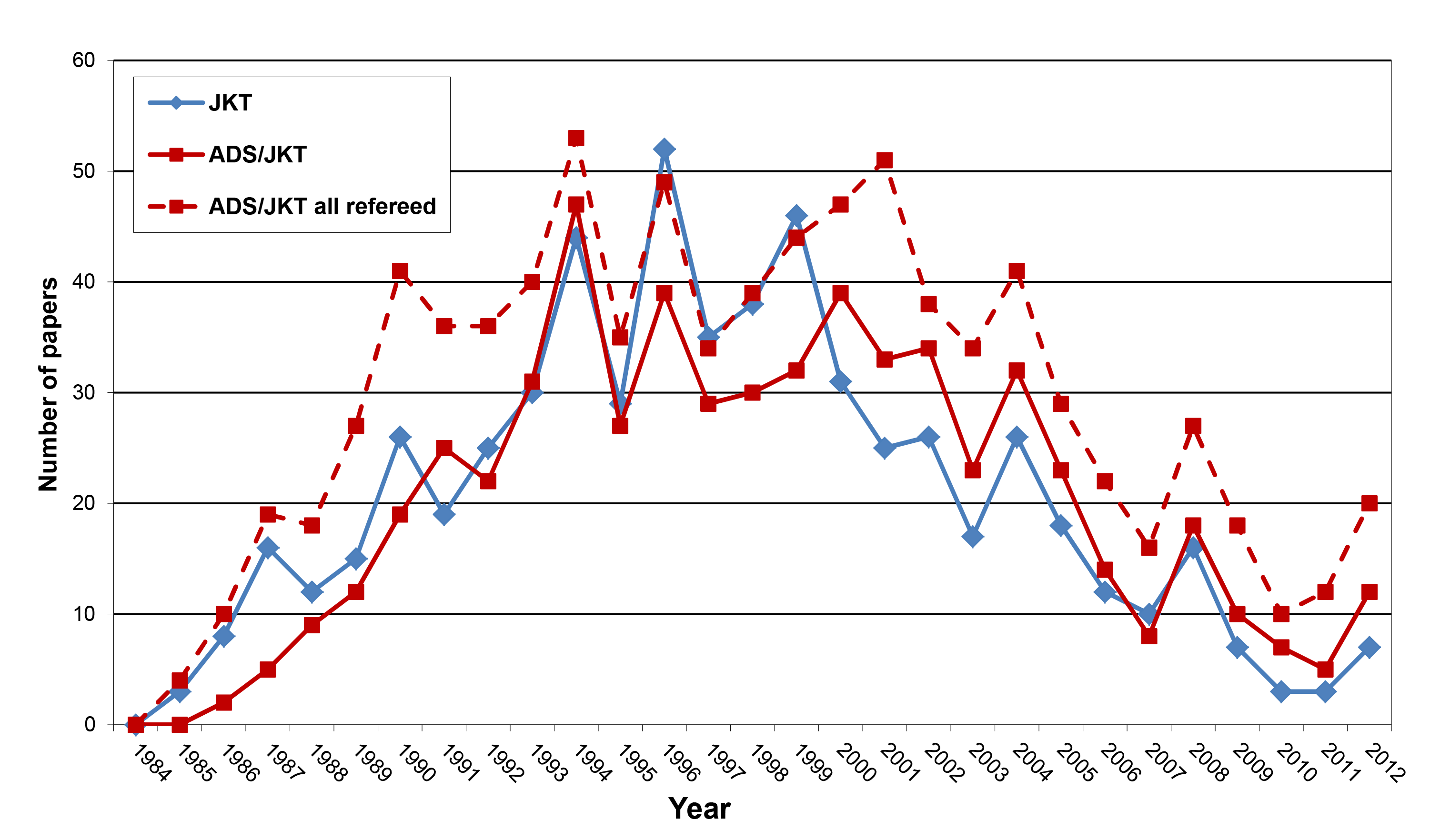
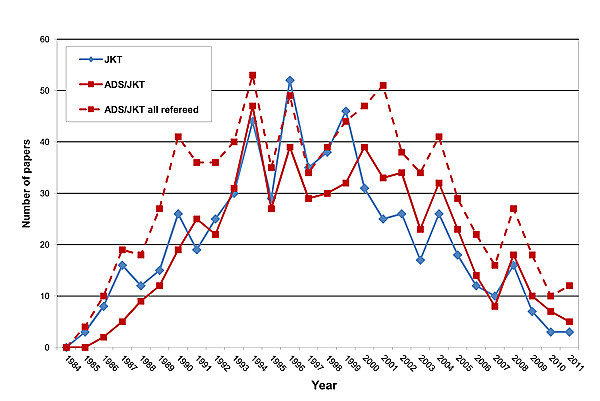
Paper counts by ING (blue) and retrieved from ADSLabs (red, http://labs.adsabs.harvard.edu/fulltext/) as a result of scanning the refereed journals listed below,
and searching for a list of specific keywords: "Jacobus Kapteyn Telescope" OR "Jacobus Kapteyn Telescopes" OR "JKT".
While the ING counts only include papers that make a direct use of the data, the ADS counts include all
the papers that contain the searched keywords. The dashed line shows the ADS paper count but including all the refereed journals in the ADS database [ PNG | TIFF ].
|
Refereed journals scanned: Astronomy and Astrophysics, Astronomical Journal,
Astrophysical Journal (including Letters and Supplement Series), Monthly Notices of the Royal Astronomical Society,
Nature, Publications of the Astronomical Society of the Pacific and Science.
ING astronomy documentation archive and publications
The ING astronomy documentation archive and publications web pages provide the ING own publications, including the ING newsletter, Annual Report, etc.
Description of the paper count
Learn how the selection of ING papers is made in this description of the paper count.
In-house research
The In-house research web pages provide the scientific productivity of our staff.
Reports on the use of observing time and scientific productivity
ING Annual Report's chapter on the use of observing time and scientific productivity:
WHT only data:
Posters:
Scientific highlights
Search or browse the scientific highlights from 1984 to present, including links to the refeered papers.
|