| |||
|

| Home > Public Information > Scientific Highlights > 2003 > A Dearth of Dark Matter |
WHT+PN.S
Over the past 25 years, astronomers have progressed from being surprised by the existence of dark matter to understanding that most of the universe is dominated by exotic nonluminous material. In the prevailing paradigm, the gravitational influence of cold dark matter (CDM) is crucial to the formation of structure, seeding the collapse and aggregation of luminous systems. An inherent consequence of CDM's role in these processes is that galaxies have massive, extended CDM halos. Indeed, such halos are evident around spiral galaxies, in which the rotational speeds in the extended cold-gas disks do not decrease outside the visible stars—a gravitational signature of dark matter.
The evidence for dark matter in elliptical galaxies is still circumstantial. Assessments of the total masses of individual elliptical systems have generally been confined to the very brightest systems, for which the gravitational potential can be measured using X-ray emission or strong gravitational lensing, and to nearby dwarfs, for which the kinematics of individual stars offer a probe of the mass distribution. More "ordinary" elliptical galaxies are more difficult to study because in general they lack a simple kinematical probe at the larger radii, where dark matter is expected to dominate. The velocity distribution of the diffuse stellar light is the natural candidate, but studies have been limited by the faintness of galaxies' outer parts to radii that are 2 Reff, where Reff is the galaxy's effective radius, which encloses half of its projected light.
A powerful alternative is offered by Planetary Nebulas (PNs), which are detectable even in distant galaxies through their characteristic strong emission lines. Once found, their line-of-sight velocities can be readily determined by the Doppler shift in these emission lines. These objects have been used in the past as tracers of the stellar kinematics of galaxies, but the procedure of locating them with narrow-band imaging surveys and then blindly obtaining spectra at the identified positions has proven difficult to implement efficiently on a large scale.
A specialized instrument, the Planetary Nebula Spectrograph (PN.S), was developed specifically to study the kinematics of PNs in elliptical galaxies. The PN.S uses counterdispersed imaging (a type of slitless spectroscopy) over a wide field to detect and measure velocities for PNs simultaneously by using their [O III] emissions at 500.7 nm. Because it is optimized for this purpose, the PN.S is far more efficient for extragalactic PN studies than any other existing instrumentation.
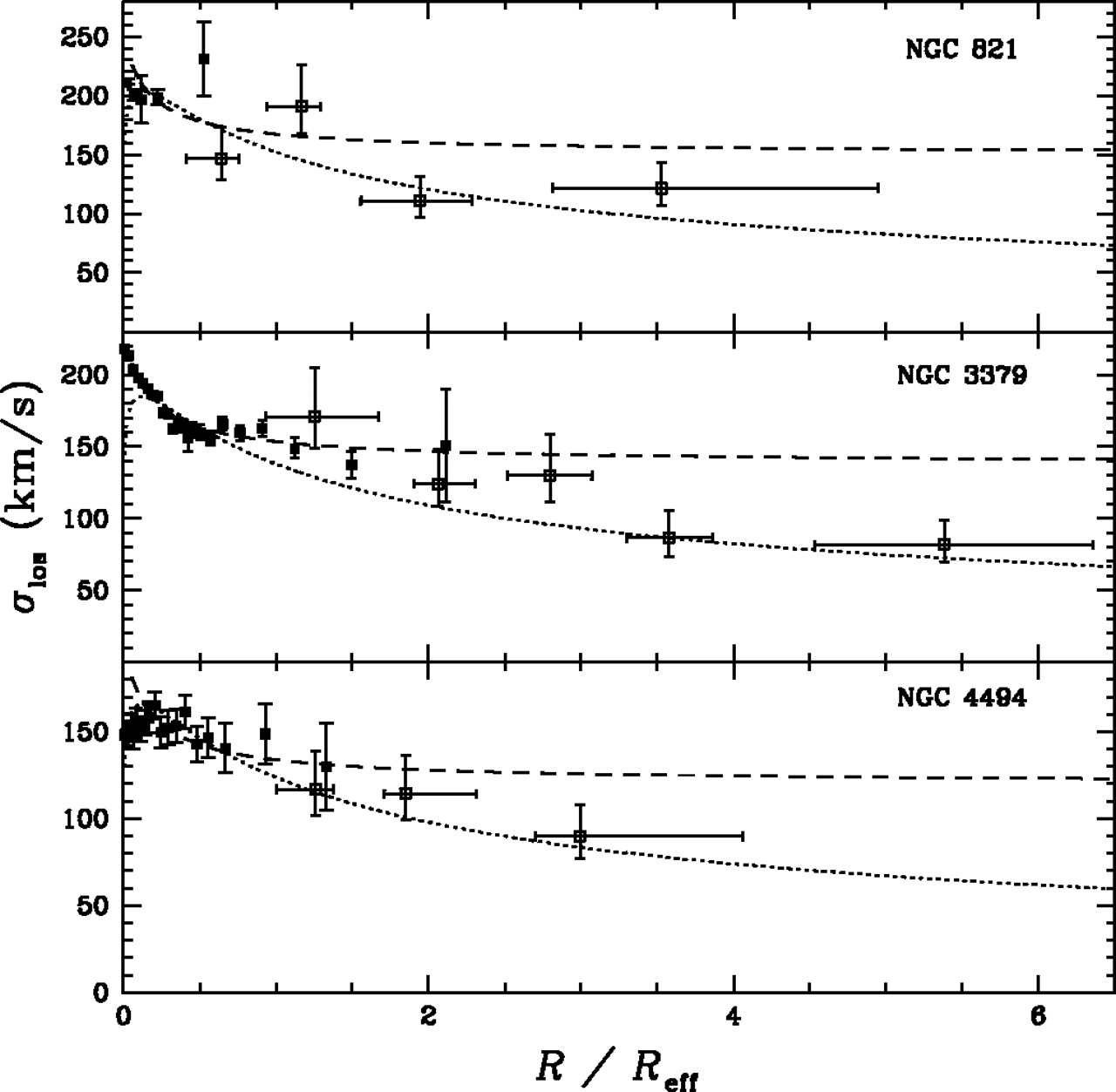
Observations with the PN.S on the William Herschel Telescope allowed astronomers to extend stellar kinematic studies to the outer parts of three intermediate-luminosity elliptical galaxies: NGC 821, NGC 3379, and NGC 4494. In each of these systems, they measured 100 PN velocities with uncertainties of 20 km s–1 out to radii of 4 to 6 Reff. The line-of-sight velocities in the outer parts of all of these galaxies show a clear decline in dispersion with the radius. A decrease in random velocities with the radius has been indicated by small samples of PNs around NGC 3379, but the more extensive data set presented here provides a more definitive measurement of this decline, and reveals that it also occurs in other similar galaxies. The new data are inconsistent with simple dark halo models and thus different from kinematical results for brighter ellipticals.

|
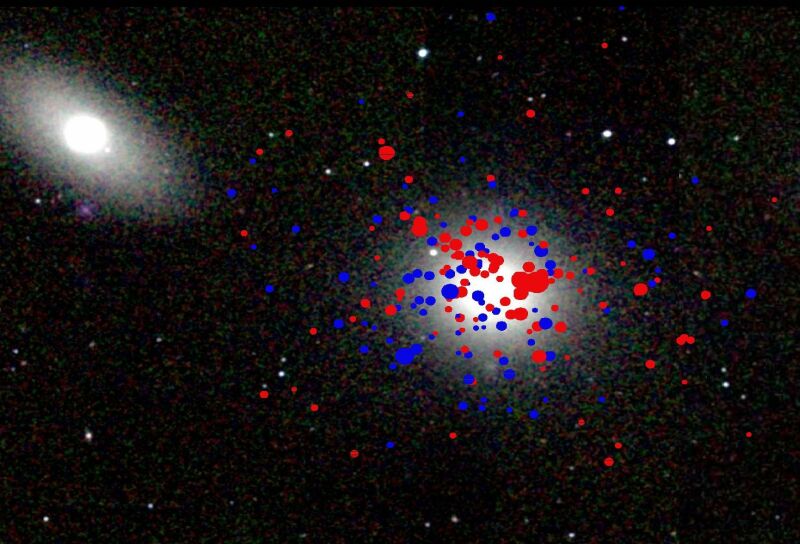
| NGC 3379 (M 105) with 109 PN line-of-sight
velocities relative to the systemic velocity, as measured with the PN.S
instrument on the William Herschel Telescope. The symbol sizes are proportional
to the velocity magnitudes. Red crosses indicate receding velocities, and
blue boxes, approaching velocities. Field of view is 8.4×8.4
arcmin=26×26 kpc=14×14 Reff. [ JPEG | TIFF ] . |
|
| This image shows the starlight from
NGC 3379 (M 105) elliptical galaxy and its near neighbour, NGC3384. The
dots show the positions of planetary nebulae located in this system: the
colour of each dot shows whether the nebula is receding or approaching, while
its size indicates its speed. Note how planetary nebulae can be detected
well beyond the apparent edge of the galaxy, and that the dots tend to get
smaller far from the galaxy, indicative of slow speeds and hence a lack of
dark matter. [ JPEG | TIFF ] |
More unexpectedly, the velocity dispersion data are consistent with simple models containing no dark matter, showing the nearly Keplerian decline with the radius outside 2 Reff that such models predict and suggesting that these systems are not embedded in massive dark halos.
|
| Line-of-sight velocity dispersion profiles
for three elliptical galaxies, as a function of projected radius in units
of Reff. Open points show planetary nebula data (from the PN.S);
solid points show diffuse stellar data. The vertical error bars show 1
uncertainties in the dispersion, and the horizontal error bars show the
radial range covered by 68% of the points in each bin. Predictions of simple
isotropic models are also shown for comparison: a singular isothermal halo
(dashed lines) and a constant mass-to-light–ratio galaxy (dotted lines).
[ JPEG ] |
This result clashes with conventional conceptions of galaxy formation. In particular, if ellipticals are built up by mergers of smaller galaxies, it is puzzling that the resulting systems show little trace of their precursors' dark matter halos. And it is also apparent that some important physics is still missing from the recipes for galaxy formation. For example, substantial portions of these galaxies' dark matter halos could have been shed through interactions with other galaxies. Such stripping has been inferred for ellipticals near the centers of dense galaxy clusters, but the galaxies studied here are in much sparser environments, in which substantial stripping is not expected to be an important process.
Crucial to understanding the incidence and origin of this low–dark matter phenomenon will be the results for a large sample of ellipticals with a broad range of properties, including differing environmental densities, which could be a key factor in determining halo outcomes; the continuing PN.S observing program will provide this sample.
Some references:
- Irion,
R, 2003, "Do some galaxies lack shrouds of dark matter?", Science,
300, 233.
- Massey, R, 2003, "Study
finds galaxies that are devoid of dark matter", Astronomy Now,
Vol. 17 No. 6, 19.
- Romanowsky, A J, et al., 2003, "A Dearth of Dark Matter in Ordinary Elliptical Galaxies", Science, 301, 1696.
- "No Need for dark matter", Physics World, Vol. 16 No. 10, 3.
- "Astronomers find "naked"
galaxies, devoid of dark matter", RAS Press Release, 2 April 2003.
| Top | Back |
|