| |||
|

| Home > Astronomy > Detectors > QUCAM1 |
QUCAM1 Parameters with UltraDAS + SDSU Gen.3
Device Identification
|
| Chip name | QUCAM1 |
| Year of manufacture | 2005 |
| Serial number | 04073-17-21 |
| First light on La Palma | May 2005 |
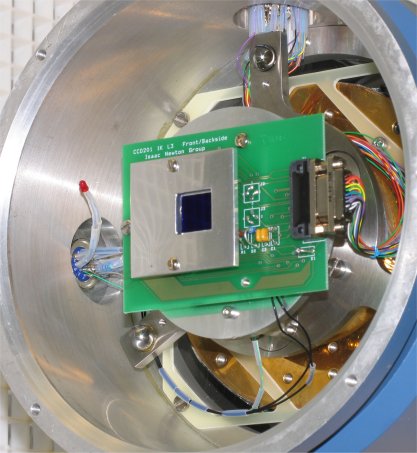
| Description | E2V CCD97 Thinned midband AR coated. L3 electron multiplying CCD. Camera Picture |
Operational Characteristics
| Speed | Fast | Slow |
| Bias (ADU) | 2680 | 1610 |
| Gain (ADU/e) | 170 | 1.0 |
| Read Noise (e) | <0.1 | 2.8 |
| Linear to (ADU) | 17K | 65K |
| L3 Gain | 1300 | 1 |
Windowed readout times as follows [timings made using the 'rspec' command]
| Window size | Fast | Slow |
| Full fame | 1.0s | 1.6s |
| 560 x 100 window | 300ms | 400ms |
| 560 x 200 window | 400ms | 600ms |
| 560 x 300 window | 600ms | 900ms |
1) The chip has been oriented such that the spectra lie with the spectral axis vertical.
2) Windows should include the full width of the chip or the L3 gain will be reduced from the figures quoted above.
3) Please note that when using the 'rspec' command the actual exposure time
will be the sum of the readout times (in the table above) and the requested
exposure time. This is because the CCD is operated in frame transfer mode and
the exposure time is effectively the cycle time of the system when making image
sequences. For information on the rspec syntax click here.
.
Windowing : when used on ISIS the spectra will have the spectral
axis along a column. Windowing in x may produce a reduction in gain and should
not be used. Y windowing fully functional. The first 10-20 columns of an x-window
will contain a large gradient. The bias in Y is very flat although the first
row may contain some stray charge.
Binning : In Y only
Physical Characteristics
| X Pixel size | 16 microns |
Y Pixel size |
16 microns |
| X size in pixels of digitised area | 560 |
| Y size in pixels of digitised area | 540 |
X size of useful imaging area |
510 |
| Y size of useful imaging area | 512 |
X start of useful imaging area |
22 |
Ystart of useful imaging area |
10 |
Operational Parameters
Operating temperature |
175K (requires 3 hour cool down to stabilise at operational temp, important for gain stability) |
Preferred Amplifier |
Camera converted to use both amplifiers. The L3 amplifier can be selected using 'rspeed fast', the conventional amplifier with 'rspeed slow'. The images are mirrored with respect to each other. |
Measured Characteristics
| Clock induced charge | 0.015e per pixel |
Dark Current |
2.7e/pix/hour |
Notes on use of camera
This L3 camera also has a conventional output. The user can select L3 operation by using 'rspeed fast' and conventional operation using 'rspeed slow'. Since these two amplifiers are positioned at different corners of the CCD they will produce mirrored images. i.e. if the user changes the readout speed they will observe the image to become horizontally flipped.
Some papers describing the use of L3 CCDs see this link
Sample Images and Observing tips for L3 Cameras see this link
| Top | Back |
|