| |||
|

| Home > Public Information > William Herschel Telescope > History of the WHT |
William Herschel
Telescope
History
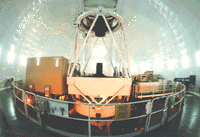 The WHT was conceived in the late 1960s, when the 3.9-m Anglo-Australian Telescope (AAT) was being designed; GRB's astronomers wanted to balance the AAT, completed in 1974, with a similar capability in the nothern hemisphere. At that time, the Science & Engineering Research Council (SERC) envisioned three instruments in the northern hemisphere now known as the Isaac Newton Group of Telescopes: a 1.0-m which became the Jacobus Kapteyn Telescope (JKT), the existing 2.5-m Isaac Newton Telescope (INT) to be moved from its site at Hertmonceux, and the new 4.5-m, all at the Roque de los Muchachos Observatory and operated by the RGO.
The initial budget for the WHT was 10M GBP, but by 1979, it had grown to 18M GBP, and a Tiger Team was empowered by the SERC to cut the budget. The solution was to decrease the diameter and focal length of the primary, which reduced the size of the telescope and the building. The pier was also shortened, since the turbulent ground layer at the site is only 3-m high, and the functions of the dome building basement could be located in a plain structure outside. This cut the cost to near the planned 10M GBP, and when The Netherlands joined the project in 1981, it could proceed. That year was the bicentennial of Herschel's discovery of Uranus, so the telescope was named for him. Also, to combine the achievement in telescope construction and the new prospects for observation with a reference to the telescope mounting and the Kingdom of Spain, it was decided to name the telescope after Sir William Herschel. It was he who used an altazimuth mount to allow the construction of telescopes with unprecedented power, one of which, and possibly the best, was delivered to Madrid Observatory in 1803. Grubb Parsons (Newcastle-upon-Tyne, UK) built the telescope, the last in their 150 year history, in 1983. The WHT saw first light in 1987; it was the third largest optical telescope in the world at the time. The 15M GBP (October 1984 prices) total cost of the telescope (design, erection and manufacture of the WHT, its control system, dome, building, aluminising tank and other plants) and an initial suite of instruments was within budget, considering inflation. Installation of the telescope started in the autumn of 1985 when a part shipment containing the azimuth bearings and the hydraulic pumping system arrived on site from the UK. RGO staff who formed the installation team then started the critical job of installing the azimuth bearings and the plant. The bearings were then grouted in place by a contractor using a special epoxy grouting system designed to maintain maximum stiffness between the bearings and the concrete pier.
Installation started as soon as loads began to arrive on site and very good progress was made by the RGO team and its subcontractors during the rest of 1986. The installation of the cables and control room progressed in parallel, and commissioning using the telescope control computer started in March 1987. The mirror was aluminized in May and installed in the telescope shortly afterwards. The azimuth and altitude bearings were the first major items to be commissioned and initial tests indicated that the design natural frequency of 4 Hz for the structure and bearings had been achieved in practice. This justified the careful mechanical design and analysis the RGO put into the telescope and eased the task of the servo control system and software design.
Its Cassegrain design includes a 4.2-m f/2.5 concave paraboloid primary made of Cervit from Owens-Illinois (USA), one of a set of four cast in 1969. The other three were for the AAT, the CFHT, and the CTIO telescopes. The solid mirror is unthinned and rigid enough to hold its shape; even on edge, the deformation is under 50 nm. The mirror rests on 60 actuators in its support cell. With a three-element field corrector inserted, it can work in a wide-field 40 arcmin primary focus mode. With the 1.0-m f/11 Zerodur hyperbolic secondary in place, the beam is reflected to the Cassegrain focus. A flat tertiary fold mirror can be inserted to add two Nasmyth and two folded-Cassegrain foci. The Coud&eeacute; focus and chopping secondary for IR work were planned but not implemented. With the former altazimuth mounts at the MMT and the BTA-6 in the 1970s, the WHT was an early adopter of that approach. The optical telescope assembly weighs
79.5 kg. Including the telescope mount, it weighs 186.25 kg. The robust telescope can bear many heavy instruments.
The building employs an onion-shaped dome made by Brittain Steel (Canada) for more effective ventilation. As with most modern telescopes, little human presence is needed, so dome conditions are in excellent equilibrium with the ambient air. The pier goes 20 m down to volcanic bedrock and holds the WHT 13.4-m above the ground, well over surface layer turbulence. A 5-m Balzers coating plant in the adjacent support building can aluminise all of the mirrors at the ORM.
The WHT began employing adaptive optics in 2001, when the NAOMI (Nasmyth Adaptive Optics for Multi-Purpose Instrumentation) with NGS and later with sodium LGS with a first-generation closed-loop system. Meanwhile, a new program MOAO (Multi-Object Adaptive Optics) called CANARY, after ORM's archipelago, was launched to extend the corrected field of view from tens of arcseconds to several arcminutes. The CANARY optical bench, in a separate enclosure 40 m from the WHT, began operation in 2010. Mainly funded by universities in UK, France, and the ESO, the multi-laser array CANARY system is developing technology for 8-m class telescopes and the much larger ELT.
The WHT has been called an astronomical "Swiss army knife" due to the variety of early-generation instruments at its foci. Some of the last common-user instruments were:
ACAM (Auxiliary-port Camera), with imaging over an 8 arcmin field of view and resolution < 900 spectroscopy,
ISIS (Intermediate Dispersion Spectrograph & Imaging System), medium resolution dual-beam optical spectrograph,
LIRIS (Long-Slit Intermediate Resolution IR Spectrograph), a near-IR imager/spectrograph/polarimeter, and the
PFIP (Prime-Focus Imaging Platform) camera.
Since 2023, WEAVE (WHT Enhanced Area Velocity Explorer), an advanced multi-object optical-range wide-field - 2 arcmin high and low-resolution spectrograph, with 1000 fiber-configurations positioned at prime focus by a pair of robots, has been the sole instrument for the WHT.
WHT captured the first evidence of a stellar black hole in the Milky Way, and the first optical counterpart of a gamma-ray burs. It also played an important role in discovering the accelerated expansion of the Universe (Physics Nobel Prize 2011).
Some articles on the WHT include:
|
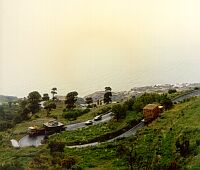 The major shipment of all the
remaining telescope components including the drive system, mirrors and
aluminizing plant was arranged for the spring. The M.V. Ston was chartered
earlier because of the special facilities on the ship for lifting heavy
loads. It sailed on 2 April 1986, arriving in La Palma eight days later.
Pickfords then transported the major parts of the telescope, which totalled
350 tonnes, to site over the next four weeks. Some of the loads were very
large, 6 × 8 metres and weighing 30 tonnes. These presented the haulage
contractor with a number of difficult problems negotiating the very tight
bends and steep gradients on the mountain road.
The major shipment of all the
remaining telescope components including the drive system, mirrors and
aluminizing plant was arranged for the spring. The M.V. Ston was chartered
earlier because of the special facilities on the ship for lifting heavy
loads. It sailed on 2 April 1986, arriving in La Palma eight days later.
Pickfords then transported the major parts of the telescope, which totalled
350 tonnes, to site over the next four weeks. Some of the loads were very
large, 6 × 8 metres and weighing 30 tonnes. These presented the haulage
contractor with a number of difficult problems negotiating the very tight
bends and steep gradients on the mountain road.
 Alec Boksenberg, 1985, "The William Herschel Telescope", Vistas
in Astronomy, 28, 531 [
Alec Boksenberg, 1985, "The William Herschel Telescope", Vistas
in Astronomy, 28, 531 [  Ian S. Glass, 2026, "Grubb Dublin & Grubb Parsons: Telescope Makers", Centre for Astronomical Heritage.