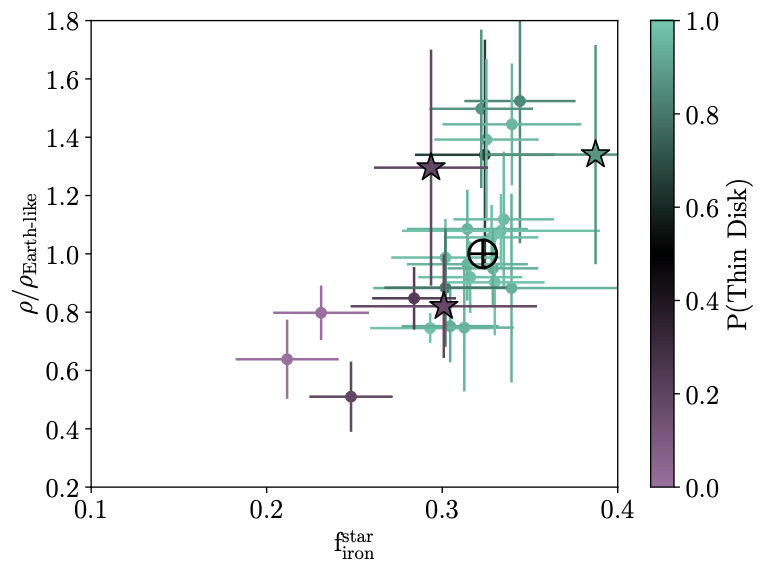
While this one system extends the explored parameter space, it is also important to build a well characterise sample of planets and their host stars that newly characterised systems, like mine, can be compared to. This work is led by one of my collaborators, Daisy Turner (University of Birmingham).
Our collaboration, including Tim Lichtenberg, Annelies Mortier, Anjali Piette and Thomas Wilson, was also awarded time on HARPS3 from the UK and Dutch time allocation committees. This program aims to obtain masses of known planets, that already have mass measurements, more precisely. We target planets at longer orbital periods which allows to explore compositional trends more robustly by spanning a wider parameter space. Obtaining radial velocities with HARPS3 will enable us to explore compositional trends between planets and their host stars in a larger parameter space and gain a deeper understanding of planet formation and evolution in different environments in the Milky Way.
About the author
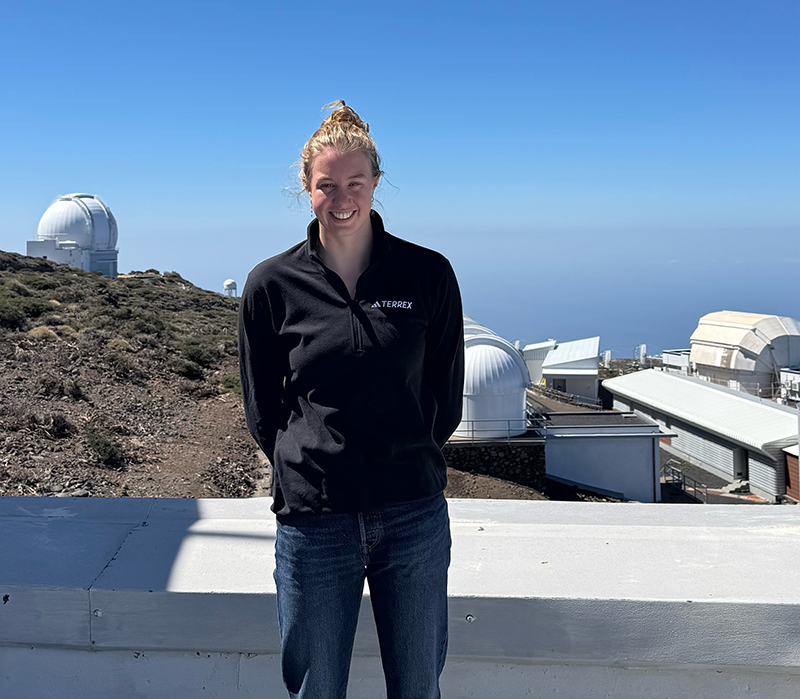
Yoshi Nike Emilia Eschen is a PhD Student at the University of Warwick, UK, working on the detection and characterisation of small planets orbiting compositionally
diverse stars. She is involved in ESA's PLATO and CHEOPS missions. Currently she is doing the ING studentship observing on La Palma.
About HARPS3
The HARPS3 instrument is a next generation high-resolution, stabilised, fibre-fed echelle spectrograph designed for ultra-precise radial velocity measurements, aimed at exoplanet detection and stellar astrophysics. It is a modified version of HARPS-N at the TNG, housed in the Coudé room at the Isaac Newton Telescope (INT). The INT has been refurbished specifically to support the HARPS3 operations, now operating in fully robotic mode to allow automated night observing sequences, ideal for the time-series observations. Currently HARPS3 is being used for the Terra Hunting Experiment (THE) survey and the HARPS3 Open Time programme.
HARPS3 and the THE consortium comprises the following institutes: University of Cambridge, University of Exeter, UK, Geneva University, Switzerland, Institute of Astrophyics of the Canaries (IAC), Spain, The Netherlands Research School for Astronomy (NOVA), The Netherlands, and Uppsala University, Sweden. The Isaac Newton Group (ING) is also a member of the consortium management board to oversee the HARPS3 project and additionally assist in the upgrade of the telescope.
About the Isaac Newton Telescope
The Isaac Newton Telescope (INT) is operated on the island of La Palma (Canary Islands, Spain) by the Isaac Newton Group of Telescopes (ING) in the Spanish Observatorio del Roque de los Muchachos of the Instituto de Astrofísica de Canarias (IAC). The ING is funded by the Science and Technology Facilities Council (STFC-UKRI) of the United Kingdom, the Nederlandse Organisatie voor Wetenschappelijk Onderzoek (NWO) of the Netherlands, and the IAC in Spain. IAC's contribution to the ING is funded by the Spanish Ministry of Science, Innovation and Universities.
Media contact
Javier Méndez
ING PR Officer
Email: outreach ing.iac.es