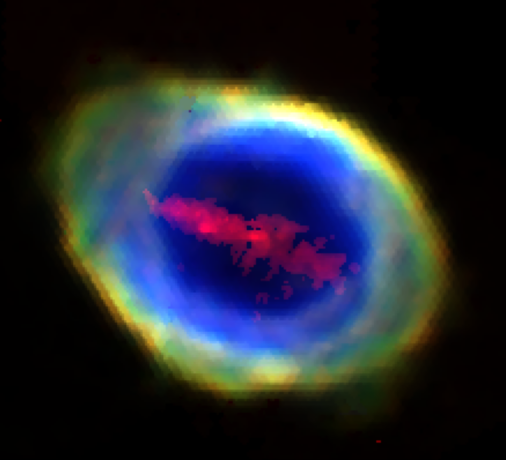
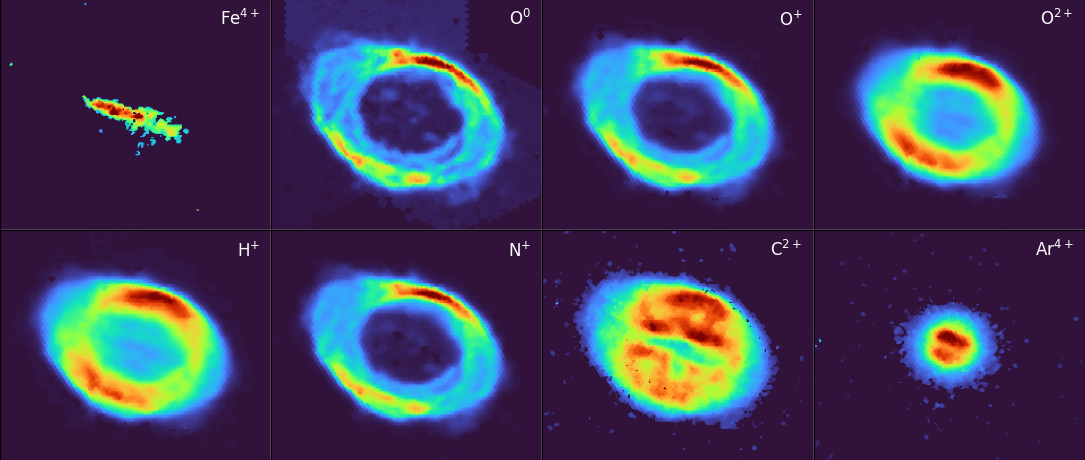
The LIFU is a bundle of hundreds of optical fibres. It has enabled the team of astronomers to obtain spectra (where light is separated into its constituent wavelengths) at every point across the entire face of the Ring Nebula and at all optical wavelengths at the same time – a new capability.
Lead author Dr Roger Wesson, based jointly at UCL's Department of Physics & Astronomy and Cardiff University, said: "Even though the Ring Nebula has been studied using many different telescopes and instruments, WEAVE has allowed us to observe it in a new way, providing so much more detail than before. By obtaining a spectrum continuously across the whole nebula, we can create images of the nebula at any wavelength and determine its chemical composition at any position."
"When we processed the data and scrolled through the images, one thing popped out as clear as anything – this previously unknown 'bar' of ionised iron atoms, in the middle of the familiar and iconic ring."
How the iron bar formed is currently a mystery, the authors say. They will need further, more detailed observations to unravel what is going on. There are two potential scenarios: the iron bar may reveal something new about how the nebula ejection by the central star progressed, or (more intriguingly) the iron might be a highly stretched-out arc of plasma resulting from the vaporisation of a rocky planet caught up in the central star's prior expansion. Co-author Professor Janet Drew, also based at UCL, advises caution: "We definitely need to know more – particularly whether any other chemical elements co-exist with the newly-detected iron, as this would probably tell us the right class of model to pursue. Right now, we are missing this important information."
The team are working on a follow-up study, and plan to obtain data using WEAVE's LIFU at higher spectral resolution to better understand how the bar might have formed.
WEAVE is carrying out eight surveys over the next five years, targeting everything from nearby white dwarfs to very distant galaxies. The Stellar, Circumstellar and Interstellar Physics strand of the WEAVE survey, led by Professor Drew, is observing many more ionised nebulae across the northern Milky Way.
"It would be very surprising if the iron bar in the Ring is unique." explains Dr. Wesson. "So hopefully, as we observe and analyse more nebulae created in the same way, we will discover more examples of this phenomenon, which will help us to understand where the iron comes from."
Professor Scott Trager, WEAVE Project Scientist based at the University of Groningen, The Netherlands, added: "The discovery of this fascinating, previously unknown structure in a night-sky jewel, beloved by sky watchers across the Northern Hemisphere, demonstrates the amazing capabilities of WEAVE. We look forward to many more discoveries from this new instrument."
About WEAVE
WEAVE is a powerful, next-generation multi-fibre spectrograph on the WHT. It uses optical fibres to gather light from celestial sources and transmits it to a two-arm spectrograph, and records them on large-format CCD light detectors. The raw data are transferred over the internet to computers at the Cambridge Centre of Excellence for Astronomical Data (CamCEAD) and the Instituto de Astroífisica de Canarias (IAC), and the science-ready products are stored in an archive at the facilities of the Telescopio Nazionale Galileo (TNG, operated by FGG for INAF) at the Roque de Los Muchachos Observatory, Spain.
WEAVE's versatility is one of its biggest strengths. While the LIFU mode hosts 547 fibres closely-packed to image extended areas of the sky, in the MOS mode up to 960 individual fibres can be separately positioned using two robots to gather light from many hundreds of stars, galaxies or quasars. In the mIFU mode, the fibres are organised into 20 units, each consisting of 37 fibres, that are used to study small extended targets such as nebulae and distant galaxies. Read more at WEAVE - Instrument Overview.
Funding for the WEAVE facility has been provided by UKRI STFC, the University of Oxford, NOVA, NWO, Instituto de Astrofísica de Canarias (IAC), the Isaac Newton Group partners (UKRI STFC, NWO, and Spain, led by the IAC), INAF, CNRS-INSU, the Observatoire de Paris, Région Îlele-de-France, CONACYT through INAOE, the Ministry of Education, Science and Sports of the Republic of Lithuania, Konkoly Observatory (CSFK), Max-Planck-Institut für Astronomie (MPIA Heidelberg), Lund University, the Leibniz Institute for Astrophysics Potsdam (AIP), the Swedish Research Council, the European Commission, and the University of Pennsylvania. The WEAVE Survey Consortium consists of the ING, its three partners, represented by UKRI STFC, NWO, and the IAC, NOVA, INAF, GEPI, INAOE, Vilnius University, FTMC – Center for Physical Sciences and Technology (Vilnius), and individual WEAVE Participants.
See the full list of granting agencies and grants supporting WEAVE, and read more on the WEAVE-project website.
About the William Herschel Telescope
The 4.2m Willliam Herschel Telescope (WHT) is operated on the island of La Palma (Canary Islands, Spain) by the Isaac Newton Group of Telescopes (ING) at the Spanish Observatorio del Roque de los Muchachos of the Instituto de Astrofísica de Canarias (IAC). The ING is funded by the Science and Technology Facilities Council (STFC-UKRI) of the United Kingdom, the Nederlandse Organisatie voor Wetenschappelijk Onderzoek (NWO) of the Netherlands, and the IAC in Spain. The IAC's contribution to the ING is funded by the Spanish Ministry of Science, Innovation and Universities.
Notes
1 See e.g. astronomers spy structures that no previous telescope could detect in new images of dying star.
2 The Ring Nebula is also known as M 57 – the 57th listing in Messier's catalogue of 'Nebulae and Star Clusters'. John L E Dreyer also included it in his New General Catalogue, first published in 1888 by the Royal Astronomical Society, where it appears as NGC 6720.
3 Once a star like the Sun runs out of hydrogen fuel, it expands to become an extreme red giant and sheds its outer layers, which then coast out to form a glowing shell. A shell created in this way is known in astronomy as a planetary nebula. The leftover stellar core becomes a white dwarf, which, though no longer burning any fuel, continues to shine as it slowly cools over billions of years. The Ring Nebula is a planetary nebula located 2,600 light years (or 787 parsec) away, that is thought to have formed about 4,000 years ago. Planetary nebula ejection returns matter forged in a star to interstellar space and is the source of much of the Universe’s carbon and nitrogen – key building blocks of life on Earth. Stars more than about eight times the mass of the Sun age differently, ending life abruptly in a powerful explosion called a supernova as they collapse to form a black hole or neutron star.
Research paper
Wesson, Richard et al., 2026, "WEAVE imaging spectroscopy of NGC 6720: an iron bar in the Ring", MNRAS, DOI: 10.1093/mnras/staf2139 [ Paper ].
Science contact
Dr Roger Wesson
University College London/Cardiff University
rw nebulousresearch.org
Professor Janet Drew
University College London
j.drewucl.ac.uk
Media contact
Javier Méndez
ING PR Officer
Email: outreaching.iac.es
Other releases
"Mysterious iron 'bar' discovered in famous nebula", Cardiff University press release, 16th January 2026.
"Mysterious iron ‘bar’ discovered in famous nebula", UCL press release, 16th January 2026.
"Mysterious iron 'bar' discovered in famous nebula", RAS press release, 16th January 2026.
"Ontdekking van een ijzeren ‘balk’ in de Ringnevel", NOVA press release, 16th January 2026.
"El telescopio William Herschel, del Observatorio del Roque de los Muchachos, halla una misteriosa ‘barra’ de hierro en la Nebulosa del Anillo", IAC press release, 16th January 2026.
"Mysterious 'Mars bar’ discovered in famous Ring Nebula", Manchester University press release, 16th Janaury 2026.