| |||
|

| Home > Astronomy > Service Programme > Description |
|
| |||
|
| Home > Astronomy > Service Programme > Description |
Description of the ING Service Programme
The aim of the ING Service Programme is to provide astronomers
with a means to obtain small sets of observations, which would
not justify a whole night or more of telescope time. On the WHT several nights per month are set aside especially
for this purpose. During these nights, ING Support Astronomers
perform observations for several service requests.
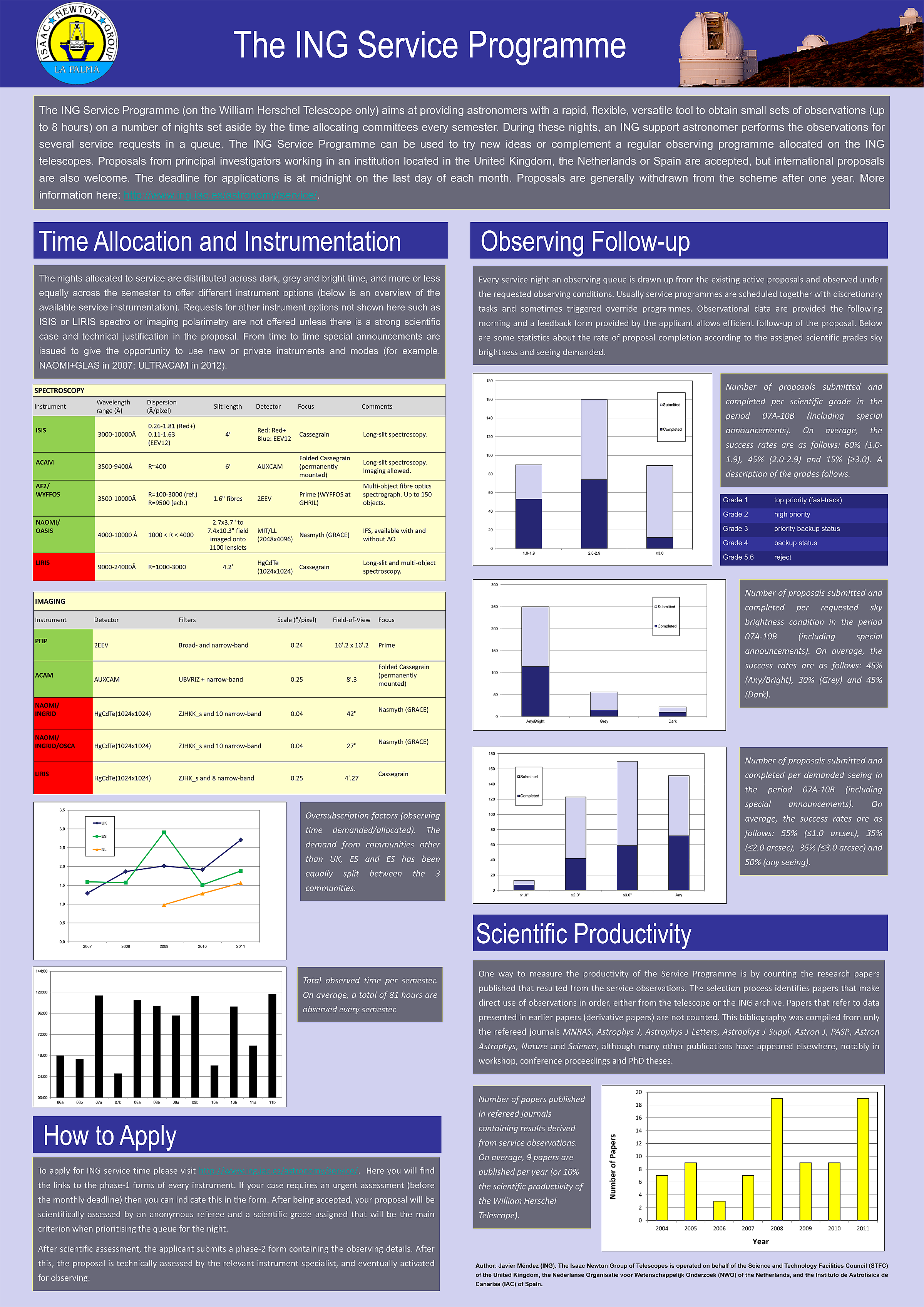
The nights allocated to service are distributed across dark, grey and bright time, and more or less equally across the semester. They are shown in the ING schedules as 'S' or 'S/D' nights in the programme reference column. Please note that 'CAT S' nights are service nights set apart from the ING service programme by the Spanish CAT time allocating committee. An overview of the ING Service Programme is provided in this poster. Typically service programmes are one of this type:
Scientific referees will endeavour to assess the applications assigned to them within a week after the deadline (0 hr on the first day of each month). However, principal investigators should be aware that applications may not become active for up to one month after the monthly deadline. If a proposal requires being observed at the earliest service night and the timing described before is not suitable, then applicants can request urgent assessment at submission. Please note urgent assessment is an exception to our regular scheme and proper justification must be provided. Proposals requesting urgent assessment usually request being observed at the earliest opportunity. If only a few days separate submission and possible attempt, then there is a risk for not assessing the proposal in time. Urgent-assessment proposals are queued together with regular proposals when they become active.
Grade 2 proposals will be attempted as high priority, and should get done over the active 1-year lifetime of the proposal, weather and instrument availability permitting. Grade 3 and 4 proposals will only be attempted when there are no higher graded proposals in the queue, and there is therefore no guarantee that they will be attempted at all. Grade 5 and 6 proposals will not be attempted. Service active and attemptable proposals are queued every service scheduled night. Please remember that in general there will be several high priority proposals in the queue waiting to be done and that weather or technical downtime could prevent observing. Applicants should also be aware that service time is allocated to each hosting institution's nationality (UK, NL or ES) on a very strict time basis, and therefore not all highly-rated proposals from a particular nationality will necessarily be completed. The service time allocation provided by every time allocating committee is taken by the Service Manager for reference and tracks the use of service observing time to reflect this nationality time share over the semesters. Principal investigators whose proposals are attempted will be contacted by the Service Manager shortly after the service night, usually via an ING Service Night Report. They will normally be asked to FTP the data back to their home site. The ING Board and the International Scientific Committee (CCI) have decided that data belong exclusively to those who requested it for a period of one year. After this time it enters the public domain and it can be retrieved from the ING archive. Service observations are similarly treated. However, calibration data may well be used for more than one observation and may therefore be available for several groups. It may happen that identical or similar service observations are requested by two or more applicants. Requests which are approved before the data are taken may be satisfied by requiring the data to be held in common by the several groups. It is up to them how they organise themselves to process it, analyse it, relate it to other work, and eventually, presumably, publish it. |
| Top | Back |
|