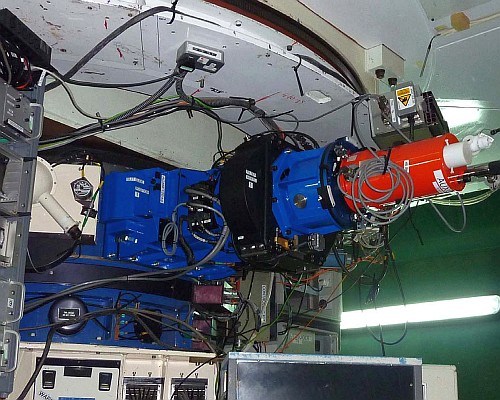
Description: ACAM can be used either for imaging (as above) through broad-band
or narrow-band filters, or for taking spectra.
In spectroscopy mode, the light from the object under study is
dispersed by a
VPH (volume-phase holographic) grating.
For a 0.5-arcsec slit,
the on-axis spectroscopic
resolution is approximately 900 at a wavelength of 6000Å.
ACAM is mounted permanently at a folded-Cassegrain focus
of the telescope, and can be deployed at a few minutes notice.
This allows astronomers to switch quickly from the main
camera in use for the night, to ACAM, for rapid follow-up of unusual
events.
ACAM´s exceptional versatility allows astronomers to carry out
a broad range of high-impact
science projects which otherwise would not be
possible with the WHT, in particular those requiring one or more
of:
rapid response;
narrow-band imaging;
wide field of view;
low-resolution spectroscopy;
or high camera throughput (very litte light is lost in the optics).
Time allocations:
Time allocated since semester 2007B
Instrument information: http://www.ing.iac.es/astronomy/instruments/acam/
Research impact:
Scientific highlights (17)
Outreach:
Media releases (20)
Multimedia:
Photo archive (2)
Image archive (5)