A team of Dutch astronomers designed and built the innovative
imaging polarimeter ExPo (the Extreme Polarimeter), which is a regular
visitor instrument at the William Herschel Telescope (WHT). ExPo was
designed and built at Utrecht University and has, due to the closure
of astronomy in Utrecht, moved to Leiden University.
ExPo makes use of polarised light to study the faint, dust-rich
environments around young and evolved stars. The advantage of using
polarimetry, over normal intensity images, is that the unpolarised
light from the star is easily removed, allowing directly observation
of the star's surroundings in scattered (linearly polarised) light. The
information contained in the polarised light constrains the
properties of the scattering particles (dust), such as their size,
albedo and structure.
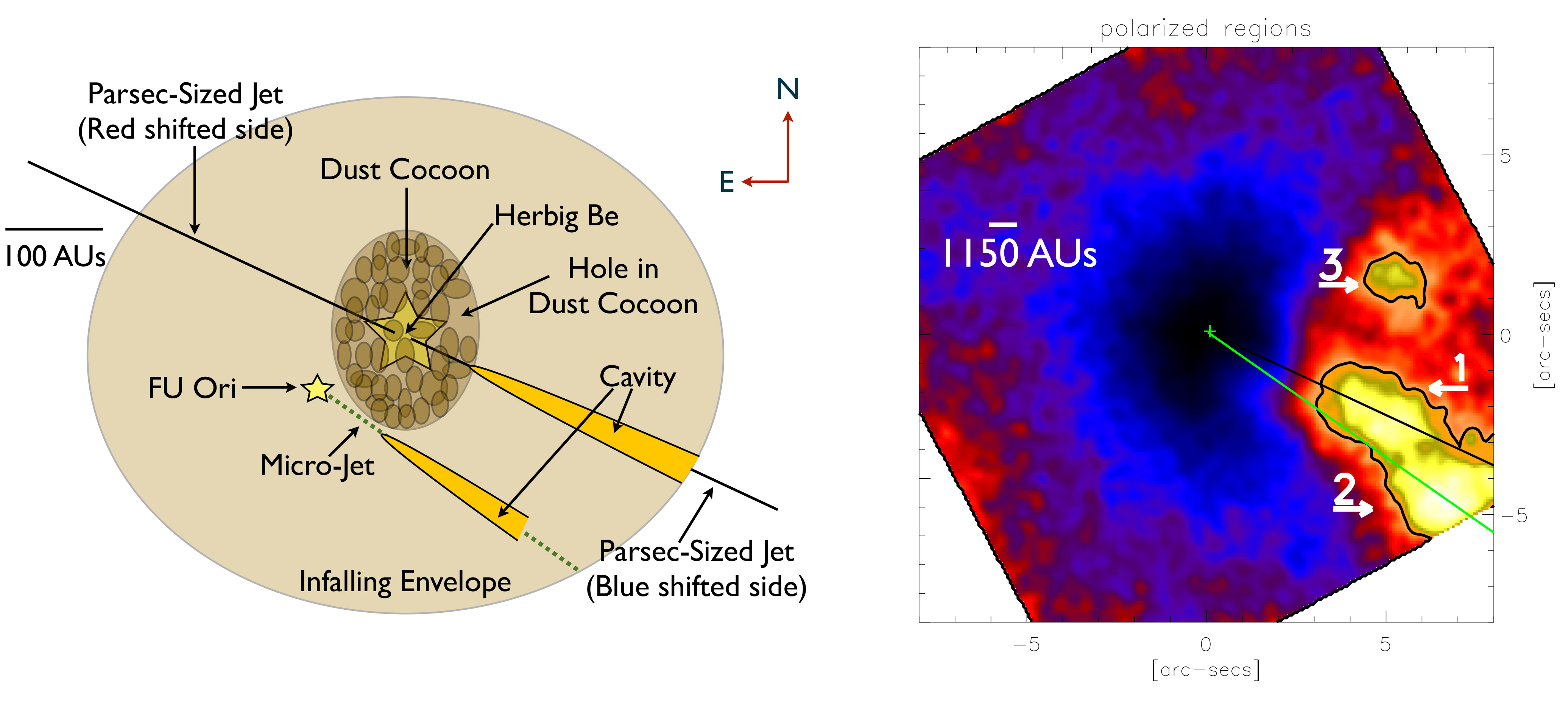
The ExPo team observed the young binary system Z CMa in 2010, right
after its strongest, and as yet unexplained, outburst. This system,
comprising an FU Ori and a Herbig Be star, is extremely variable at
visible wavelengths. Previous measurements indicate that the Herbig Be
star is surrounded by a dust cocoon that blocks its light at visible
wavelengths. Using ExPo observations, Cánovas et al. 2011 show direct
evidence for a hole in the dust cocoon. The light escaping through
the hole produces a polarised signature that is observable in the ExPo
images (see Figure 1, polarised feature 3). This can explain some of
the variability of Z CMa when a hole forms in the dust cocoon, the
contribution of the Herbig Be star to the total brightness of the system
suddenly increases.
 |
Figure 1: Left: Schematic picture of the Z CMa system. The primary Herbig
Be-type star is surrounded by an irregular dust cocoon. There is a
3.6-pc jet associated with this star. The secondary FU Ori star is
known to drive a jet, at a position angle of ~20 degrees with respect
to the primary's jet. The whole system is surrounded by a massive
envelope. Right: ExPo image of Z Cma in (linearly) polarised light.
The positions of the primary and secondary jets are indicated by black
and green lines, respectively. The two stars are unresolved in the ExPo
images, and their position is indicated by a green cross at the center
of the image. The polarised features labelled as 1 and 2 coincide in
position with the primary (black) and secondary (green) jets. The
third polarised feature can be explained in terms of polarised light
escaping through a hole in the dust cocoon.
[ JPEG ]. |
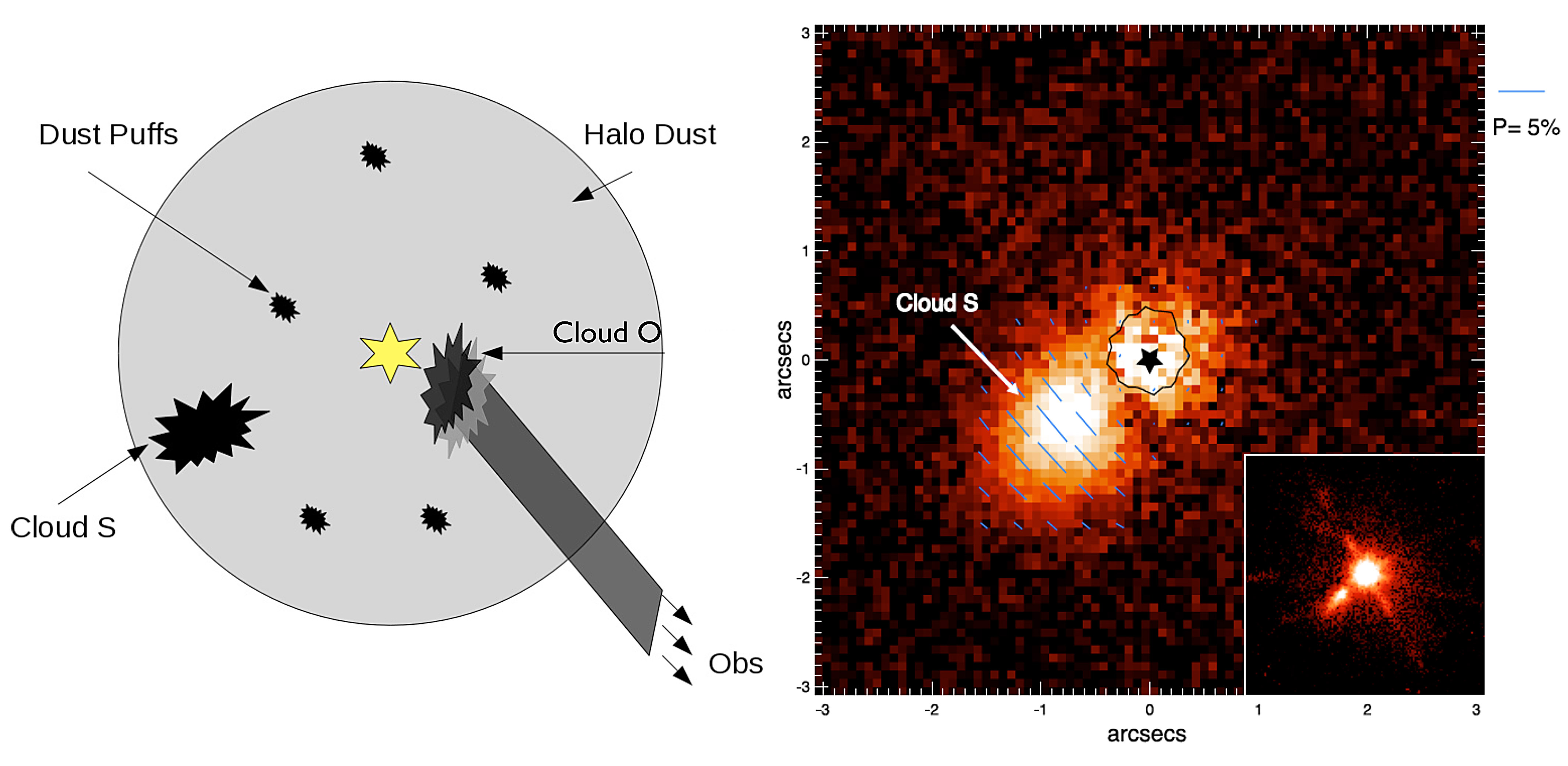
Another example of the capabilities of imaging polarimetry for investigating faint
circumstellar environments is shown in Figure 2 for the evolved
star R CrB. These carbon-rich stars are known to be surrounded by a
dust-rich halo and to emit dust clouds at irregular intervals. The
ExPo observations of R CrB were secured when a large dust cloud was
emitted along the line of sight to the observer, acting like a natural
coronograph. This allowed the astronomers to derive the dust
properties in three different regions around R CrB: the "obscuring"
cloud, the dust halo that surrounds R CrB, and in one dust cloud that
is evident in the ExPo images (see Figure 2). The results are
published in Jeffers et al. (2012).
 |
Figure 2. Left: Schematic picture of R CrB showing the obscuring cloud (Cloud O), the ejected cloud
that is detected in ExPo images (Cloud S), and the dusty halo around the star. Right: Polarised
intensity image of RCrB, where a dust cloud is clearly detected. An HST image is shown in the right
bottom corner for comparison. Combining the HST (intensity) and ExPo (polarised intensity) images,
the astronomers were able to derive the properties of this cloud.
[ JPEG ]. |
More information:
Cánovas, H., Min, M. , Jeffers, S. V., Rodenhuis, M. and Keller, C. U., 2012, A&A, 543, A70. Paper.
Jeffers, S. V. Min, M., Waters, L. B. F. M., Cánovas, H., Rodenhuis, M., Ovelar, M.D.J., Chies-Santos, A.L., and Keller, C.U., 2012, A&A, 539, A56. Paper.