Astronomers from the Atlas
3D team, using the SAURON integral-field spectrograph on the William Herschel Telescope,
have found that some of the oldest galaxies in the
Universe have three times as much stellar mass, and as many more stars, than all current models of galaxy evolution predict. This result means that the models, which assumed for decades that the light we
observe from a galaxy can be used to infer its stellar mass, will have to be revised. And it also suggests that researchers have a new riddle to ponder: exactly how galaxies forming so early in the life of the Universe
got to be massive so fast. A report of the research is published in
Nature on 26 April 2012.
'The light we see from galaxies is just the tip of the iceberg, but what we really need to measure are galaxy masses that all models directly predict,' said Dr Michele Cappellari of Oxford University's Department of Physics, who led the work.
'Galaxies can contain huge numbers of small stars, planets or black holes that have lots of mass but give out very little or no light at all. Up until now models assumed that stellar light could be used to infer the stellar masses and any
remaining discrepancy with the observed total mass could be hidden behind a 'halo' of dark matter. Our analysis shows that they can't hide any longer: galaxies are diverse and some have many more stars and are even stranger than we had assumed.'
Until now the main limitation on what it was possible to say about the stellar mass of galaxies was the difficulty of separating this out from the mass contributed by dark matter.
The Atlas3D team's analysis consists of removing the 'halo' of dark matter that has clouded previous calculations, and it succeeds thanks to the availability of two-dimensional maps of stellar motions for a large sample of galaxies, combined with sophisticated models.
By disentangling stellar mass from dark matter the team was able to show that instead of the relationship between
observable light and stellar mass being universal, it varies between different types of galaxies - with some older galaxies having three times the mass suggested by the light they give off.
 |
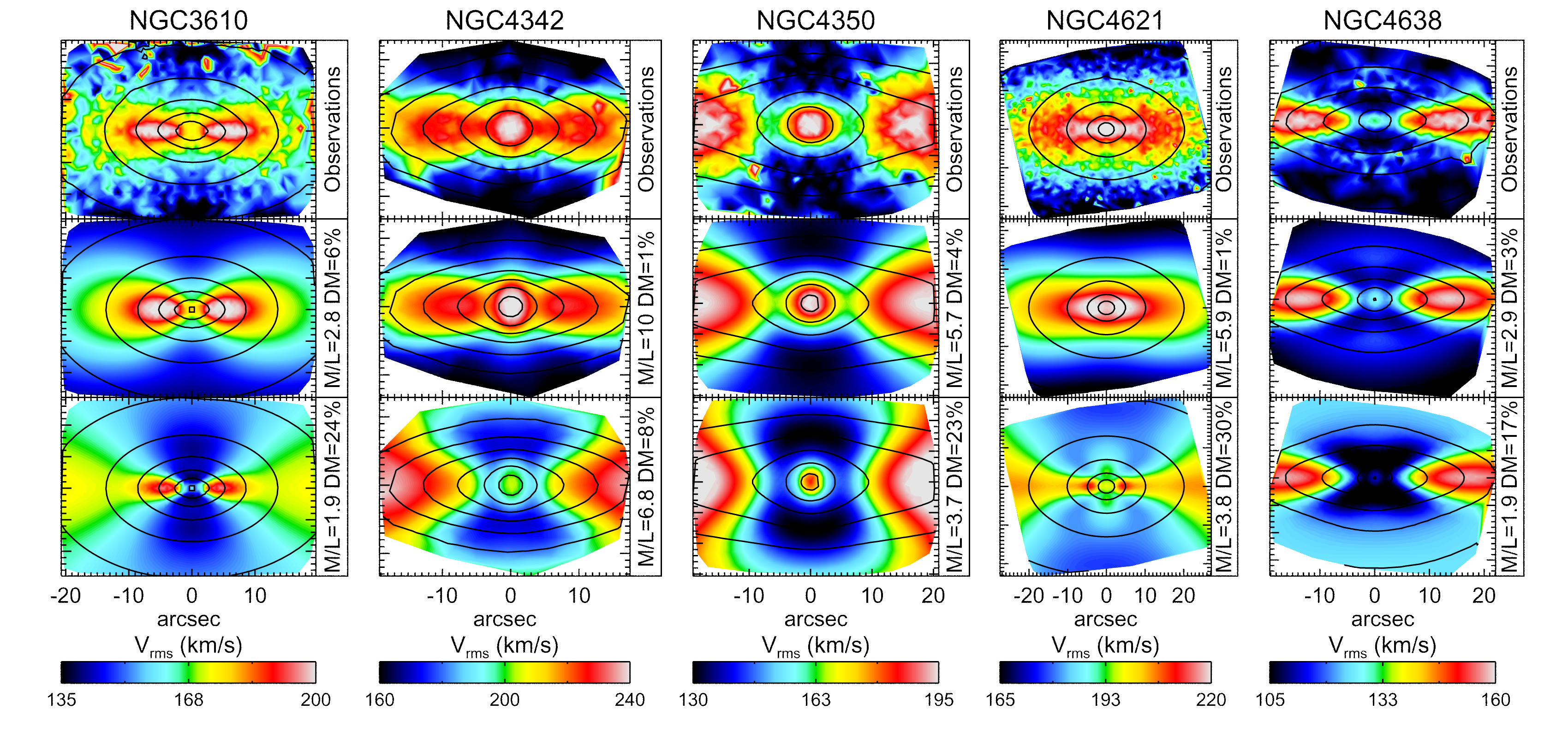
Disentangling the stellar and dark masses with integral-field stellar kinematics. The top panels show the symmetrized SAURON stellar kinematics
for five galaxies representing a variety of kinematic-field shapes, and spanning a range in stellar mass-to-luminosity (M/L) stars values.
The middle panel is the best-fitting dynamical model with a standard dark halo. The
bottom panel is a dynamical model where the (M/L) stars was fixed to be 0.65 times the best-fitting one. This plot shows that, for a standard halo profile, the data tightly constrain
both the dark matter fraction and (M/L) stars. The contours show the
observed and modelled surface brightness respectively. The values of (M/L) stars and the fraction of dark matter within a sphere with radius equal to the projected
half-light radius R e are printed next to each panel. The galaxy names are given at the top
[ PNG | TIFF].
|
More information:
M. Cappellari et al., 2012, "Systematic variation of the stellar initial mass function in early-type galaxies",
Nature, 484, 485.
More information about the project and its team can be found here:
http://www-astro.physics.ox.ac.uk/atlas3d/.
The Atlas3D team included researchers from: Oxford University; Gemini Observatory; University of California, Berkeley; Observatoire de Paris; Laboratoire AIM Paris-Saclay; University of Massachusetts; European Southern Observatory; Leiden University; Observatoire de Lyon; Max-Planck Institut fur extraterrestrische Physik; Netherlands Institute for Radio Astronomy; University of Groningen; Max-Planck Institut fur Astrophysik; University of Hertfordshire; Swinburne University of Technology; University of Toronto; New Mexico Institute of Mining and Technology.