DISCOVERY OF A NEW TYPE OF GALAXY: ONE
IN WHICH THE BULGE ROTATES RETROGRADE TO THE DISK
 A
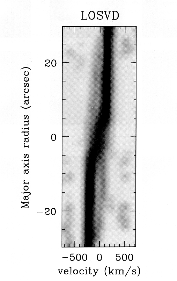
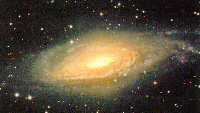
team of astronomers found that the bulge of the large, nearby Sb galaxy
NGC 7331 rotates retrograde to its disk. Analysis of spectra in the region
of the near-IR Ca II triplet along the major axis shows that, in the radial
range between 5 and 20 arcseconds, the line-of-sight velocity distribution
of the absorption lines has two distinct peaks and can be decomposed into
a fast-rotating component and a slower rotating, retrograde component.
The radial surface brightness profile of the counterrotating component
follows that of the bulge, obtained from a two-dimensional bulge-disk decomposition
of a near-infrared K-band image, while the fast-rotating component follows
the disk. At the radius at which the disk starts to dominate, the isophotes
change from being considerably boxy to being very disky. A
team of astronomers found that the bulge of the large, nearby Sb galaxy
NGC 7331 rotates retrograde to its disk. Analysis of spectra in the region
of the near-IR Ca II triplet along the major axis shows that, in the radial
range between 5 and 20 arcseconds, the line-of-sight velocity distribution
of the absorption lines has two distinct peaks and can be decomposed into
a fast-rotating component and a slower rotating, retrograde component.
The radial surface brightness profile of the counterrotating component
follows that of the bulge, obtained from a two-dimensional bulge-disk decomposition
of a near-infrared K-band image, while the fast-rotating component follows
the disk. At the radius at which the disk starts to dominate, the isophotes
change from being considerably boxy to being very disky.
 Although
a number of spiral galaxies have been found that contain cold, counterrotating
disks, this is the first galaxy known to have a boxy, probably triaxial,
fairly warm, counterrotating component, which is dominating in the central
regions. If it is a bar seen end-on, this bar has to be thicker than the
disk. NGC 7331, even though it is a fairly early-type spiral, does not
have a conventional, corotating bulge. The fact that the inner component
is retrograde makes the astronomers believe that it was formed from infalling
material in either stellar or gaseous form. Another possibility discused
by the discoverers is that the structure has been there since the formation
of the galaxy. In this case, it will be a challenge to explain the large
change in orientation of the angular momentum when going outward radially. Although
a number of spiral galaxies have been found that contain cold, counterrotating
disks, this is the first galaxy known to have a boxy, probably triaxial,
fairly warm, counterrotating component, which is dominating in the central
regions. If it is a bar seen end-on, this bar has to be thicker than the
disk. NGC 7331, even though it is a fairly early-type spiral, does not
have a conventional, corotating bulge. The fact that the inner component
is retrograde makes the astronomers believe that it was formed from infalling
material in either stellar or gaseous form. Another possibility discused
by the discoverers is that the structure has been there since the formation
of the galaxy. In this case, it will be a challenge to explain the large
change in orientation of the angular momentum when going outward radially.
| More
information
ING facilities involved:
Pictures:
Some references:
-
F Prada et al, 1996, "A counterrotating
bulge in the Sb galaxy NGC 7331", ApJ, 463, L9
-
C M Gutiérrez et al,
1996, "Un bulbo retrógado en la galaxia cercana NGC 7331", IAC
Noticias,
1/1996, 4
|
|