| |||
|

| Home > Public Information > Scientific Highlights > 1995 |
|
in 1995* |
[ 1994 Scientific Highlights | 1996 Scientific Highlights ]
[ STARS | THE MILKY WAY | GALAXIES | OBSERVATIONAL COSMOLOGY | OTHER ]
|
|
|
|
|
| More
information
ING facilities involved:
|
|
|
||
| ||
| More
information
ING facilities involved:
|
THE CURIOUS M100'S CORE
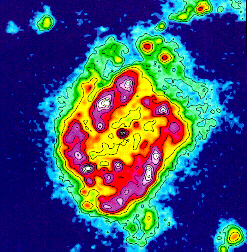 The
inner region of the barred spiral NGC 4321 (M100) shows remarkably different
morphology in the optical and the near-infrared. Whereas in the optical
it is dominated by two spiral arms lying in an ovally shaped region of
enhanced star formation, a K-band image reveals an inner bar aligned with
the 5 kpc stellar bar and a pair of leading arms emerging from its ends.
Neither feature is observed directly in the optical.
The
inner region of the barred spiral NGC 4321 (M100) shows remarkably different
morphology in the optical and the near-infrared. Whereas in the optical
it is dominated by two spiral arms lying in an ovally shaped region of
enhanced star formation, a K-band image reveals an inner bar aligned with
the 5 kpc stellar bar and a pair of leading arms emerging from its ends.
Neither feature is observed directly in the optical.
NGC 4321 is a nuclear starburst induced
and maintained by a global bar-driven density wave. The location of the
starburst in the circumnuclear "ring" is related to the slowing down of
the radial gas inflow in the presence of inner Lindblad resonances. Understanding
the details of such radial flows in barred galaxies may well shed light
on the origin and fueling of active galactic nuclei.
| More
information
ING facilities involved:
|
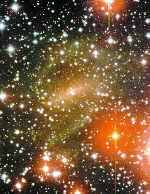 The
disk of the Milky Way contains gas and dust which obscures about 20% of
the extragalactic sky, the so-called "Zone of Avoidance". Nearby galaxies
hidden behind the zone of avoidance may have an important influence on
the dynamics of the Local Group and its peculiar motion relative to the
cosmic microwave background radiation. Such galaxies suffer extinction
by gas and dust at optical wavelengths and confusion by stars in the infrared.
However, 21 cm neutral atomic hydrogen (HI) emission, associated with late-type
galaxies, may be observed if the velocity of the emission differs from
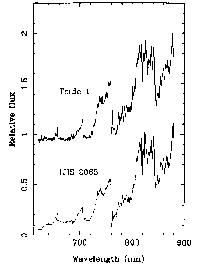
that of the local gas. The Dwingeloo Obscured Galaxy Search is a
long-term international collaboration of astronomers to search about 2000
degress2 of the northern galactic plane at 21 cm for new galaxies,
using the Dwingeloo 25 m radio telescope. The first result of this search,
in August 1994, was the detection of a new galaxy, Dwingeloo 1. Follow-up
service imaging on UKIRT and the INT revealed it to be an SBb barred spiral.
Dwingeloo 1 is rotating at about 130 km per second, has a mass about one-third
that of the Milky Way, and lies about 3 kpc distant. Its angular and radial
proximity to Maffei 1, Maffei 2 and IC342 suggest that it is a prominent
member of this group of galaxies, a close neighbour of the Local Group.
The
disk of the Milky Way contains gas and dust which obscures about 20% of
the extragalactic sky, the so-called "Zone of Avoidance". Nearby galaxies
hidden behind the zone of avoidance may have an important influence on
the dynamics of the Local Group and its peculiar motion relative to the
cosmic microwave background radiation. Such galaxies suffer extinction
by gas and dust at optical wavelengths and confusion by stars in the infrared.
However, 21 cm neutral atomic hydrogen (HI) emission, associated with late-type
galaxies, may be observed if the velocity of the emission differs from
that of the local gas. The Dwingeloo Obscured Galaxy Search is a
long-term international collaboration of astronomers to search about 2000
degress2 of the northern galactic plane at 21 cm for new galaxies,
using the Dwingeloo 25 m radio telescope. The first result of this search,
in August 1994, was the detection of a new galaxy, Dwingeloo 1. Follow-up
service imaging on UKIRT and the INT revealed it to be an SBb barred spiral.
Dwingeloo 1 is rotating at about 130 km per second, has a mass about one-third
that of the Milky Way, and lies about 3 kpc distant. Its angular and radial
proximity to Maffei 1, Maffei 2 and IC342 suggest that it is a prominent
member of this group of galaxies, a close neighbour of the Local Group.
| More
information
ING facilities involved:
|
|
|
||
|
||
| More
information
ING facilities involved:
|
DEFICIT OF DISTANT X-RAY-EMITTING GALAXY CLUSTERS AND IMPLICATIONS FOR CLUSTER EVOLUTION
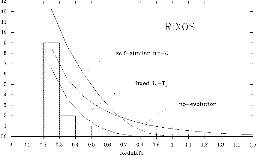 The
ROSAT International X-ray Optical Survey (RIXOS) was aimed at the optical
identification of a complete sample of ~400 serendipitous X-ray sources
found in 81 northern ROSAT fields, achieved using an International Time
award on the Canarian Telescopes. Fields at high Galactic latitude (b>+28°)
were selected with exposure times longer than 8000 seconds achieving a
limiting flux optimized for wide-area optical follow-up. In total, 385
X-ray sources were catalogued over 20.4 deg2 to a limiting flux
of fX>=3e+10–14 erg/s/cm2 in the 0.5–2.0
keV energy band.
The
ROSAT International X-ray Optical Survey (RIXOS) was aimed at the optical
identification of a complete sample of ~400 serendipitous X-ray sources
found in 81 northern ROSAT fields, achieved using an International Time
award on the Canarian Telescopes. Fields at high Galactic latitude (b>+28°)
were selected with exposure times longer than 8000 seconds achieving a
limiting flux optimized for wide-area optical follow-up. In total, 385
X-ray sources were catalogued over 20.4 deg2 to a limiting flux
of fX>=3e+10–14 erg/s/cm2 in the 0.5–2.0
keV energy band.
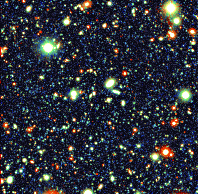
An overview of the various stages of data preparation and acquisition for RIXOS included: source searching and positional calibration of the X-ray images, the construction of finding charts around each of the sources using digitised sky-survey plates, a search for previously-known catalogued sources from on-line services, deep imaging of the optically empty fields using the Nordic Optical Telescope and the INT, spectroscopic observation of the brighter sources with the INT and of the fainter ones with the WHT, and, finally, multicolour imaging photometry of extended or interesting objects using the JKT. The results of the RIXOS survey provided a sample which is complete over 15 deg2 of sky, including 319 X-ray sources of which the largest population is of Active Galactic Nuclei (AGN), followed by stars, clusters of galaxies, Emission Line Galaxies (ELG), and finally, just one 'normal' galaxy.
The most significant scientific result
from the survey was the deficit of distant X-ray-emitting galaxy clusters
found. Clusters of galaxies are the largest gravitationally bound systems
in the Universe and therefore provide important constraints on the formation
and evolution of large-scale structure. Cluster evolution can be inferred
from observations of the X-ray emission of the gas in distant clusters,
but interpreting these data is not straightforward. In a simplified view,
clusters grow from perturbations in the matter distribution, and the intracluster
gas is compressed and shock-heated by the gravitational collapse. If the
gas is in hydrostatic equilibrium the resulting X-ray emission is related
in a simple way to the evolving gravitational potential. But if processes
such as radiative cooling or pre-collapse heating of the gas are also important,
the X-ray evolution will be strongly influenced by the thermal history
of the gas. In the RIXOS project very few distant clusters were identified,
and their redshift distribution seems to be inconsistent with simple models
based on the evolution of the gravitational potential. These results thus
suggest that radiative cooling or non-gravitational heating of intracluster
gas must be important in the evolution of clusters.
| More
information
ING facilities involved:
|
The maximum redshift for quasar fuzz
seen from Earth has grown to z=2.3 thanks to observations obtained with
the WHT (I Aretxaga et al, 1995, MNRAS, 275, L27). WHT also
discovered the most distant giant double radio source: 4C 39.24 at z=1.887
(J D B Law-Green et al, 1995, MNRAS, 277, 995).