 For
decades researchers have speculated about the existence of brown dwarfs
- celestial objects which probably constitute a link between stars with
lower masses and giant planets, such as Jupiter, whose mass is approximately
one thousandth of the mass of the Sun. There is no reason to assume that
these substellar objects cannot form randomly in space through a process
similar to that of the stars; i.e. as a result of gravitational collapse
and fragmentation of dust and gas clouds. However, despite many searches
carried out, their existence had not yet been unequivocably proved.
For
decades researchers have speculated about the existence of brown dwarfs
- celestial objects which probably constitute a link between stars with
lower masses and giant planets, such as Jupiter, whose mass is approximately
one thousandth of the mass of the Sun. There is no reason to assume that
these substellar objects cannot form randomly in space through a process
similar to that of the stars; i.e. as a result of gravitational collapse
and fragmentation of dust and gas clouds. However, despite many searches
carried out, their existence had not yet been unequivocably proved.
A brown dwarf is a self-gravitating
gaseous object composed mainly of hydrogen and helium, whose mass is too
small to induce stable hydrogen fusion in its interior. All the theoretical
surveys conducted agree that the limiting mass which separates stars from
brown dwarfs is about 7 or 8% of the mass of the Sun. Incapable of generating
nuclear energy, the gravitational contraction of a brown dwarf takes place
unavoidably until the pressure of the degenerated electrons in its interior
interrupts the whole process. The nearby star cluster of the Pleiades,
a group of stars which formed about a hundred million years ago at a distance
of approximately 400 light years (3780 billion kilometers) from the Sun,
is considered to be one of the most suitable astronomical sources for the
detection, and the subsequent study of brown dwarfs. At such early ages,
these objects should be undergoing gravitational contraction, radiating
much more energy than in later stages of their evolution. More massive
brown dwarfs in the Pleiades should be detectable in sufficiently deep
surveys.
After only 0.3% of the cluster's area
had been explored using IAC80 telescope at Teide Observatory, a faint object
was detected, whose extremely red colour possibly indicated a very low
surface temperature. Firstly, its motion in space was confirmed to coincide
with that of the stars of the cluster and, later, a precise photometric
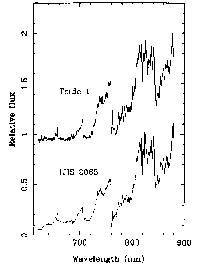
characterization was achieved. Several high resolution spectra between
600 and 900 nm were obtained with the WHT. These spectra confirmed the
discovery of one of the coldest quasi-stellar objects known in the Universe.
The spectral lines of neutral potassium between 767 and 770 nm indicated
that it was an object with high surface gravity, as was expected for a
brown dwarf, and the presence of prominent bands of titanium oxide and,
especially, vanadium oxide at 750 nm allowed to derive its spectral classification
and an estimate of its effective surface temperature, which turned out
to be some 2350 K. The spectrum allowed to infere a velocity measurement
of this object in regard to the Sun, which happened to be very similar
to that of the stars in the cluster. All the entire set of observations
suggested that it was a member of the cluster and, therefore, that its
age was the same as the cluster's: 100 million years approximately, with
a margin of error below 30%. It was the first time that the age of a celestial
object of this nature had been so accurately determined, overcoming one
of the most important restrictions preventing the true substellar nature
of brown dwarf candidates to be classified. From the cluster's distance
it was possible to determine that the luminosity of Teide 1
(this is how the discoverers decided to call the object) was one thousandth
of the solar luminosity. The comparison of its principal features (luminosity,
temperature and age) with all the evolutionary models available in the
scientific literature led to the conclusion that Teide 1 had to be a brown
dwarf.
In 1996 the International Time Project
"Observational Properties of Brown Dwarfs" detected new brown dwarfs in
the Pleiades cluster. Several have masses similar to Teide 1 (55 Jupiter
masses approximately) or higher, but various present slightly lower masses.
They were all first detected using the INT. Subsequent confirmation involved
spectra from the WHT and infrared photometry from UKIRT and WHT. The Keck
telescope was then used to detect the element lithium in the spectra of
brown dwarfs. Lithium is an important test for brown dwarfs because it
is destroyed by nuclear reactions in stars of low mass but not in brown
dwarfs.
| More
information
ING facilities involved:
Pictures:
Some references:
-
R Rebolo et al, 1995, "Discovery
of a brown dwarf in the Pleiades star cluster", Nature, 377,
129
-
"Brown Dwarfs in the cluster
of the Pleiades", 1995 CCI Annual Report, 13
-
"New Brown Dwarfs in the
Pleiades",
1996 CCI Annual Report, 7
-
R Jameson, 1997, "The search
for brown dwarfs", 1996/1997 PPARC Annual Report, 28
-
"Another Brown Dwarf discerned",
S&T,
12/95,
10
|