SPECTRALLY RESOLVED ECLIPSE MAPS OF AN
ACCRETION DISK
 Accretion
disks play an important role in many astrophysical environments, such as
active galactic nuclei, protostellar systems, X-ray binaries and cataclysmic
variables. The lack of spatially resolved information, however, has meant
that theoretical models for accretion disks are in general poorly constrained
by observations. By using the shape of the light curves from an an eclipsing
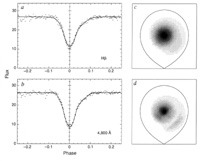
cataclysmic variable, UX Ursae Majoris, astronomers have reconstructed
the spectral energy distribution across the face of an accretion disk.
The spectral resolution is sufficient to reveal both the radial dependence
of absorption and emission line features within the disk, and the spectral
details of the bright spot formed at the point where the accretion stream
from the secondary star collides with the disk. Such detailed reconstructions
of accretion-disk spectra will help to bridge the gap between observations
and theoretical models. Accretion
disks play an important role in many astrophysical environments, such as
active galactic nuclei, protostellar systems, X-ray binaries and cataclysmic
variables. The lack of spatially resolved information, however, has meant
that theoretical models for accretion disks are in general poorly constrained
by observations. By using the shape of the light curves from an an eclipsing
cataclysmic variable, UX Ursae Majoris, astronomers have reconstructed
the spectral energy distribution across the face of an accretion disk.
The spectral resolution is sufficient to reveal both the radial dependence
of absorption and emission line features within the disk, and the spectral
details of the bright spot formed at the point where the accretion stream
from the secondary star collides with the disk. Such detailed reconstructions
of accretion-disk spectra will help to bridge the gap between observations
and theoretical models.
| More information
ING facilities involved:
-
Isaac Newton Telescope
using the FOS spectrograph
Pictures:
Some references:
-
Rutten, R.G.M. et al, 1992,
"Reconstruction of the accretion disk in six cataclysmic variable stars
", A&A, 260, 213
-
Rutten, R.G.M. et al, 1993,
"Spectrally resolved eclipse maps of the accretion disk in UX Ursae Majoris",
Nature, 362, 518
-
Rutten, R.G.M. et al, 1994,
"Spectral eclipse mapping of the accretion disk in the nova-like variable
UX Ursae Majoris", A&A, 283, 441
|
|