COMET SHOEMAKER-LEVY
9
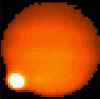 In
common with many observatories all over the world, a major campaign was
undertaken in July at the time of the impact on Jupiter of Comet Shoemaker-Levy
9. On the INT, the IDS, configured for low-resolution spectroscopy in the
3500 to 6600Å region, obtained a continuous sequence of spectra of
impact L. Apart from recording the fireball, atomic line emission from
sodium, magnesium, calcium and possibly iron was detected. The series of
spectra showed a typical solar absorption line spectrum reflected from
the surface of Jupiter, as well as the broad methane absorption band centered
on 6190Å. Division by a spectrum obtained before the impact removed
the solar spectrum, making it possible to see that sodium was present in
emission even in the first spectrum taken 600 seconds after impact. In
common with many observatories all over the world, a major campaign was
undertaken in July at the time of the impact on Jupiter of Comet Shoemaker-Levy
9. On the INT, the IDS, configured for low-resolution spectroscopy in the
3500 to 6600Å region, obtained a continuous sequence of spectra of
impact L. Apart from recording the fireball, atomic line emission from
sodium, magnesium, calcium and possibly iron was detected. The series of
spectra showed a typical solar absorption line spectrum reflected from
the surface of Jupiter, as well as the broad methane absorption band centered
on 6190Å. Division by a spectrum obtained before the impact removed
the solar spectrum, making it possible to see that sodium was present in
emission even in the first spectrum taken 600 seconds after impact.
The JKT was employed in imaging
the impacts through six narrow-band filters sampling the continuum and
methane absorption bands. The sequence of events that emerges from the
data is as follows. The fireball is first glimpsed 328 seconds after impact
when it is still 2° beyond the limb, on the far side of Jupiter. As
it comes to the horizon after 553 seconds it achieves maximum brightness
but no emision lines are yet visible. By 600 seconds the fireball is fading
and sodium is brightening, reaching its maximum after 848 seconds, after
which it rapidly fades. In the meantime magnesium and calcium brighten
and fade more slowly. A simple model is that the fireball is at first optically
thick. As it expands and cools it becomes optically thin and the emission
lines are seen.
| More information
ING facilities involved:
-
Isaac Newton Telescope,
using IDS
-
Jacobus Kapteyn Telescope,
using CCD imaging
Some references:
-
Walton, N. et al, 1994,
Spectrum,
3, 4
|
|