 For
some time, astronomers have considered the idea of using Type Ia supernovae
to determine the extragalactic distance scale. Supernovae of this type
occur in the late stages of evolution of a binary system consisting of
a white dwarf star orbiting a companion star. As the companion evolves
to the red giant phase it overflows its Roche Lobe and matter accretes
onto the surface of the white dwarf, gradually increasing the gravitational
pressure. When the white dwarf mass reaches a critical value, the nuclear
fuel ignites explosively. The subsequent growth and decay of light from
the supernova is characteristic of the type, and the intrinisc luminosity
of the explosion is thought to be independent of distance and therefore
usable as a "standard candle". A systematic search for distant supernovae
is being made on the INT as part of an international collaboration by a
team of astronomers.
For
some time, astronomers have considered the idea of using Type Ia supernovae
to determine the extragalactic distance scale. Supernovae of this type
occur in the late stages of evolution of a binary system consisting of
a white dwarf star orbiting a companion star. As the companion evolves
to the red giant phase it overflows its Roche Lobe and matter accretes
onto the surface of the white dwarf, gradually increasing the gravitational
pressure. When the white dwarf mass reaches a critical value, the nuclear
fuel ignites explosively. The subsequent growth and decay of light from
the supernova is characteristic of the type, and the intrinisc luminosity
of the explosion is thought to be independent of distance and therefore
usable as a "standard candle". A systematic search for distant supernovae
is being made on the INT as part of an international collaboration by a
team of astronomers.
The light curves of newly discovered
supernovae will be monitored over the period of visibility to determine
their types, and in the case of type Ia discoveries their "standard candle"
properties will be used to measure their distances. The distances and redshifts
combined will provide a measure of the decleration parameter of the Universe
to the critical density.
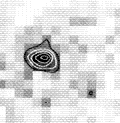
As part of this campaign, one
type Ia supernova has already been discovered in a distant galaxy. The
new supernova was detected at R=22mag on an INT CCD prime focus image and
then confirmed in follow-up images over a period of weeks. A spectrum of
the host galaxy was obtained with the WHT and the redshift measured to
be z=0.457, making it the most distant supernova ever observed.