NUCLEOSYNTHESIS
 According
to standard Big Bang nucleosynthesis theory the light elements - deuterium,
helium 3, helium 4 and lithium 7 - owe their origin in whole or part to
nuclear reactions that took place in the whole Universe about two minutes
after the Big Bang. Indeed the theory has been remarkably successful in
explaining and predicting the primordial abundances of these elements relative
to hydrogen. Furthermore, these abundances can be used to estimate the
mean baryonic (i.e. ordinary matter) density of the Universe today. The
primordial helium mass fraction Y is also related to two other fundamental
physics parameters: the number of light neutrino "flavours" -- the three
known ones correspond to the three known leptons: the electron, the muon,
and the tau meson - and the half life of the neutron. Consequently, an
accurate determination of Y simultaneously provides an important test of
standard Big Bang nucleosynthesis theory, and sets cosmological constraints
on the values of these two parameters. According
to standard Big Bang nucleosynthesis theory the light elements - deuterium,
helium 3, helium 4 and lithium 7 - owe their origin in whole or part to
nuclear reactions that took place in the whole Universe about two minutes
after the Big Bang. Indeed the theory has been remarkably successful in
explaining and predicting the primordial abundances of these elements relative
to hydrogen. Furthermore, these abundances can be used to estimate the
mean baryonic (i.e. ordinary matter) density of the Universe today. The
primordial helium mass fraction Y is also related to two other fundamental
physics parameters: the number of light neutrino "flavours" -- the three
known ones correspond to the three known leptons: the electron, the muon,
and the tau meson - and the half life of the neutron. Consequently, an
accurate determination of Y simultaneously provides an important test of
standard Big Bang nucleosynthesis theory, and sets cosmological constraints
on the values of these two parameters.
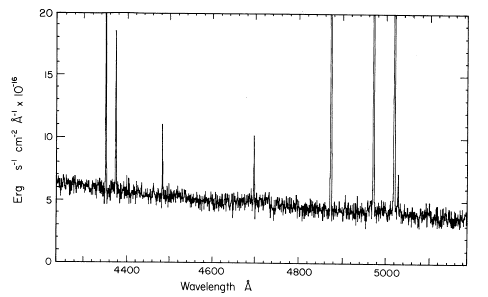
Researchers used the INT and the
AAT to measure the primordial helium abundance from the emission lines
of HII galaxies. Combined with selected data from the literature relating
to extragalactic HII regions in general, they determined Y to be 0.228±0.005
or Y < 0.242 with 95 per cent confidence. This value places in turn
an upper limit of 10.4 minutes on the half-life of the neutron and limits
the number of neutrino species to < 3.2. These limits based on purely
astronomical work, have been confirmed by experiments in the laboratory
(10.25 minutes and 3.01±0.01 species). In the course of this work,
HII galaxies with broad Wolf-Rayet emission features were excluded from
the analysis since they often showed higher helium abundance, supporting
a suggestion that there may be additional local sources of helium in the
form of winds from Wolf-Rayet stars.
|
| More
information
ING facilities involved:
-
Isaac Newton Telescope,
using IDS
Some references:
-
Pagel,B.E. et al, 1992,
"The primordial helium abundance from observations of extragalactic HII
regions", MNRAS, 255, 325
|
|
|