ACTIVE GALACTIC NUCLEI
 Active
galaxies appear in a wide variety of guises, with observed phenomena covering
vast ranges in luminosity and spatial scale. This diversity has hindered
attempts to understand the nature of the fundamental energy source. In
recent years, however, it has emerged that at least some of the radiation
produced by active galactic nuclei (AGN) is emitted anisotropically. This
has led to the development of "unified schemes" which seek to relate apparently
differently classes of AGN. In one model an active nucleus is largely enclosed
by a thick torus of obscuring material. The strong non-stellar continuum
and broad emission lines characteristic of Seyfert 1 galaxies are seen
when the object is oriented so that we have an unobstructed view of the
nucleus but when the obscuring disk is edge-on, the nucleus is hidden and
a Seyfert 2 galaxy is seen, with narrow emission lines and weak non-stellar
continuum. Active
galaxies appear in a wide variety of guises, with observed phenomena covering
vast ranges in luminosity and spatial scale. This diversity has hindered
attempts to understand the nature of the fundamental energy source. In
recent years, however, it has emerged that at least some of the radiation
produced by active galactic nuclei (AGN) is emitted anisotropically. This
has led to the development of "unified schemes" which seek to relate apparently
differently classes of AGN. In one model an active nucleus is largely enclosed
by a thick torus of obscuring material. The strong non-stellar continuum
and broad emission lines characteristic of Seyfert 1 galaxies are seen
when the object is oriented so that we have an unobstructed view of the
nucleus but when the obscuring disk is edge-on, the nucleus is hidden and
a Seyfert 2 galaxy is seen, with narrow emission lines and weak non-stellar
continuum.
As a test of these ideas, the
consortium called the "Lovers of Active Galaxies" observed the circum-nuclear
region of the Seyfert 1 galaxy NGC 4151, using both the WHT and INT as
part of and International Time Programme, looking for evidence of effects
on the surrounding interstellar medium of ionizing radiation emitted by
the nucleus. Like many Seyferts, NGC 4151 contains an extra-nuclear emission
line region (ENLR) which is elongated over several kiloparsecs. The LAG
consortium find that the ENLR emission line spectrum is characteristic
of photoionization by a AGN continuum source and that the ionizing radiation
field is very probably anisotropic.. Furthermore, the ionising parameter
decreases with distance from the nucleus, consistent with geometrical dilution
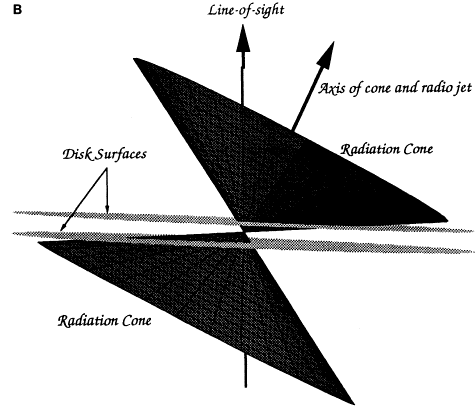
of the radiation of a central source. It is thought that ionising radiation
from the nucleus could be being emitted into a broad cone whose axis is
inclinned at a large angle to the plane of the galactic disk (by about
70 degrees) and that the ENLR is that segment of the disk which is illuminated
by the cone. An elongated nuclear radio source is obsserved at an angle
to the ENLR: the ejection axis of the radio-emitting plasma could conincide
with the axis of the cone. This geometry is consistent with the fact that
NGC 4151 is a Seyfert 1, since our line of sight would fall within the
cone, giving a direct view of the nucleus.
|
| More
information
ING facilities involved:
-
Isaac Newton Telescope,
using IDS
-
William Herschel Telescope,
using ISIS
Some references:
-
Robinson, A. et al,
1994, "The extended narrow line region of NGC 4151", A&A, 291,
351
|
|
|