GRAVITATIONAL LENSING
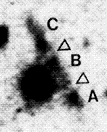 During
the past few years, several giant luminous arcs and faint blue gravitationally
distorted images have been discovered in the centres of various distant
and rich clusters of galaxies. The redshift measurements of such structures
have proved that they are background galaxies gravitationally distorted
by the cluster core. At present, more than 10 different clusters of galaxies
show an arclike structure or distorted images, though few of them have
been confirmed spectroscopically. In the course of an observing run with
the INT, researchers discovered that the rich cluster of galaxies Abell
2390 contains a strange linear object with could be an arc. Spectra of
the structure were obtained with the WHT and the ESO 3.6m which show an
emission line along its whole length. The identification of this emission
line as [OIII] at a wavelength of 3727Å leads to a redshift of z=0.913
for the structure. During
the past few years, several giant luminous arcs and faint blue gravitationally
distorted images have been discovered in the centres of various distant
and rich clusters of galaxies. The redshift measurements of such structures
have proved that they are background galaxies gravitationally distorted
by the cluster core. At present, more than 10 different clusters of galaxies
show an arclike structure or distorted images, though few of them have
been confirmed spectroscopically. In the course of an observing run with
the INT, researchers discovered that the rich cluster of galaxies Abell
2390 contains a strange linear object with could be an arc. Spectra of
the structure were obtained with the WHT and the ESO 3.6m which show an
emission line along its whole length. The identification of this emission
line as [OIII] at a wavelength of 3727Å leads to a redshift of z=0.913
for the structure.
The double quasar Q0957+561AB is believed
to be a gravitationally lensed image of a single quasar at z=1.41. It is
seen as two images because of an intervening galaxy, a giant cD elliiptical
in a cluster of redshift z=0.36. Both quasar images vary in brightness
but there is a time delay of 415 days between the appearance of brightness
variations in the two images and this is attributed to the difference in
length of the light paths from the quasar. Simple models have been developed
to account for the properties of the lensing system. The lensing galaxy
is represented by a circularly symmetric smooth surface density profile
whose parameters are the core radius and the velocity dispersion. The model
shows that the time delay is a function of measurable parameters such as
distances and the velocity dispersion, but scales inversely with the Hubble
constant H0. Consequently, an estimate
of the value of H0 is possible. Researchers
using ISIS on the WHT to obtain spectra of the galaxy and quasar images,
and measured the line-of-sight velocity dispersion of the galaxy as 303±50
kms-1. Using the model, the value of H0
becomes 50±17 kms-1Mpc-1.
A key uncertainty in this calculation is the contribution of the cluster
to the lensing effect: this can be estimated from the cluster velocity
dispersion, for which further obsservations will be needed.
| More
information
ING facilities involved:
-
Isaac Newton Telescope,
using prime focus CCD
-
William Herschel Telescope,
using FOS
Some references:
-
Pello, R. et al, 1991
"A straight gravitational image in Abell 2390 - a striking case of lenssing
by a cluster of galaxies", ApJ, 366, 405
-
Leborgne, J.-F. et
al, 1991, "Photometric and spectroscopic observations of cluster of galaxies
Abell 2390", A&AS, 88, 133
|
|
|