GRAVITATIONAL LENSING
 Gravitational
lensing, the reimaging of a distant object by a massive intervening one,
is a prediction of General Relativity which has only recently been observationally
confirmed. Astronomers are seeking to use this phenomenon constructively
to learn about the Universe. The most promising lenses are moderate redshift
clusters of galaxies whose gravitational potential produces distorted arc-like
images of remote background galaxies. The technique promises to reveal
details of the high redshift universe unobtainable by conventional observations.
One of the most challenging arc redshift determinations was achieved using
ISIS on the WHT. Gravitational
lensing, the reimaging of a distant object by a massive intervening one,
is a prediction of General Relativity which has only recently been observationally
confirmed. Astronomers are seeking to use this phenomenon constructively
to learn about the Universe. The most promising lenses are moderate redshift
clusters of galaxies whose gravitational potential produces distorted arc-like
images of remote background galaxies. The technique promises to reveal
details of the high redshift universe unobtainable by conventional observations.
One of the most challenging arc redshift determinations was achieved using
ISIS on the WHT.
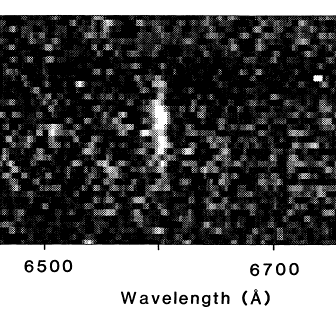
An exposure lasting over three
hours was made of an extremely faint arc structure around the central galaxy
of the rich cluster Abell 963 (redshift z=0.206) in 0.8 arcsecond seeing,
revealing a single strong emission line at a wavelength of 6600Å.
The interpretation of this observation is that the imaged object is a very
distant spiral galaxy containing regions of active star formation: the
emission line is [OII] redshifted to z=0.771. A second arc in this cluster
proved too faint for spectroscopy, but INT images showed that the two arcs
have similar unusually blue colours, indicating that they are two gravitational
images of the same object.
| More
information
ING facilities involved:
-
William Herschel Telescope,
using ISIS
-
Isaac Newton Telescope,
using the prime focus CCD
Some references:
-
Ellis, R. et al, 1991,
"Spectroscopy of arc in the rich cluster Abell 963", MNRAS, 249,
184
|
|
|