PROBLEMS FOR COLD DARK MATTER AND
THE 'GREAT ATTRACTOR'
 Bright
hight redshift quasars are important observation probes of the structure,
evolution and early history of the Universe. The mere existence of the
most luminous high-redshift quasars poses problems for currently popular
models of the Universe, for example Cold Dark Matter, because the time
available to form such massive energy sources since the Big Bang is uncomfortably
short: only 1 billion years at a redshift of z=4. Their high optical luminosity
means that they can be easily studied over very large cosmological distances,
and they are particularly valuable as probes of the intervening gas clouds
and galaxies, and for such fundamental investigations as the temperature
of the microwave background, deuterium abundance and the large scale structure
at early epochs. Bright
hight redshift quasars are important observation probes of the structure,
evolution and early history of the Universe. The mere existence of the
most luminous high-redshift quasars poses problems for currently popular
models of the Universe, for example Cold Dark Matter, because the time
available to form such massive energy sources since the Big Bang is uncomfortably
short: only 1 billion years at a redshift of z=4. Their high optical luminosity
means that they can be easily studied over very large cosmological distances,
and they are particularly valuable as probes of the intervening gas clouds
and galaxies, and for such fundamental investigations as the temperature
of the microwave background, deuterium abundance and the large scale structure
at early epochs.
There are now 20 quasars known
above a redshift of z=4, seven of which have had their nature and redshift
confirmed using the INT. One third of the 36 highest known redshift quasars
have been discovered by the ING.
Further problems with the Cold
Dark Matter model were revealed in an analysis of large-scale galaxy clustering
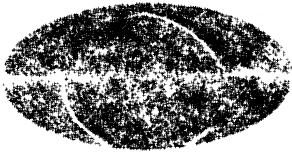
published recently. The researchers undertook an all-sky redshift survey
of IRAS galaxies: 1211 new redshifts were obtained, the great majority
with the WHT, with some from the INT and other telescopes. Other redshifts
were obtained from the literarure or unpublished sources. The result was
a uniform all-sky sample encompassing a larger volume of the Universe than
any previous redshift survey and a map of the distribution of galaxies
within a radius of 150h-1 Mpc. A clustering analysis of this
map showed that the variation in density of galaxies over the Universe
is inconsistent with the predictions of the Cold Dark Matter model.
The same reseachers used the map
of the distibution of galaxies on the Local Group of Galaxies, and deduce
the corresponding perculiar motion of the Local Group. They found that
the acceleration acting on the Local Group is generated by a dozen or so
clusters within 100h-1Mpc, and the velocity of the Local Group
with respect to the microwave background radiation of 600 kms-1
can be explained provided the Universe has a density close to the critical
value. No additional clusters located behind the galactic plane are needed
to account for the Local Group motion, and there is no very large structure
behind the Centaurus cluster capable of generating the claimed streaming
motions of 1000kms-1, so the rationale for the 'Great Attractor'
appears to have faded.
| More
information
ING facilities involved:
-
William Herschel Telescope,
using FOS-2
-
Isaac Newton Telescope,
using IPCS and FOS-1
Some references:
-
Rowan-Robinson, M.
et al, 1990, "A sparse-sample redshift surveyed of IRAS galaxies - Part
One - The convergence of the IRAS dipole and the origin of our motion with
respect to the microwave background", MNRAS, 247, 1
-
Irwin, M. and McMahon,
R., 1990, "Yet more z > 4 QSOs discovered using the INT", GEMINI Newsletter
Royal Greenwich Obs., 30, 6
-
Frenk, C.S. et al.,1991,
"Is Cold Dark Matter Really Dead?", Nature, 351, 22
|
|
|