 Accretion
disks have aroused much interest in many different fields of astronomy.
When they occur in binary star systems they can be studied particularly
well since they are relatively nearby and bright, and because a reliable
model of the geometry of the system is available. Among the most interesting
type of binary system is the cataclysmic variable, which exhibits a spectacular
variability on a wide range of timescales. This consists of a white dwarf
primary and a cool secondary star. The cool star fills its Roche Lobe and
mass from its outer layers falls towards the white dwarf. Because of its
angular momentum, however, the infalling gas is forced into orbit around
the white dwarf where it is stored in an accretion disk, which is responsible
for a large proportion of the light emitted by the system. In some systems,
the secondary star periodically eclipses parts of the accretion disk, producing
a dip in the light curve typically lasting half an hour. The shape and
colour of the eclipse curve reflects the intensity and temperature structure
of the disk. Accretion
disks have aroused much interest in many different fields of astronomy.
When they occur in binary star systems they can be studied particularly
well since they are relatively nearby and bright, and because a reliable
model of the geometry of the system is available. Among the most interesting
type of binary system is the cataclysmic variable, which exhibits a spectacular
variability on a wide range of timescales. This consists of a white dwarf
primary and a cool secondary star. The cool star fills its Roche Lobe and
mass from its outer layers falls towards the white dwarf. Because of its
angular momentum, however, the infalling gas is forced into orbit around
the white dwarf where it is stored in an accretion disk, which is responsible
for a large proportion of the light emitted by the system. In some systems,
the secondary star periodically eclipses parts of the accretion disk, producing
a dip in the light curve typically lasting half an hour. The shape and
colour of the eclipse curve reflects the intensity and temperature structure
of the disk.
Using the Multipurpose Fotometer
mounted on the JKT, researchers observed several eclipses of the eclipsing
cataclysmic variable UX Uma in four wavebands and reconstructed the accretion
disk structure using a maximum-entropy technique. The reconstruction shows
that the bulk of the optical radiation comes from a more or less symmetric
structure centered on the white dwarf, but that there is also a smaller
spot, where the gas stream from the cool star hits the accretion disc.
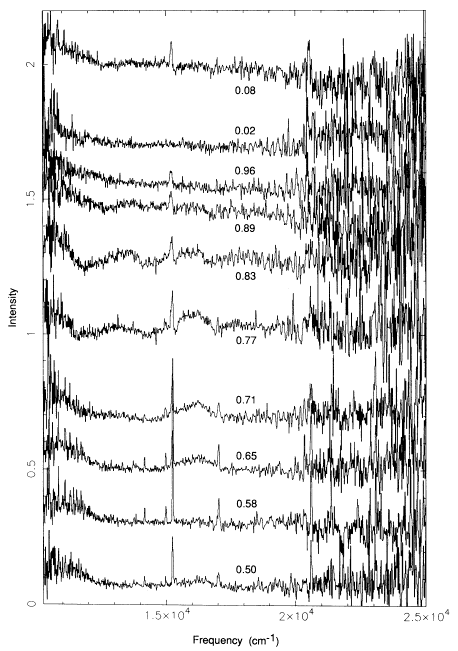 AM
Her systems are an important class of cataclysmic variables in which the
secondary star loses material to a strongly magnetic white dwarf primary.
The magnetic field on the primary is enormously strong, some tens of megagauss,
so that the stream of material does not form a disk, but is captured by
the field, and accretes on to the white dwarf in one or more shock regions
at the magnetic poles. The energy of the system is released partly as X-rays
in the shocks, and partly as optical cyclotron radiation from free electrons
in the stream spiralling in the magnetic field. This radiation is emitted
at low-order harmonics of the fundamental cyclotron frequency, broadened
into humps by Doppler motion of the electrons in the emission region. Observing
these humps in the spectra of AM Her systems is very difficult, but some
reseachers using the WHT Faint Object Spectrograph were able to detect
humps in a total of five systems. From the observations it is possible
to determine the magnetic field strengths and temperatures of the emitting
regions. The fields lie between 25 and 44 megagauss and the estimated temperatures
lie between 5.0 and 23 keV. The data are now subject to detailed modelling. AM
Her systems are an important class of cataclysmic variables in which the
secondary star loses material to a strongly magnetic white dwarf primary.
The magnetic field on the primary is enormously strong, some tens of megagauss,
so that the stream of material does not form a disk, but is captured by
the field, and accretes on to the white dwarf in one or more shock regions
at the magnetic poles. The energy of the system is released partly as X-rays
in the shocks, and partly as optical cyclotron radiation from free electrons
in the stream spiralling in the magnetic field. This radiation is emitted
at low-order harmonics of the fundamental cyclotron frequency, broadened
into humps by Doppler motion of the electrons in the emission region. Observing
these humps in the spectra of AM Her systems is very difficult, but some
reseachers using the WHT Faint Object Spectrograph were able to detect
humps in a total of five systems. From the observations it is possible
to determine the magnetic field strengths and temperatures of the emitting
regions. The fields lie between 25 and 44 megagauss and the estimated temperatures
lie between 5.0 and 23 keV. The data are now subject to detailed modelling.
|
| More
information
ING facilities involved:
- Isaac Newton
Telescope, using the Faint Object Spectrograph
-
Jacobus Kapteyn Telescope,
with MPF
-
William Herschel Telescope,
with FOS-2
Some references:
-
Cropper, M. et al,
1990, "Cyclotron humps in AM-Herculis systems - variations around the orbit
in DP-Leonis", MNRAS, 245, 760
-
Cropper, M. et al,
1989, "The magnetic field in four AM Her systems - Measurements from cyclotron
humps", MNRAS, 236, 29
- Rutten, R.G.M. et
al, 1992, "Reconstruction of the accretion disk in six cataclysmic variable
stars", A & A, 260, 213
|
|