STARSPOTS
DISCOVERED IN BINARY SYSTEMS
 Contact
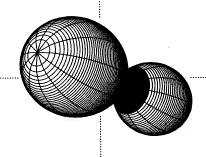
binaries are composed of two low-mass intermediate type stars in rapid
circular orbit around each other, with orbital periods between about 6
and 24 hours. Systems in true contact are joined at a neck, and a common
convective envelope surrounds both stars, ensuring nearly uniform brightness
over the common surface. As would then be expected, many contact binaries
show stable and symmetric light curves as the stars orbit. However a few
systems show very substantial changes in the shape of the light curve,
on timescales of weeks to years. One hypothesis is that these systems are
prone to extensive starspots. Contact
binaries are composed of two low-mass intermediate type stars in rapid
circular orbit around each other, with orbital periods between about 6
and 24 hours. Systems in true contact are joined at a neck, and a common
convective envelope surrounds both stars, ensuring nearly uniform brightness
over the common surface. As would then be expected, many contact binaries
show stable and symmetric light curves as the stars orbit. However a few
systems show very substantial changes in the shape of the light curve,
on timescales of weeks to years. One hypothesis is that these systems are
prone to extensive starspots.
BX And is such a system: orbital
period changes indicate mass transfer 4×10⁻⁸ solar masses
per year, and variable light curves can be explained by a hotspot located
symmetrically about the line of centres covering about 20% of the secondary,
perhaps a mass of gas floating on the secondary during the initial stages
of transfer. Variations in the period are probably due to changes in the
mass transfer rate, which also have an effect on the size and temperature
of the hotspot and hence on the shape of the light curve. Once into contact,
these systems continue to display enhanced magnetic activity in the form
of starspots and active chromospheres, as demonstrated by recent INT observations
of AG Vir and SS Ari.
| More
information
ING facilities involved:
-
Isaac Newton Telescope,
using IDS
Some references:
-
Bell, S.A. et al.,
1990, "A photometric and spectroscopic study of BX Andromedae", MNRAS,244,
328
-
Hilditch, R.W. et al,
1990, "Spots on contact binary stars", GEMINI Newsletter Royal Greenwich
Obs., 28, 16
|
|
|