BLACK HOLE CANDIDATES AT GALACTIC
CENTRES
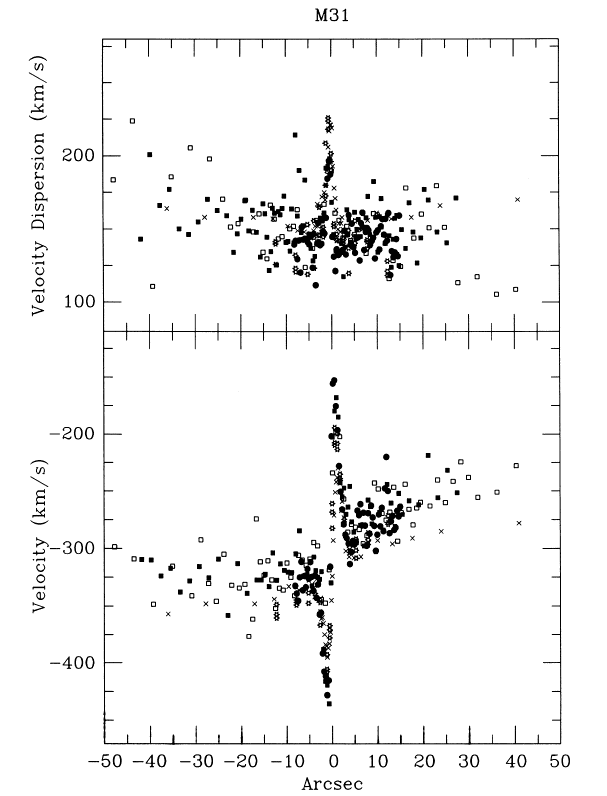 Observations
with the WHT and the ISIS spectrograph have greatly improved our knowledge
of the rotation properties of a number of nearby galaxies. Two of the galaxies
observed, the Andromeda nebula M31, and its compact elliptical companion
M32, have been proposed as black hole candidates on the basis of their
rapid central rotation. In excellent seeing conditions rotation velocities
in the centres were measured with unprecedented spatial resolution. Despite
the excellent seeing the central velocity in M31 is still unresolved, strengthening
the case for a central black hole of at least 107 and probably
108 solar masses in this galaxy. In M32 the rotation gradient
is much less steep, but the case for a central black hole of around 8x10⁶
solar masses is still strong. Observations
with the WHT and the ISIS spectrograph have greatly improved our knowledge
of the rotation properties of a number of nearby galaxies. Two of the galaxies
observed, the Andromeda nebula M31, and its compact elliptical companion
M32, have been proposed as black hole candidates on the basis of their
rapid central rotation. In excellent seeing conditions rotation velocities
in the centres were measured with unprecedented spatial resolution. Despite
the excellent seeing the central velocity in M31 is still unresolved, strengthening
the case for a central black hole of at least 107 and probably
108 solar masses in this galaxy. In M32 the rotation gradient
is much less steep, but the case for a central black hole of around 8x10⁶
solar masses is still strong.
Based on the success of these
observations, researchers have searched for similarly rotating cores in
other galaxies. Two very strong candidates have emerged, NGC3115, a lenticular,
and NGC5813, an elliptical. In the later case the rotation gradient is
also unresolved, and this is a particularly strong candidate for a black
hole. NGC205 is a different kind of galaxy, a dwarf spheroidal companion
on M31. It is elongated with an axial ratio of two to one. Observations
with the intermediate dispersion spectrograph on the INT have shown that
this galaxy does not rotate at all. It must be flattened by an anisotropic
velocity dispersion, which is suprising for such a small galaxy.
|
| More
information
ING facilities involved:
-
William Herschel Telescope,
using ISIS
-
Isaac Newton Telescope,
using IDS
Some references:
-
Carter D. et al., 1993,
"High-resolution kinematic observations of rapidly rotating spheroidal
components of galaxies", MNRAS, 263, 1049.
-
Carter, D. et al, 1990,
"Kinematics of the Dwarf Spheroidal Galaxy NGC205", MNRAS,245,
12
|
|
|