| |||
|

| Home > Public Information > Scientific Highlights > 1986-87 |
THE FIRST IMAGES FROM OPTICAL APERTURE SYNTHESIS
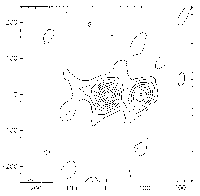
The revival of interest in optical Michelson interferometry stems from the remarkable success it has had in radio astronomy. Aperture synthesis has been providing diffraction-limited images of ever increasing resolution over the past 30 years, but only because the radio interferometer phases are relatively undisturbed by atmospheric fluctuations. In VLBI, however, where the telescopes are separated by as much as 10,000 km, large and varying phase uncertainties do become important. The solution adopted by radio astronomers has been not to consider the corrupted interferometer phases themselves rather their sums round closed loops of baselines - the so-called closure phases. Such sums of phases are completely independent of the atmospheric contributions above each telescope; they neither represent the whole of the phase information nor do they present it in a convenient form, but fortunately they almost always uniquely constrain the images that fit the visibility amplitudes. Radio images, with dynamic ranges of several hundred to one, of complex jets in galactic nuclei have been made with arrays of fewer than 10 antennae. The high quality of these images encourages one to believe that the closure phase technique may be equally succesful for optical imaging. The attainment of diffraction-limited images with large ground-based optical telescopes is an important objective for many astronomical programmes. The limited resolution set by atmospheric fluctuations in refractive index can be overcome by applying aperture symthesis and phase-closure techniques to short-exposure images taken through non-redundant aperture masks. Most previous attempts to obtain high-resolution astronomical images from the ground used short-exposure 'speckle' images obtained by using the whole telescope aperture. Some of these methods enable the amplitudes, but not the pases, of the spatial coherence function to be measured and hence does not in general permit unambiguous image reconstruction. Later developments have enabled some phase information to be retrieved and true images have been made in a few cases. The alternative approach is to mask the telescope mirror with an array of apertures each no larger than the scale size r0 of the atmospheric fluctuations. Short-exposure images can then be analysed to give both amplitudes and phases. The discovery team had already demostrated that closure phases can be obtained at high light levels. They have made systematic observations to measure the spatial-coherence function with this technique at low photon rates and have derived high-resolution images from the data. First observing run on the Isaac Newton Telescope, in November 1985, used the Image Photon Counting System (IPCS) together with the empty TAURUS box as a bench for the optical components. A 136-mm focal length lens behind the f/15 Cassegrain focus re-imaged the pupil at a diameter of 9.0 mm. The aperture mask consisted of four holes whose separations gave six uniformly space non-redundant baselines in one dimension: the hole diameter corresponded to 5.6 cm at the pupil and the unit baseline separation to 16 cm. After passing through the aperture mask the collimated beam was refocused onto the IPCS at an image scale of 1.24 arcsec/mm, giving 3.8 pixels per fringe for the finest fringes. An area of 512 pixels × 128 pixels was scanned every 16 ms and the coordinates of each photon recorded on magnetic tape. A 12-nm (FWHM) interference filter centred on 512 nm defined the bandwidth and no atmospheric dispersion corrector was used. Stellar profiles, observed with the whole of the telescope pupil, had widths of 1.2 arcsec, which corresponds to a value of r0 of approximately 9 cm. Two of the stars observed were Lambda Peg, a 3.95-m single star and Phi And, a binary system with a separation of 0.45 arcsec and magnitude difference of 1.2 m. Lambda is unresolved at a 1-m baseline, providing a good calibration source, whereas the wide double is well resolved at the maximum baseline. Subsequent observing runs have taken advantage of the new RGO/RSRE imaging box. This contains two easily accessible optical benches for the reimaging and magnifying optics. Two more bunary stars were observed in July 1987. A linear 4-hole mask, similar to the one employed in the first experiments, was used in an almost identical instrumental configuration. Again both images are diffraction-limited and have good dynamic ranges. One of the major successes of the run is the image of Delta Equ. This is the first reconstruction from data obtained with a 2 m maximum baseline and has a resolution of 50 milliarcseconds. The images produced show that
good results can be obtained even at low photon rates. For the simplest
image-plane interferometer, such as the one described here, a limiting
magnitude as faint as +11 is expected to be achievable if larger apertures
and wider bandwidths are used. By working at longer wavelengths, where
both the seeing scale size and the atmospheric coherence time increase
favourably, and by correcting for image motions in the focal plane, high-quality
images should be obtained at much fainter limiting magnitudes .
|
||
|
||