| |||
|

| Home > Public Information > Scientific Highlights > 1986-87 |
THE EXTREMELY LOW METAL CONTENT OF GR 8
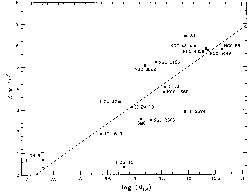
It remains possible, however, that searches for low abundance galaxies have not been optimized for finding extremely low abundance regions. Recent searches focus on selecting the highest excitation (generally most metal poor) regions from surveys capable of detecting intense bursts of star formation. The chosen samples of objects failed to produce candidates with oxygen abundance less than 0.05 of solar. In retrospect, it may be that the previous programs have been conducted backwards, i.e. it makes more sense to look for star formation regions in galaxies suspected of low abundance rather than vice versa. This above statement may appear fatuous by reason of the fact that one does not know, a priori, where to look for low abundance regions. However, as early as 1968, van der Bergh suggested that the average metal content was a function of total galaxian mass. Lequeux and collaborators were the first to show a good correlation between galaxian mass and oxygen abundance for Dwarf Irregular galaxies. Most subsequent studies show a good relation between the total galaxy mass and observed oxygen abundance for irregular galaxies. Wh this relationship has been challenged by some, a good test is to measure the oxygen abundance in extremely low mass gas rich galaxies. Thus a spectrophotometric study of the HII regions in GR 8 was undertaken. GR 8 was discovered in search for dwarf galaxies in the Virgo cluster. The best estimate of its distance gives 1.0 Mpc, making GR 8 a Local Group member. Using a distance of 1.1 Mpc, an absolute magnitude of -10.7 is derived, establishing GR 8 as one of the faintest known gas rich irregulars. The first series of observations were obtained in February 1984 with the SIT vidicon attached to the RC-spectrograph of the CTIO 4-m telescope. GR 8 was observed for a total of 5,400 seconds. Unfortunately in these spectra the measurement of the critical [OIII] 4363 Å line was uncertain, due to confusion with the strong Hg I 4368 Å night sky line. However, the temperature sensitive [OIII] [OIII] 4363 Å line was clearly detected in spectra taken with the IPCS in the IDS spectrograph of the Isaac Newton Telescope. The abundance analysis gives an electron temperature of 18,500 K and a relative oxygen content of 0.024 of solar. This is, within the errors, equal to the oxygen abundance in I Zw 18, the lowest abundance HII region known. Confidence in the abundance-mass
relationship for irregular galaxies may speed up the process in determining
the primordial helium abundance and lead to a better understanding of the
evolution of dwarf irregular galaxies.
|
||
|
||