| |||
|

| Home > Public Information > Scientific Highlights > 1984-85 |
FROM HERE TO QUASARS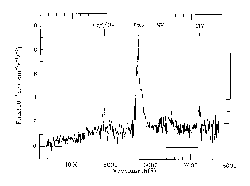 Quasi-stellar
objects, or quasars, are the most luminous sources in the universe. Most
astronomers now share the view that quasars are the nuclei of distant galaxies
where energetic processes, such as accretion of gas by a massive black
hole, produce more light than the total amount emitted by all the stars
in the galaxy (a typical galaxy contains about one hundred billion stars
as luminous as our Sun). Because of the still mysterious nature of their
central 'power-houses', quasars are objects of great interest at present.
However, in recent years astronomers have devoted large efforts to the
study of quasar spectra for an entirely different reason. Quasi-stellar
objects, or quasars, are the most luminous sources in the universe. Most
astronomers now share the view that quasars are the nuclei of distant galaxies
where energetic processes, such as accretion of gas by a massive black
hole, produce more light than the total amount emitted by all the stars
in the galaxy (a typical galaxy contains about one hundred billion stars
as luminous as our Sun). Because of the still mysterious nature of their
central 'power-houses', quasars are objects of great interest at present.
However, in recent years astronomers have devoted large efforts to the
study of quasar spectra for an entirely different reason.
Being so luminous, quasars can be observed over much larger distances in the universe than any other class of object. We now know that the universe we live in is expanding in a manner analogous to a balloon being inflated - the further two points are on the surface of the balloon, or two galaxies in the universe, the faster the distance between them increases with the expansion, and therefore the faster they recede from one another. Proof of the extremely high velocities of recession of quasars is readily provided by the very high red-shifts of their spectra. As an example of this, Fig. 1 shows the optical spectrum of a quasar identified by Boksenberg and Sargent with the Isaac Newton Telescope (the object was recognized as a quasar candidate by C. Hazard and R. McMahon.) The most obvious feature in the spectrum is the broad emission line of neutral hydrogen labelled Lyman-alpha. The rest wavelength of this line - that is the wavelength at which it would be recorded in objects at rest relative to an observer on Earth - is 1216 Å, in the far ultraviolet. In this quasar, the same spectral line is instead observed at 5691 Å implying that, since the time when the quasar light was emitted, the universe has increased in linear size in the same proportion as the wavelength of the Ly-alpha photon, that is by a factor (5691/1216) = 4.68 = (1 + z). At a redshift z=3.68, this quasar is one of the most distant objects in the universe known to date.
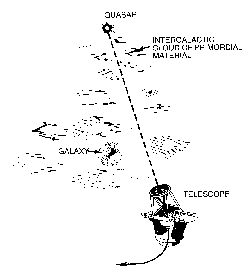
Over the last five years there have been several major steps forward in our understanding of quasar absorption spectra, made possible in large part by the availability of a new type of detector - the Image Photon Counting System (IPCS), developed jointly by University College London and RGO. The IPCS is particularly efficient at detecting faint light signals with the maximum possible accuracy; this is especially important for QSO absorption line work, since both high-spectral resolution and photometric accuracy are necessary to register the weak and narrow absorption lines seen in the spectra of generally faint quasars. It now appears that there are at least two kinds of absorption lines, formed in physically distinct intervening regions. In a typical quasar spectrum most of the lines at wavelengths longer than the emission Ly-alpha line can be readily grouped in well-defined absorption systems, with all the lines within a system appearing at the same redshift, generally lower than that of the quasar itself. These lines can be convincingly identified with those of the most abundant elements - such as H, C, N, O and heavier species, up to and including Fe and Zn - in the stages of ionization prevalent in the interstellar medium of our Galaxy. Furthermore, the metal-line systems are clustered in redshift in a manner consistent with the present-day clustering of nearby galaxies. Thus, it appears that they are most likely formed in intervening haloes of galaxies randomly distributed in line of sight to the quasars. This in turn implies that galaxies possess tenuous gaseous haloes extending far beyond their optical dimensions, a conclusion supported by recent ultraviolet observations of the halo of our own Galaxy. Another important result deduced from studies of the quasar metal-line systems is that in a few cases where it has been measured with the required accuracy, the chemical composition of the interstellar gas in these distant galaxies has been found to be similar to that of the interstellar medium near our own Sun. This indicates that even when the universe was only 1/10 of its present age, at least some galaxies had already undergone a significant amount of metal enrichment via stellar nucleosynthesis. The second class of quasar absorption
lines is found only at wavelengths shorter than the emission Ly-alpha and
consists of single Ly-alpha absorption lines, with no obvious associated
heavy-element lines. These Ly-alpha lines are far more numerous, by a factor
of about 50, than the metal-line systems. Furthermore, they are not
clustered like galaxies, leading to the suggestion that they represent
an intergalactic population of primordial clouds. Much effort is currently
being directed towards determining stringent upper limits to the metallicity
of the Ly-alpha clouds. If this is indeed pristine gas, which has not condensed
to form stars, it should still bear the imprint of the original composition
determined by nucleosynthesis in the early universe and can thus
serve as a powerful test of the predictions of the hot Big-Bang model.
One result which has now been established beyond doubt is that the comoving
density of the Ly-alpha clouds exhibits a marked cosmological evolution,
in the sense that the clouds became progressively less abundant as the
universe expanded. This result has important implications for a problem
of much current interest: how structure, in the form of galaxies, clusters
and superclusters, formed and evolved from an initially smooth universe.
|