 In
1982, an international research team, with leading members from the RGO,
weighed the centre of a quasar, and the discovery strengthened the theory
that the immense and concentrated power of a quasar is due to gas swirling
around a very massive black hole in the centre of the host galaxy, NGC
4151.
In
1982, an international research team, with leading members from the RGO,
weighed the centre of a quasar, and the discovery strengthened the theory
that the immense and concentrated power of a quasar is due to gas swirling
around a very massive black hole in the centre of the host galaxy, NGC
4151.
The team have been studying the
galaxy since 1978. To qeigh its centre, they investigated gas clouds very
close to the galaxy's core. They found that the clouds are moving at speeds
up to 14,000 km/sec. In a crucial new step, they also ascertained the distances
of the clouds from the core by finding the time it took for a brightening
of the core to 'light up' the clouds.
It truns out that the slower-moving
gas clouds lie farther from the core -just as the slowest planets in the
Solar System are those that are farthest from the Sun. This means that
there is some very massive object at the centre of the galaxy NGC 4151
(analogous to the Sun at the centre of the Solar System). The speeds and
distances of the gas clouds show that this object is 1,000 million times
heavier than the Sun - and the only kind of object which can be so massive,
yet sufficiently small, is a black hole.
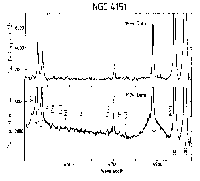
In May and June 1979, astronomers
were particularly lucky to pick up a major outburst in the galaxy which
was the studied by the IUE satellite. In 1984 another exciting result,
made possible by the fading of NGC 4151, followed the first spectra taken
with the resited Isaac Newton Telescope. These showed an enormous change
in NGC 4151 compared to spectra taken ten years previously when the INT
was at Herstmonceux. In 1974, the spectra showed clear signs of the rapid
motions in the centre of the galaxy mentioned above. In 1984 these had
all but disappeared and the spectral classification of the galaxy had changed
from Seyfert Type 1 (broad spectral lines, indicating rapid motions) to
Type 2 (strong narrow emission lines but no evidence of rapid motions).
This result the suggested that other Type 2 Seyfert galaxies might all
be presenting fossilized evidence of previous quasar-type activity in their
centres. In the Seyfert Type 2 galaxies, the emission lines were known
to come from volumes hundreds or thousands of light years in size, and
so of course cannot change rapidly even if the original activity in the
core completely stops. The fossil activity would continue for hundreds
or thousands of years.
| More
information
ING facilities involved:
-
Isaac Newton Telescope,
using IPCS on IDS.
Pictures:
Some references:
-
Penston,
M. V. and Pérez E., 1984, "An evolutionary link between Seyfert
I and II galaxies?", MNRAS, 211, 33
-
Penston M. V., 1985,
"Weighing the black hole", RGO Telescopes, Instruments, Research and
Services October 1 1980 — September 30 1985, 9
|