| |||
|

| Home > Public Information > Scientific Highlights > 1984-85 |
THE JETS OF SS433
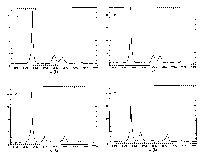
The interaction causing an emission-line spectrum may have any of many causes. Some of the stars in the SS catalogue are rotating so rapidly that centrifugal force at their equators counteracts their attractive gravitational force, so that the stars shed an equatorial disk of gas which shows as the emission-line region. Some, like SS433, are binary stars with matter flowing around and between the two stars. Since hydrogen is the most common element in the Universe, the stars in the SS catalogue typically show hydrogen emission lines, the strongest line of which is H-alpha at 6563 Å. Helium lines are also typical. SS433 languished as one star among many hundreds in the SS catalogue until its rediscovery in 1978. Spectra taken then show the Balmer series and spectral ines from neutral helium, both arising from the circumstellar material ripped from one star by its companion. There were also present in its spectrum other lines which were unidentified, particularly because they seemed. to come and go sporadically. It was only after several months of monitoring the spectrum of SS433 that the pattern became apparent. The unidentified lines appear in pairs, the most prominent of which shift cyclically in position about a wavelength which is somewhat to the red of the H-alpha line. The cycle has a period of 164 days, and the range over which each member of the pair shifts is more than 1000 Å. The lines are antiphased. With this clue to the interpretation of the two strongest of the unidentified lines, the other unidentified lines could then be paired off. They show similar behaviour, oscillating in antiphase about wavelengths which lie to the red of the other Balmer lines and the neutral helium lines. Thus the emission line spectrum of SS433 consists of three components — a stationary set of Balmer and helium emission lines arising from the interaction of a double star, and two antiphased oscillating sets of moving spectral features associated with the Balmer and helium emission, and arising from a new phenomenon. The interpretation of the moving features is in terms of a pair of equal and opposite jets of material shooting from SS433. Because of the speed of outflow of material, the spectral emissions of hydrogen and helium gases in each jet are Doppler-shifted from their rest wavelengths, one (the approaching jet) generally to the blue and the other (the receding jet) generally to the red. The jets precess like a spinning top in a conical motion with period of 164 days and so the features move in antiphased cycles of this period. Curiously, even at the moments when the jets are in the plane of the sky, with no component of speed towards or away from us, there is a shift. It has its origin in the phenomenon of relativistic time dilation. The fast-moving hydrogen atoms in the jets have 'clocks' — the natural time-scales of atomic phenomena — which are running slow with respect to ours and so emit H-alpha photons of lower frequency. The speed of the material in the jets is an astonishing one quarter the speed of light! Interest was focussed in SS433 because it was identified with an X-ray star centrally within a spherical radio supernova remnant called W50. This led to the suggestion that SS433 is the stellar remnant of the same supernova explosion which gave rise to W50. Perhaps SS433 contained a black hole produced in a supernova explosion on one of a pair of stars. In this model, the black hole accretes material expelled by its companion (this material gives rise to the stationary emission lines which earned SS433 its place in the SS catalogue). As it approaches the boundary (event horizon) of the black hole, in-falling material is accreted in a.disc around the black hole and compressed by its gravitational field. Accretion yields the X-rays which are the reason why SS433 is an X-ray star. The accretion is over the rate which would generate the Eddington luminosity of the black hole, and pressure of the radiation generated by heating of the in-falling material drives the relativistic jets, which are collimated by the holes in the accretion disk. Not only is SS433 an X-ray star, it is also a radio star indeed. Techniques of very Long Baseline Interferometry have resolved the radio image of SS433 into a blobby, elongated structure in which the blobs move out in a cone, with transverse speeds of 0.0088 arc sec day-1 — matching the 0.26c (light speed) jet speed at the 5 kiloparsec distance of the star.
The picture behind this sequence
is that the jets of SS433 are somewhat like tracer bullets in the sweep
of a machine gun. Once fired, the bullet flies in its trajectory, decoupled
from the subsequent behaviour of the gun, which is revealed by later bullets.
Between nights B and C therefore, on this interpretation, the machine gun
had shifted to a different position, and a bullet was fired, with an orientation
in the sky defined, through the projected radial velocity, by the wavelengths
of the main emission lines on night C. The bullet is predicted to appear
in the VLBI observations at that orientation after the appropriate time
delay, and to coast outwards from the central radio image. The prediction
is currently being put to the test by analysis of the huge volume of VLBI
data.
|