TIDAL STREAMS IN THE GALACTIC HALO
INT+WFC
A prediction
of standard cosmology is that dwarf protogalaxies
are the first to born as individual systems
in the universe. Afterward, many
of these merge to form larger galaxies such
as the Milky Way. The
way in which this process takes place
has consequences for the present-day structure
of the Milky Way. The significant issues are
how the merging efficiency compares with
the star formation efficiency in the protogalactic
fragments and how the fragment merging
and disruption compare with the age
of the Milky Way. If fragments are able
to form stars before merging, they will
collapse nondissipatively. If disruption
was not complete, Galactic precursors should
be visible today as dwarf galaxy satellites
or as stellar streams within the Galactic
halo.
The Sagittarius dwarf
galaxy, the closest Milky Way satellite
in an advanced state of tidal disruption,
provides a "living" test for tidal interaction
models and for galaxy formation theories. It was
soon apparent that its extent was larger than
at first assumed, and dynamical models
predict that the stream associated with the
galaxy should envelop the whole Milky Way in
an almost polar orbit.
Using the Wide Field
Camera on the Isaac Newton Telescope, astronomers detected a
very low density stellar system at 50 ±
10 kpc from the Galactic centre that could
be related to a merger process.
|
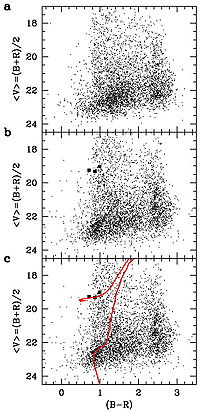
Color-magnitude diagrams
of the (panel a) control and (panels b and
c) target fields. Panel a
the distribution of the foreground
Milky Way stars. The overdense strip at (
provides B-R)  0.8, 22
  "V"
23.5 in panel b CMD is
interpreted as produced by a stellar system
at a distance of 51 ±
12 kpc from us, which could make it
part of the Sagittarius northern
stream or, alternatively, could be
the trace of a hitherto
unknown tidally disrupted dwarf galaxy. Squares
represent variable star candidates. Panel
c shows the CMD of the target field
with an old, low-metallicity (age:
12 Gyr; metallicity: 1/20 solar) isochrone from
the Padua library superposed. The isochrone MS
shape shows good agreement
with the hypothetical target field
MS. Also, the variable star candidates (squares)
fall in the predicted region
of the horizontal branch. [
JPEG | TIFF ]
"V"
23.5 in panel b CMD is
interpreted as produced by a stellar system
at a distance of 51 ±
12 kpc from us, which could make it
part of the Sagittarius northern
stream or, alternatively, could be
the trace of a hitherto
unknown tidally disrupted dwarf galaxy. Squares
represent variable star candidates. Panel
c shows the CMD of the target field
with an old, low-metallicity (age:
12 Gyr; metallicity: 1/20 solar) isochrone from
the Padua library superposed. The isochrone MS
shape shows good agreement
with the hypothetical target field
MS. Also, the variable star candidates (squares)
fall in the predicted region
of the horizontal branch. [
JPEG | TIFF ]
|
The found system is 60°
north and 46±12 kpc away from the centre
of the Sagittarius dwarf galaxy. If it
is really associated with this galaxy, it would
confirm predictions of dynamical interaction models indicating
that tidal debris from Sagittarius
could extend along a stream completely enveloping the
Milky Way in a polar orbit. However, the possibility that
it corresponds to a hitherto unknown
galaxy, also probably tidally stripped, cannot
be rejected.
Some references:
- "Galactic Cannibalism",
IAC Press Release, 9 March 2001.
- CCI Annual Report 2001, 16.
- D.
Martínez, A Aparicio, M. Angeles Gómez-Flechoso, R.
Carrera, 2001, "Tidal Streams in the Galactic Halo: Evidence for the
Sagittarius Northern Stream or Traces of a New Nearby Dwarf Galaxy",
ApJ Letters, 549, 199.
|