COMPLETELY DARK GALAXIES
INT+WFC
The universe could be harbouring numerous galaxies
that have no stars at all and are made entirely of dark matter. Astronomers
may ultimately discover that completely dark galaxies outnumber
the familiar kind populated by shining stars and gas, perhaps by
as many as 100 to 1. There is already a considerable amount of evidence
that bright galaxies contain large amounts of dark matter, often
ten times more than the mass of all their stars put together. There
must be extra mass that we do not see to account for the observed
movements of the stars under the influence of the gravity of the whole
galaxy. In some galaxies we see so few stars they are incapable of
holding themselves together as a galaxy. They would have long since
scattered through space without the gravity of unseen matter to keep
them together. But the question is: How do we look for these largely or
even completely dark galaxies?
It's a difficult challenge, and the best technique
will depend on the nature of the dark matter, which is still unknown.
If the dark matter is composed entirely of fundamental particles,
dark galaxies may act as gravitational lenses, distorting the appearance
of; distant galaxies that happen to lie behind them. If the dark
matter includes some brown dwarfs their infrared radiation may be
detectable. The same will be true if the galaxies contain any dead
stars, such as white dwarfs or black holes. If they are nearby, it might
be possible to detect these stellar remnants acting as gravitational
lenses on the light of individual stars in other galaxies beyond them.
Several lensing events in a small area of sky would suggest the presence
of a dark galaxy.
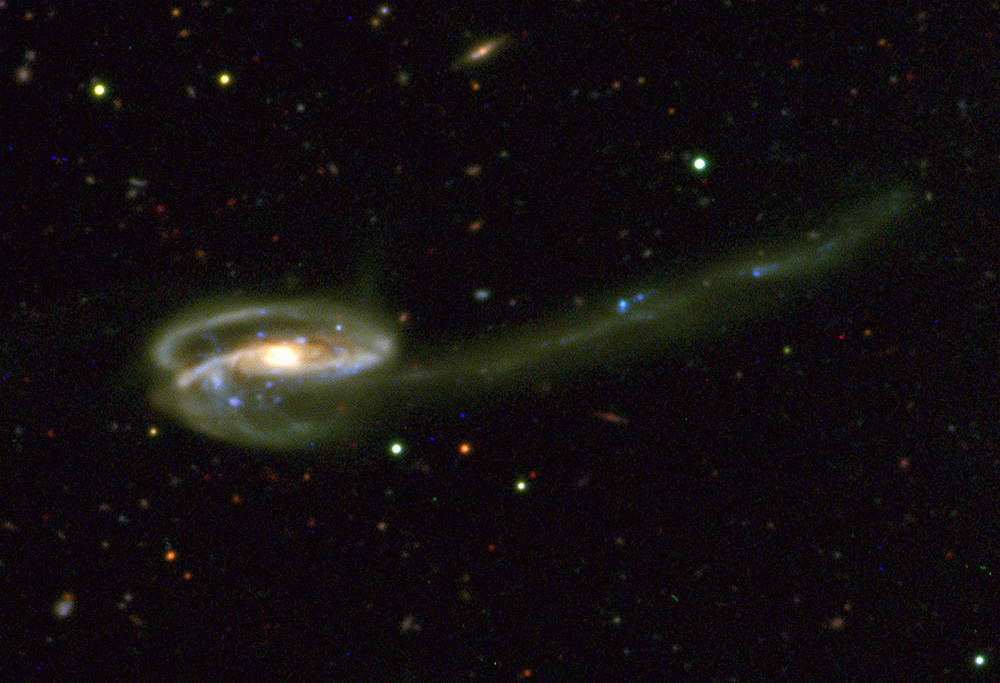
On place where a dark galaxy may exist has been identified
using images taken with the INT Wide Field Camera. A galaxy called
UGC 10214 has a stream of material flowing out of it, as if it is
interacting with another galaxy. But in this case, there is no other
galaxy or source of visible light present, hence the companion galaxy
may be completely dark.
|
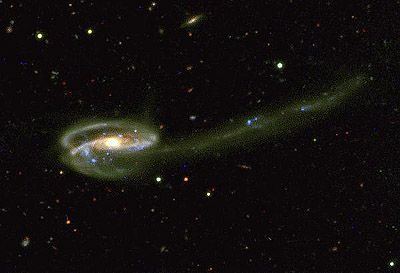
From observations carried out as
part of the ING Wide-Field Survey astronomers have been able to identify
one place where a dark galaxy may exist. They noticed that a galaxy
called UGC 10214, shown above, has a stream of material flowing out
of it, as if it is interacting with another galaxy. In this case, the
stream of material is apparently flowing towards nothing.
[ JPEG | TIFF ]
|
Some references:
|