A GIANT STREAM OF METAL-RICH
STARS IN THE HALO OF THE GALAXY M31
INT +WFC
Within the
framework of hierarchical structure formation, large spiral galaxies
like the Milky Way or Andromeda arose from the merger of many small
galaxies and protogalaxies. Later in their evolution, spiral galaxies
become the dominant component in such mergers, cannibalizing smaller
systems that fall within their sphere of influence. The complete destruction
of the victim is usually progressive, and may take several orbits.
However, the stellar debris from the destroyed dwarf galaxy follows
a similar orbital trajectory to the progenitor, which is likely to
have started life far away from the place of its final demise, and
so the tidally disrupted matter tends to be deposited over a broad range
in distance from the larger galaxy. Over time, with the accumulation
of many such mergers, large galaxies develop an extensive stellar and
dark-matter 'halo', the latter being by far the most massive component
of the galaxy. Meanwhile, part of the (dissipative) gas component of
the smaller galaxies feeds the growth of the disk of the larger galaxy.
This is seen in numerical simulations of galaxy formation, which result
in galactic haloes comprising clumps of dark matter. If this prediction
is correct, then haloes should possess significant substructure—in contrast
to previous suggestions, which predict the dark and luminous components
of haloes to be distributed smoothly.
Andromeda or M31 galaxy
is our Galaxy's "big sister", twice as large but otherwise very similar.
It is the nearest large galaxy, lying only 2.2 million light-years away.
Astronomers have known for some years that our own Galaxy is a cannibal.
Its outer parts are threaded with tell-tale streams of stars from small
galaxies it has engulfed.
The first sensitive panoramic
wide field imaging
survey of M31 using the Wide Field Camera on the Isaac Newton Telescope
has unambiguously revealed the presence of a giant stellar stream
within M31's halo. The source of the stream is likely to be either,
or both, of the peculiar dwarf galaxies M32 and NGC205, close companions
of M31, which may have lost a substantial amount of stars, gas and dust
due to their tidal interactions with the massive host galaxy. The broad
agreement of the metallicity distribution of the stream stars with
these two dwarf satellites together with their alignment, physical
proximity, and distorted morphological appearance, point to a common
origin. The well-known disparity in properties between the Milky
Way and M31 stellar haloes would be understandable if the majority
of M31's stellar halo arose as relatively recent tidal debris from prolonged
bouts of aggressive tidal interaction with its two nearest neighbour
satellites. Together with recent observations of tidal debris in
the Milky Way halo, these results clearly demonstrate that the epoch
of galaxy building still continues, and that substructure in the form
of huge, recently-deposited tidal streams, could be a generic feature
of large galaxy haloes.
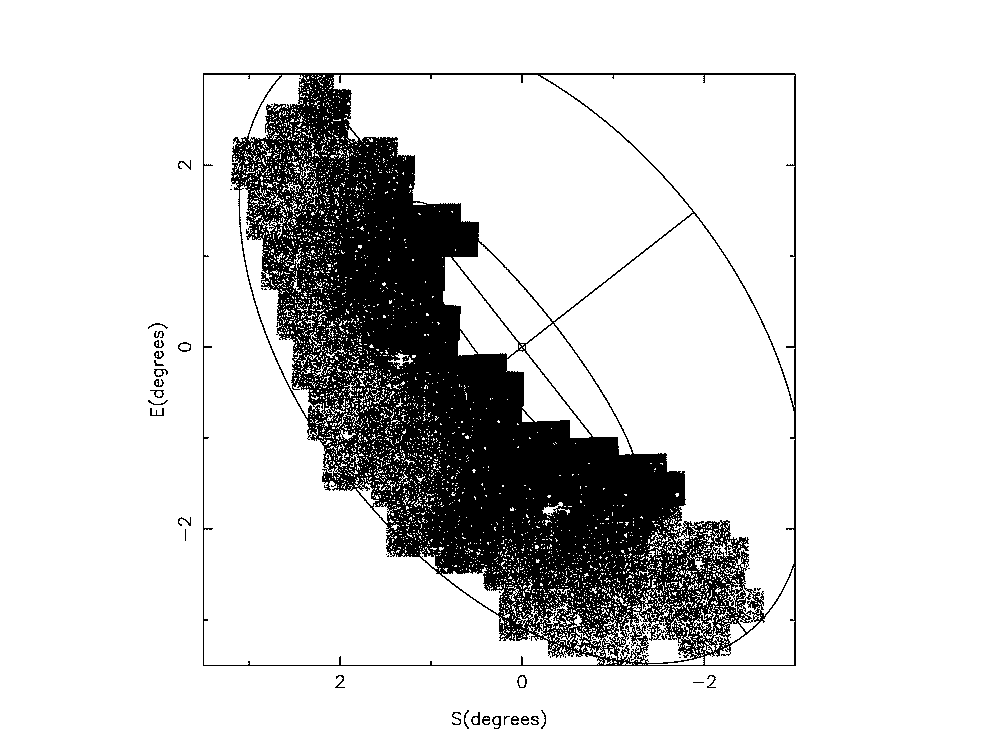
|
Surface density of RGB stars over the southeastern
halo of M31. The over-density of stars is seen as a stream extending
out of M31 close to, but distinct from, the minor axis. [ GIF | TIFF ]
|
The new survey was possible only because the digital
detector arrays such as the Wide Field Camera now cover fairly
large areas of sky. Even so, more than fifty long exposures had
to be pieced together to give a panorama of the halo on one side
of Andromeda.
Some references:
- CCI Annual Report 2001, 14.
- R.
Ibata, M. Irwin, G. Lewis, A. M. N. Ferguson and N. Tanvir,
2001, "A Giant Stream of Metal-Rich Stars in the Halo of the Galaxy
M31", Nature, 412, 49.
- M. Irwin et al., 2001, "The Andromeda
Stream: A Giant Trail of Tidal Stellar Debris in the Halo of M31",
ING Newsl., 5, 3.
- Irwin, M, Lewis,
G, Ibata, R, 2003, "Galactic Cannibals", Frontiers, No 17 Autum 2003.
- "Our Galaxy's "Sister" is a Cannibal",
AAO Press Release, 4 July 2001.
|