|
A NEW NEARBY DWARF GALAXY
INT+WFC
The Wide Angle Survey,
one of the ING Wide Field Survey programmes, brings together a
diverse range of scientific topics, merging the observational programme
to increase scientific effectiveness.
As part of the Virgo
survey component some 25 square degrees of Virgo were obtained in the
B photometric band, and the pipeline processed object catalogues were
analysed. More than 500 Low Surface Brightness galaxies Btot<21 were discovered
by comparing the light profiles of the millions of objects in the
data frames with those of previously known template LSB galaxies.
Using this data astronomers
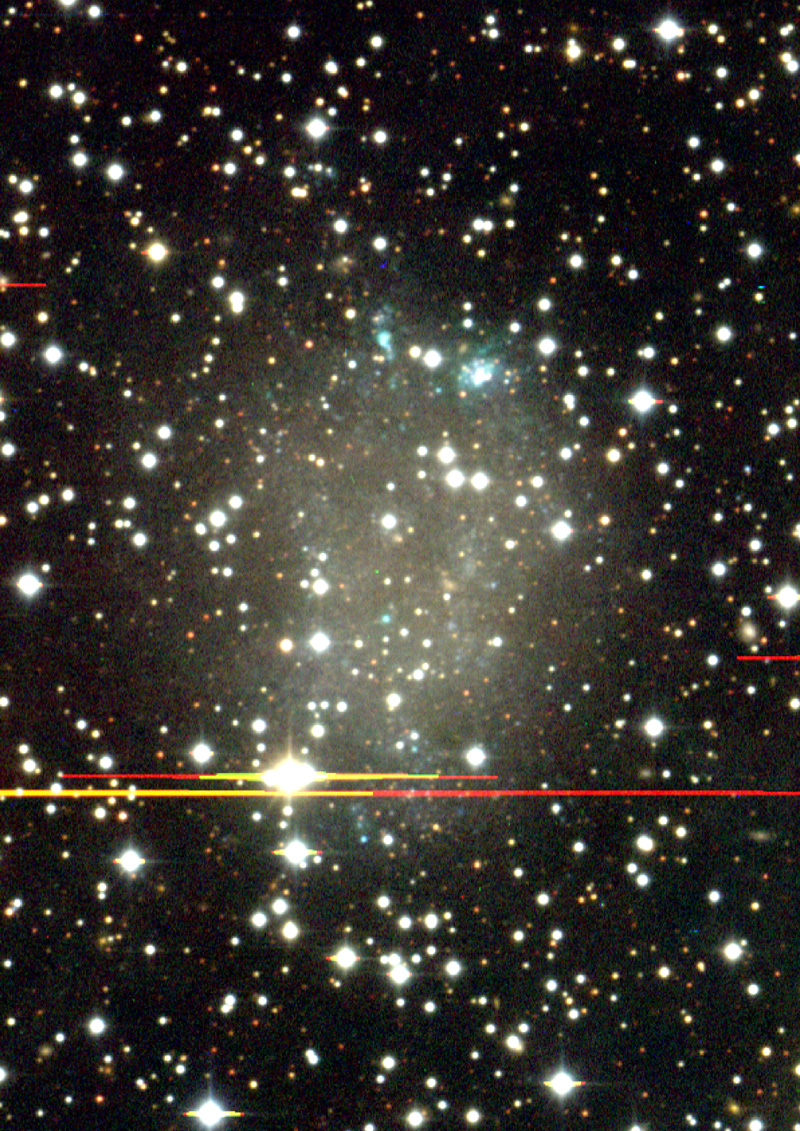
at Cambridge discovered a new nearby dwarf galaxy in the constellation of Cepheus. This LSB dwarf galaxy is a typical
example of previously unknown nearby galaxies, and it had been previously
overlooked because of its low surface brightness relative to the night
sky.
Most Local Group galaxies are satellites of the Milky
Way and Andromeda systems leaving only a few outliers to use as
probes of the dynamical evolution of the Local Group and for characterizing
the unperturbed evolution of nearby dwarf galaxies.
The luminosity
function in Virgo, when combined with the much flatter function found
in the field, will enable the efficiency of low mass galaxy formation
in differing environments to be investigated. First results are indicating
a strong environmental dependence, which would need to be taken
into consideration by Cold Dark Matter theories.
|
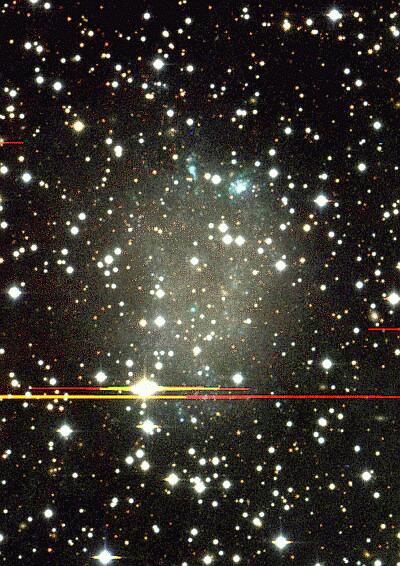
| Colour composite of Cepheus galaxy
created from 1200 second exposures in g', r' and i'-band images
taken in sub-arcsec conditions using the Wide Field Camera on the
INT [ JPEG
| TIFF ] |
Some references:
|