|
A
SEARCH FOR PLANETARY NEBULAE IN M33
INT+WFC
Extragalactic planetary
nebulae (PNe) are known in almost all galaxies of the Local Group. Most
of them were discovered in the last decade by means of continuum-subtracted
images in the bright nebular line of [O III]. M33, one of the two other
large spiral galaxies of the Local Group besides the Milky Way, was the
only major nearby galaxy which had not been searched for PNe yet. Astronomers
aimed to fill up this gap taking advantage of new observational capabilities
offered by the Wide Field Camera at the Isaac Newton Telescope. [O III],
H-alpha and continuum images allowed astronomers to detect 134 candidate
PNe in M33 and a large number of other emission line objects (mostly H
II regions).
|
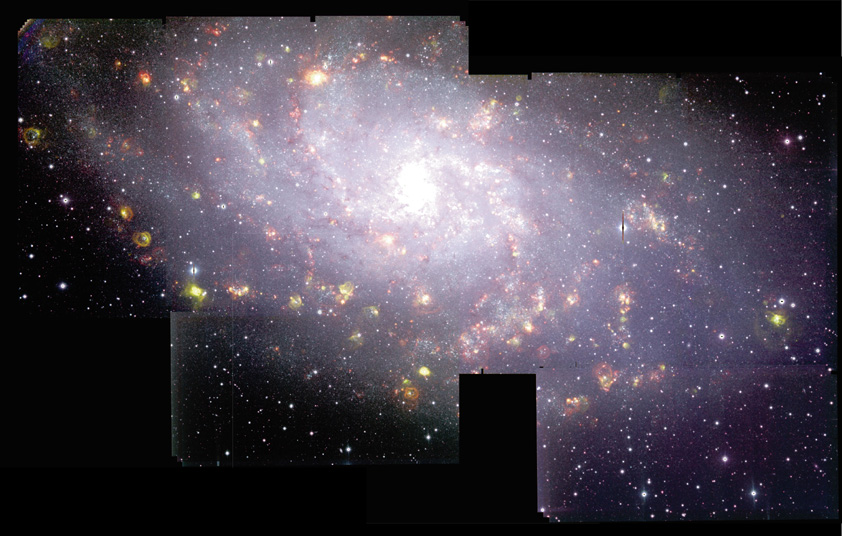
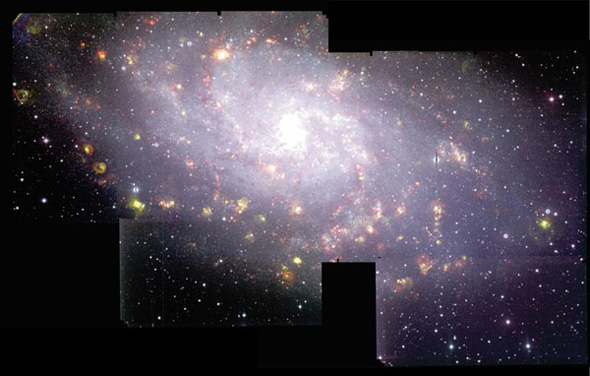
| This image is a composition of frames
taken in three narrow bands: the green colour represents the galaxian emission
in a filter centred on the [OIII] nebular line at 500.7nm, red is the H-alpha
hydrogen emission at 656.3nm, while blue is mainly stellar light taken
through a continuum filter centred at 555.0nm (Stromgren Y). In only one
observing night, and with two positionings of the telescope, it was possible
to cover the whole galaxy which has a size of approximately one degree
in the sky. [ JPEG | TIFF
] |
Some references:
-
R. Corradi, 2000, "Another
view of M33", ING Newsl, 2, 18.
-
L. Magrini, R. L. M.
Corradi, A. Mampaso, and M. Perinotto, 2000, "A search for planetary nebulae
in M33", A&A, 355, 713.
|