|
THE
COOLEST KNOWN HALO WHITE DWARF
JKT+CCD, WHT+ISIS
White dwarfs are the remnant
cores of stars that initially had masses of less than 8 solar masses. They
cool gradually over billion of years, and have been suggested to make up
much of the 'dark matter' in the halo of the Milky Way. But extremely cool
white dwarfs have proved difficult to detect, owing to both their faintness
and their anticipated similarity in colour to other classes of dwarf stars.
A white dwarf star, named
WD0346+246, was serendipitously discovered as a faint, very fast moving
star on a sequence of photographic plates. The high apparent velocity is
a characteristic of stars which are very old and are traveling on inclined
elliptical orbits around the Galaxy. Astronomers secured parallax measurements
on the Jacobus Kapteyn Telescope to determine the distance to WD0346+246
and confirm its low luminosity. They reported a distance of 28 parsecs.
They also estimated a surface temperature of around 3,500 Kelvin degrees.
Thus WD0346+246 has been shown to be one of the coolest and therefore oldest
white dwarfs ever found, and has to be a member of a hitherto unobserved
and possibly large population of faint stars in the Galactic halo.
|
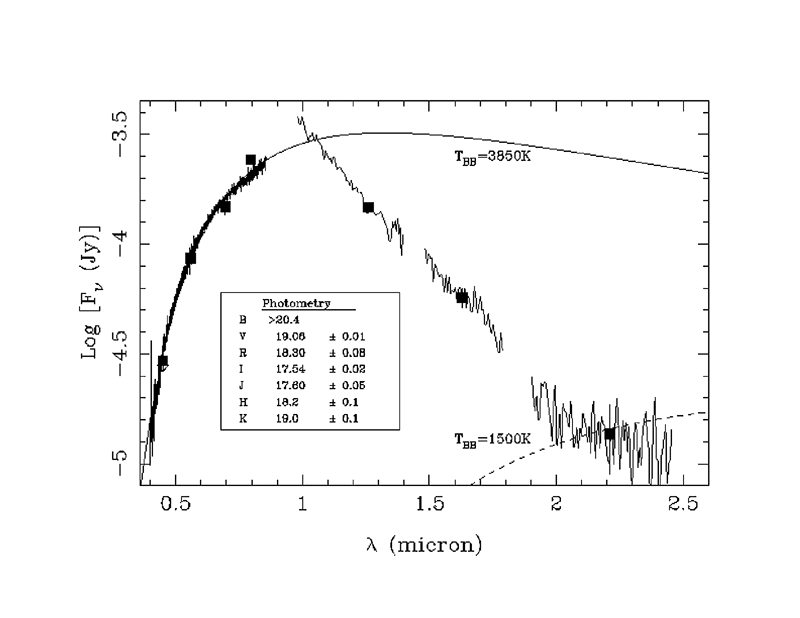
| The spectrum
of the halo white dwarf WD 0346+246 showing the dramatic effects of collision
induced absorption by molecular hydrogen in the infrared. Thus the object
appears red in the optical, but blue in the infrared. [ GIF
| TIFF ] |
This discovery has serious
implications for our understanding of the Milky Way. The coolest white
dwarfs provide a measurement of the age of the Galaxy. But they may also
play a more important role. For the last thirty years, astronomers have
found that most of our Galaxy seems to be invisible. In fact, as much as
90% of the mass in our Galaxy may be hidden in the form of 'dark matter'.
Dark matter theories fall into two broad classes. The first suggests that
the dark matter is not really dark - but is composed of many faint stars
such as cool white dwarfs and brown dwarfs. The second class of dark matter
candidates are various elementary particles, left over from the big bang.
Indirect evidence for the dark matter being comprised of cool white dwarfs
first came from the MACHO gravitational microlensing experiment. The MACHO
project monitored some ten million stars in the Magellanic Clouds in the
hope of detecting the occasional brightening caused by a dark halo object
moving across our line of sight to one of the stars. The MACHO results
suggest that these stars can be very numerous, and could contribute approximately
50% of the total mass of the Galaxy.
The discovery of one nearby,
very old and cool white dwarf does not solve the dark matter problem. But
it does lend weight to the MACHO scenario, and presents astronomers with
an astonishing conclusion: the Galaxy may be full of extremely old white
dwarf stars. The race is now on to count how many objects like WD0346+246
exist in the Galaxy and to measure how much they weigh in total.
Some references:
-
N. C. Hambly, S. J. Smartt, S.
T. Hodgkin, R. F. Jameson, S. N. Kemp, W. R. J. Rolleston
and I A Steele, 2000, "On the parallax of WD 0346+246: a halo white dwarf
candidate", MNRAS, 309, L33.
-
S. T. Hodgkin, B. R. Oppenheimer,
N. C. Hambly, R. F. Jameson, S. J. Smartt and I. A. Steele, 2000, "Infrared spectrum
of an extremely cool white-dwarf star", Nature, 403 , 57.
|