| |||
|

| Home > Public Information > Scientific Highlights > 1999 |
GAMMA RAY BURSTS:
NEW LIGHT ON THE UNDERSTANDING OF THESE OBJECTS
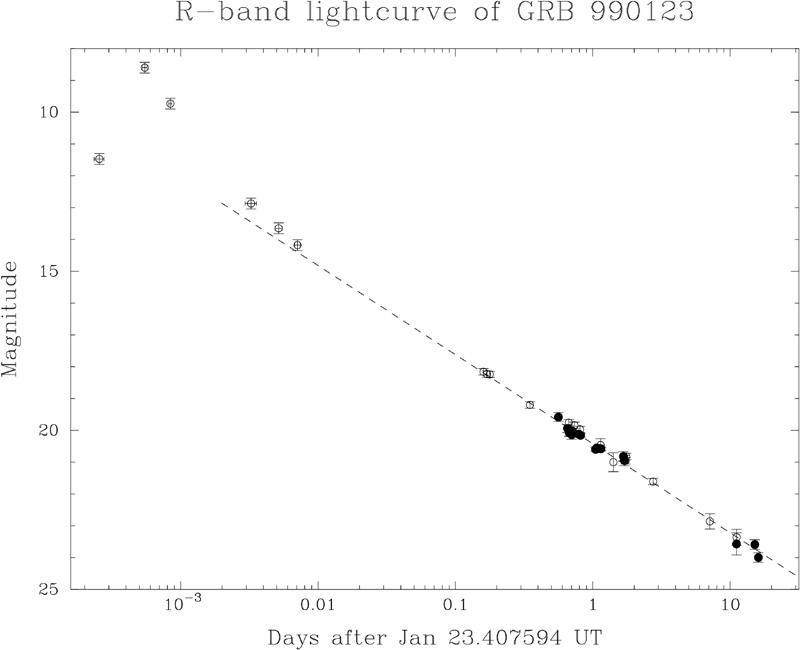
WHT, INT, JKT In 1999 the ING telescopes discovered and followed up more optical afterglows of gamma-ray bursts, like the extremely intense GRB 991208 (IAU Circ 7332). Moreover, the observations carried out by the ING telescopes have been used to shed new light on the understanding of these objects (see for instance: F J Castander, D Q Lamb, 19999, "A photometric investigation of the GRB 970228 afterglow and the associated nebulosity", ApJ, 523, 593; A J Castro-Tirado, J Gorosabel, 1999, "Optical observations of GRB afterglows: GRB 970508 and GRB 980326 revisited", A&A Suppl., 138, 449; N Masetti et al., 1999, "Broad-band spectral evolution of GRB afterglows", A&A Suppl., 138, 453; J Gorosabel et al., 1999, "Early detection of the optical counterpart to GRB 980329", A&A, 347, L31; F A Harrison et al., 1999, "Optical and radio observations of the afterglow from GRB 990510: Evidence for a jet", ApJ Letters, 523, 121). Below we extend on two interesting topics relates to GRB research: JKT+CCD Gamma-Ray Bursts (GRB) are believed to be the largest explosions in the universe since the Big Bang. However, the origin of these bursts have remained a mystery since their discovery more than 30 years ago. The bursts occur almost daily and shine at least a billion times brighter than any other phenomenon in the universe, including quasars. The bursts last anywhere from a few milliseconds to several minutes, then disappear forever. The bursts are followed by afterglows that are visible for a few hours or days at other wavelengths. GRBs are thought to arise when an extremely relativistic outflow of particles from a massive explosion interacts with material surrounding the site of the explosion. Multi-wavelength observations, following their light-curves, are needed to understand the nature of the explosions. The time scale of the decay since the gamma-ray explosion is detected is about 10 days: the brightness of the optical counterpart can decrease about fifteen magnitudes over this period. Therefore, a quick and accurate determination of the position of the optical counterpart and the follow-up photometry of the source is crucial, which requires a global observing campaign, involving many telescopes. On 23 January 1999 one of the brightest GRBs ever seen was detected by the BATSE satellite. For the first time, observations at optical, infrared, sub-millimetre and radio wavelengths were obtained of an entire gamma-ray burst. In this effort the JKT was involved, contributing to the photometric light-curve at multiple wavelengths. These observations revealed that the optical and gamma-ray light curves are not the same. This was also the first time that the three different regions involved in the emission process were seen: the internal shocks causing the GRB, the reverse shock causing the pronounced optical flash, and the forward shock causing the afterglow. If the blast radiated the same amount
of energy in all directions as it did towards Earth, its energy would be
equivalent to that of almost two neutron stars and irreconcilable with
current theories of gamma-ray bursts. However, the speed at which the radiation
faded over the following two days suggests that material was ejected from
the explosion in two cones, one of which pointed towards the Earth. This
would make it easier to explain gamma-ray bursts by conventional mechanisms
such as the shock waves formed following the death of a massive star.
References:
WHT+PFC, INT+WFC The discovery of both an X-ray and optical afterglow to GRB 970228 by the WHT and INT revolutionised the study of gamma-ray bursters. The mean temporal and spectral properties of this afterglow appeared to be consistent with the relativistic fireball model. However, now that more data has been gathered on several gamma-ray bursts, not all of them appear to fit the fireball model. One of them is GRB 970228. Studies of this gamma-ray burst, including observations from the WHT and INT, found evidence of extreme reddening of the afterglow with time, which is difficult to explain in the fireball model. Re-analysing the light-curves of the afterglow at different wavelengths suggested a link with a possible rare type of supernova explosions, which strengthens ideas that at least some type of gamma-ray bursts are produced following the collapse of a massive star. Some references:
|
| Top | Back |
|