| |||
|

| Home > Public Information > Scientific Highlights > 1999 |
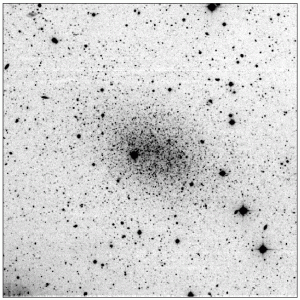
INT+WFC The observational universe is built mostly from galaxies. For obvious reasons, most of the known (detected and catalogued) galaxies are intrinsically the largest and brightest ones, those which can be seen from the greatest distance and are most easily studied. Dwarf galaxies, however, dominate numerically in any volume-limited sample, and were probably even more numerous in the cosmological past. Despite their unassuming appearance dwarf galaxies hold the key to many questions of galaxy formation, structure and evolution. They also provide important constraints on the distribution and nature of dark matter, and star formation in low density environments. The need for more data in all these matters, together with the relatively few known dwarf galaxies, make a search for more of them very worthwhile. However, almost by definition dwarf galaxies are difficult to detect and observe. Searches for dwarf galaxies have been carried out in nearby galaxy groups with good results. However, owing to their small intrinsic size, dwarfs in external groups are difficult to characterize morphologically, and it is only within and near the Local Group that the resolved stellar photometry necessary for construction of detailed star formation histories can be obtained. Thus it appears most promising to limit a search to the Local Group and its immediate environs. To this end a visual examination of all 894 fields covered by the ESO-SRC and SERC Equatorial surveys of the southern sky was performed. Objects resembling the Andromeda dwarf spheroidals and the Tucana dwarf, that is of very low surface brightness (VLSB), diffuse and large (1 to a few minutes of arc), were noted. Some of the more northerly candidates were followed up using the Wide Field Camera (WFC) on the Isaac Newton Telescope. Candidates were initially examined
by taking short exposures in the R band. With good seeing this enables
stellar objects to R~23 to be detected. At this depth objects close to
or within the Local Group should begin to resolve into stars, with the
tip of the giant branch becoming readily visible. If a candidate appeared
to resolve into stellar components, further broadband observations in V
and I together with narrow-band H-alpha were obtained. The initial exposure
of an uncataloged object in the constellation Cetus, at RA = 00h26m11.0s,
DEC=-11º02´40"e; (J2000), showed a diffuse swarm of faint stars.
Further exposures were taken in order to characterise the new object.
The Cetus dwarf has a smooth, diffuse appearance and appears to be a dwarf spheroidal of type dE3.5. A color-magnitude diagram in V, V-I shows a clear giant branch but no sign of recent star formation. From the position of the tip of the giant branch, a reddening-corrected distance modulus of 24.45 ± 0.15 and a metallicity of -1.9 ± 0.2 is derived. With an implied heliocentric distance of 775 ± 50 kpc, and a corresponding Local Group barycentric distance of 615 kpc, the Cetus dwarf lies well within the boundaries of the Local Group. Although the Cetus dwarf is unlikely to be directly associated with any other Local Group galaxy, it does lie in the general direction of the extension of the Local Group toward the Sculptor Group. Some references:
|
| Top | Back |
|