PALOMAR 1:
A YOUNG GALACTIC HALO GLOBULAR CLUSTER
INT+PFC, IDS
Globular clusters are well known
as the oldest conglomerations of stars in the Milky Way. Once thought all
to have formed at roughly the same time, a small number of these clusters
were recently found to have ages at least 3 Gyr younger that their siblings.
According to deep V and I CCD
images of the loosely populated galactic globular cluster Palomar 1 and
the surrounding field obtained with the Isaac Newton Telescope, an estimated
age at 6.3 to 8 Gyr was derived. That makes Palomar 1 just over half as
old as typical globulars and the youngest Galactic globular cluster identified
so far. Also surprising are its comparatively low luminosity and uncrowded
population of stars — unusual traits for a globular.
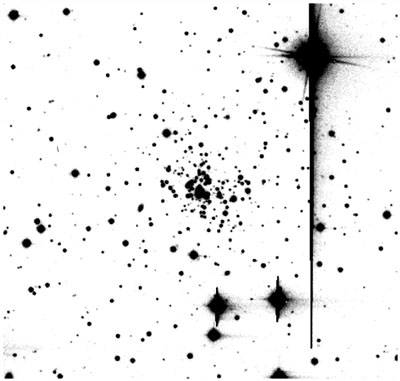 |
| Central 4.3' × 4.3'
image of Palomar 1, taken with the I filter and an exposure time of 600
s. [
TIFF ] |
The astronomers discuss the possibility
that Palomar 1 is in fact a very old open cluster. But that would be an
even worse fit for its properties. Furthermore, Palomar 1's location in
the outer halo, about 55,000 light-years from the Galaxy's centre, would
be difficult to reconcile with an open-cluster classification. An alternate
explanation, which may also account for the other young globular clusters,
could be a different formation process. Most globulars are thought to have
coalesced at the same time as the Galaxy itself. The younger ones, on the
other hand, may have come in three other ways: as gas clouds that survived
in the halo after the Milky Way's formation, later to form stars; as captured
intergalactic star groups; or as cannibalised dwarf galaxies.
References:
-
A Rosenberg et al, 1998, "Palomar
1: Another Young Galactic Halo Globular Cluster?", Astron J, 115,
648.
-
A Rosenberg et al, 1998, "The Metallicity
of Palomar 1", Astron J, 115, 658.