| |||
|

| Home > Public Information > Scientific Highlights > 1998 |
THE BRIGHTEST
OBJECT EVER OBSERVED
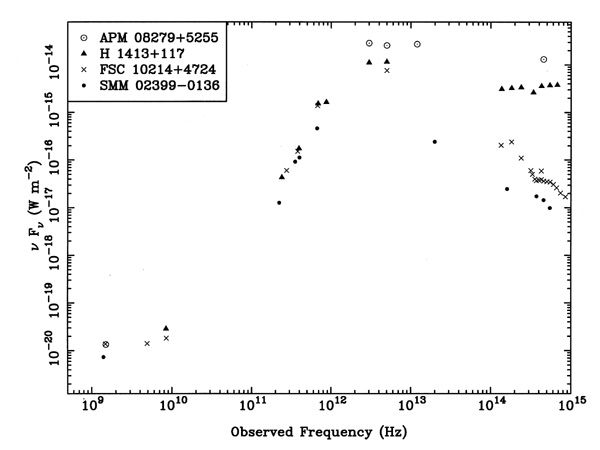
INT+IDS, JKT+JAG CCD APM 08279+5255 is an extremely bright quasar four to five million, billion times brighter than the Sun and about 100 times brighter than the next brightest object that has been observed. The light from the quasar has been travelling to us for roughly 11 billion years, nearly 90% of the age of the universe and set out on its long journey when the universe was only about 10% of its present age. The only way such a huge amount of energy could be generated is from accretion of dust and gas particles onto a super massive black hole, located at the centre of the quasar. The object's apparent brightness actually comes from two different regions around the black hole. Light in the ultraviolet and optical range comes directly from an accretion disk surrounding the super massive black hole. Gas and dust and even entire stars are attracted by the black hole's gravitation and generate energy, including light, from friction as they are torn apart and fall toward the black hole. The second source of brightness, in the infrared portion of the spectrum, comes from dust further away from the central engine, which is heated by radiation from the centre of the quasar and which re-radiates this radiation at much longer wavelengths in the infrared. Quasars are generally the most
energetic objects observed in the universe. Each quasar generates more
energy than the rest of a galaxy's stars combined. Yet a quasar, its accretion
disk and the glowing dust surrounding it occupy a relatively small amount
of space, not much larger than the size of the Solar System.
Most quasars are not bright enough to reveal this strong infrared signature. However a few, much closer, ultra-luminous galaxies have similar properties. By comparing the newly discovered object with these fainter nearby well studied examples, it is possible to weigh the amount of dust in the object and find a staggering value of almost a billion solar masses. This is more than the entire dust mass in the Milky Way, yet has been created and accreted in a small fraction of the time and is contained in a volume the size of the Solar System. Since this quasar is such a powerful beacon of light and has travelled 11 billion light years, it can also be used to investigate intervening objects that leave an imprint on the light from the quasar. By studying these imprints we can learn what conditions in the early universe were like and measure how primordial gas was converted into the stars and galaxies that we see around us today. It is possible that some of these intervening absorbing systems may have acted as giant gravitational lenses and magnified the light from the quasar. Gravitational lenses are often seen to be the cause of apparently extremely bright objects. Typically, such a lens might exaggerate the real light level by a factor of 30 or 40, which however in this case, would still make APM 0827+5255 an order of magnitude brighter than its nearest competitor. References:
|
| Top | Back |
|