| |||
|

| Home > Public Information > Scientific Highlights > 1998 |
THE UNIVERSE
WILL EXPAND FOREVER
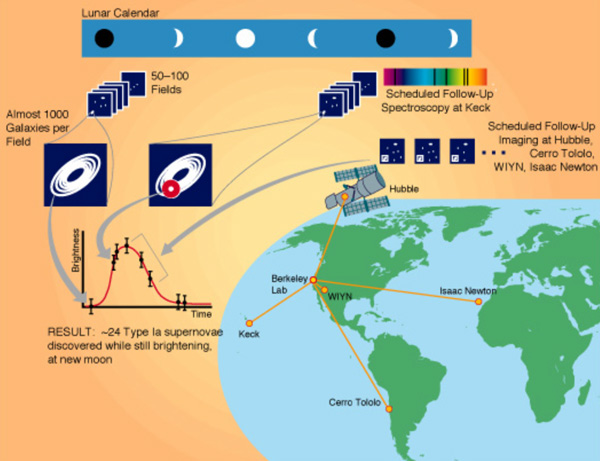
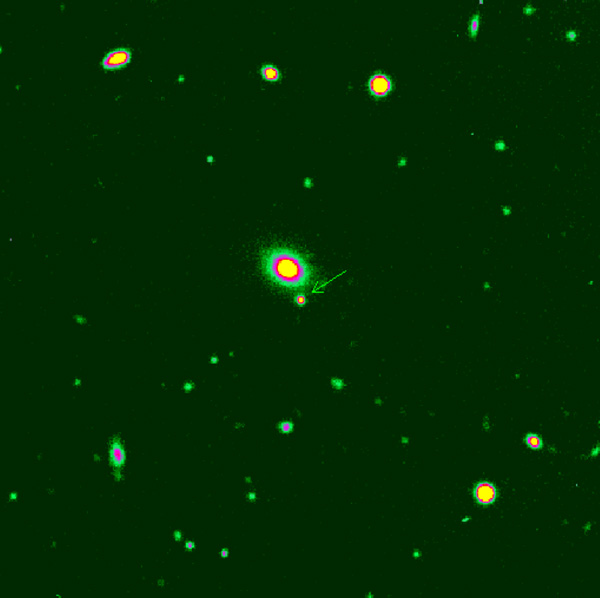
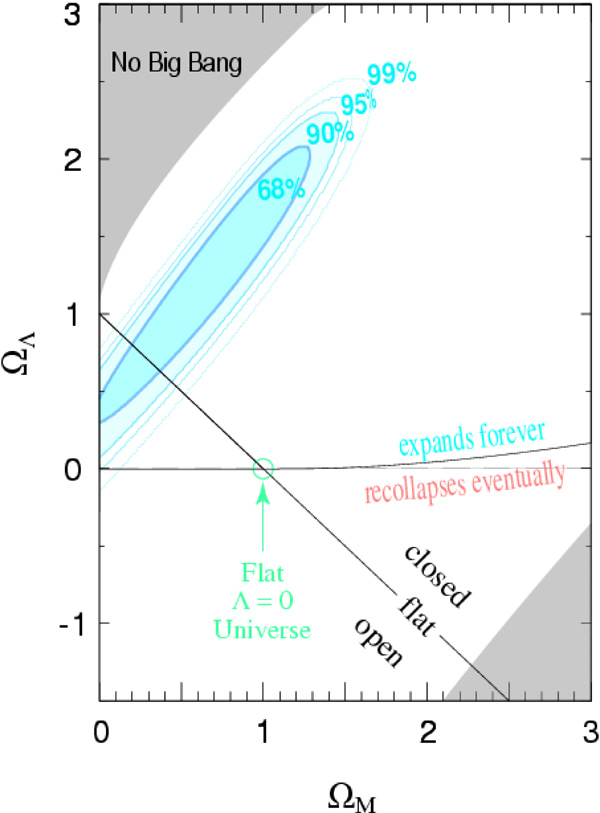
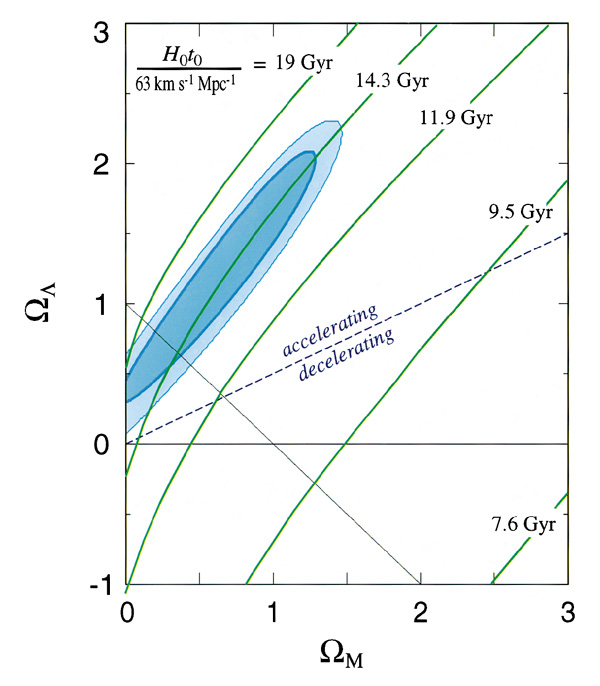
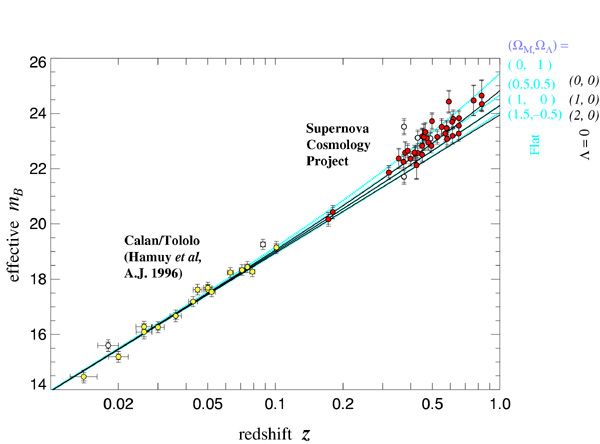
WHT+ISIS, INT+PFC New studies of supernovae in the farthest reaches of deep space indicate that the universe will expand forever because there isn't enough mass in the universe for its gravity to slow the expansion, which started with the Big Bang. This result rests on analysis of 42 of the roughly 78 type Ia supernovae so far discovered by the Supernova Cosmology Project(1). By the time the light of the most distant supernova explosions so far discovered by the team reached telescopes on Earth, some seven billion years had passed since the stars exploded. After such a journey the starlight is feeble, and its wavelength has been stretched by the expansion of the universe, i.e. red-shifting its wavelength. By comparing the faint light of distant supernovae to that of bright nearby supernovae, one could tell how far the light had travelled. Distances combined with redshifts of the supernovae give the rate of expansion of the universe over its history, allowing a determination of how much the expansion rate is slowing. Although not all type Ia supernova have the same brightness, their intrinsic brightness can be determined by examining how quickly each supernova fades. Since the most distant supernova explosions appear so faint from Earth, last for such a short time, and occur at unpredictable intervals, the Supernova Cosmology Project team had to develop a tightly choreographed sequence of observations to be performed at telescopes around the world, among them, the Isaac Newton and the William Herschel telescopes. While some team members are surveying distant galaxies using the largest telescopes in Chile and La Palma, others in Berkeley are retrieving that data over the Internet and analysing it to find supernovae. Once they detect a potential supernova they rush out to Hawaii to confirm its supernova status and measure the redshifts using the Keck telescope. Meanwhile, team members at telescopes outside Tucson and on La Palma are standing by to measure the supernovae as they fade away. The Hubble Space Telescope is called into action to study the most distant of the supernovae, since they are too hard to accurately measure from the ground. Reaching out to these most distant supernovae teaches us about the cosmological constant. If the newly discovered supernovae confirm the story told by the previous 42, astrophysicists may have to invoke Einstein's cosmological constant to explain the observed accelerated expansion of the universe. This cosmological constant has nowadays an interpretation in terms of vacuum energy density which works against gravity to produce the observed accelerated rate of expansion. (1)The Supernova Cosmology Project is a collaboration between the following institutions: Lawrence Berkeley National Laboratory (USA), Institute of Astrophysics, Cambridge and Royal Observatory of Edinburgh (UK), LPNHE, Paris and College de France, Paris (France), University of Barcelona (Spain), and Isaac Newton Group, La Palma (UK and The Netherlands), Stockholm University (Sweden), ESO (Chile), Yale University (USA) and STscI (USA). References:
| ||||||
| Top | Back |
|