| |||
|

| Home > Public Information > Scientific Highlights > 1998 |
THE SEARCH
FOR EXTRASOLAR PLANETS
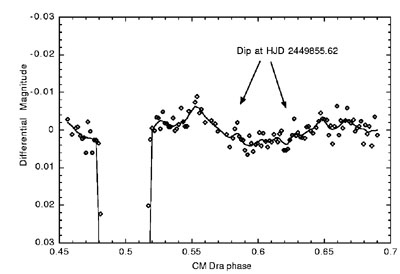
Planetary Systems: Their Formation and Properties WHT, INT, JKT The team EXPORT (EXoPlanetary Observational Research Team) was awarded the 1998 International Time Programme 'Planetary Systems: their formation and properties'. The project focused on formation and evolution of planetary systems, the search for spectral signatures of extrasolar planet atmospheres, and planet searches. Formation and evolution of planetary systems. An enormous data set including high and intermediate resolution spectroscopy, optical photopolarimetry and near-IR photometry of Herbig AeBe, T Tauri, UXORs and Beta Pic-like stars at different stellar evolutions stages was collected. The data were taken simultaneously, which is crucial since many of the phenomena that have to do with preliminary stages in planet formation are variable. Monitoring took place on time-scales of one night (hours), consecutive nights (days), different runs (months). The wide spectral coverage allowed the astronomers to study the behaviour of many transitions of different species and to establish correlations — if any — with broad-band photometry and polarimetry. A large number of the spectra show interesting and puzzling events: evidence of infalling solid bodies (possibly comets) by red-shifted Ca II and Na I components, rotating (possibly stable condensed structures) by flips in H-alpha components, and many other dynamical features. This data set seems to contain a key for the understanding of disk structures that might ultimately lead to planet formation. Spectral signatures of extra-solar planet atmospheres. After the detection of massive planets in close orbits around their star the question of their nature is raised. Although it seems that these planets are large gas giants, similar to Jupiter, large solid planets cannot be ruled out. For these observations, the astronomers adopted the hypothesis that the planets around the stars 51 Peg and tau Boo are large gas giants. Due to interaction with the UV flux of the star, stellar wind, or thermal escape, atoms and molecules of their atmosphere may escape and fill a large volume around the planet. Such extended exosphere could be detected by obtaining spectra of the stars during transit of their planets through the Earth-star line. Spectra of 51 Peg and tau Boo were obtained at the WHT using UES covering several atomic and ionic transitions of potential constituents in a Jupiter-like planet. The stars were observed on two consecutive nights: during transit of the planet and when the planet was not in the line-of-sight. The analysis of the spectra includes a very careful comparison of spectra taken on and off-transit. Search for planets. More than a dozen exo-planets haven been reported. These detections are based on the radial velocity method. Two competitive observing strategies are microlensing and planet transit searches in clusters. Both techniques can be carried out with small 1-m class telescopes. The JKT was hence used to obtain CCD images of two open clusters. The observing strategy consisted in taking R band images of the same cluster position, each image corresponding to a 10 min exposure. Several hundred images were obtained with roughly 1,000 stars within the field of view. This large amount of data provided very accurate light curves of the cluster stars. Many images have already been tested for transit events and several possible candidates have been found. Extrasolar Planetary Transits JKT+JAG CCD, INT+PFC The TEP (Transits of Extrasolar Planets) network has been observing photometrically the eclipsing binary CM Dra since 1994. This is the first long-term observational application of the transit method for the detection of extrasolar planets. The transit method is based on observing small drops in the brightness of a stellar system, resulting from the transit of a planet across the disk of its central star. Such transits would cause characteristic changes in the central star's brightness and, to a lesser extend, colour. The depth of a transit is proportional to the surface area of the planet, and the duration of a transit is indicative of the planet's velocity. If the central star's mass is known, the distance and period can be obtained with great precision. Previous observational tests have been prevented by the required photometric precision (which is about 1 part in 105 in the case of an Earth-sized planet transiting a sun-like star), and by the generally low probability that a planetary plane is aligned correctly to produce transits. An observationally appealing application is available with close binary systems, where the probability is high that the planetary orbital plane is coplanar with the binary orbital plane, and thus in the line of sight. This makes the observational detection of planetary transits feasible in systems with an inclination very close to 90º. The CM Dra system is the eclipsing binary system with the lowest mass known. The total surface area of the system's components is about 12% of the Sun's, and the transits of a planet with 3.2 RE (Earth radii), corresponding to 2.5% of the volume of Jupiter, would cause a brightness drop of about 0.01 magnitudes, which is within easy reach of current differential photometric techniques. The low temperature of CM Dra also implies that planets in the thermal regime of solar system terrestrial planets would circle the central binary with orbital periods on the order of weeks. This allows for a high detection probability of planetary transits by observational campaigns with coverages lasting more than one planetary period. Planets with orbital periods of 10-30 days around CM Dra are especially interesting, since they would lie within the habitable zone, which is the region around a star where planetary surface temperatures can support liquid water, and therefore the development of organic life. CM Dra is relatively close (17.6 pc) and has a near edge-on inclination of 89.82º. With this inclination, coplanar planets within a distance of CM Dra of 0.35 AU aproximately will cause a transit event. This maximum distance corresponds to a circular orbit with a period of about 125 days. There is also a low probability of observing orbits from planets inclined out of CM Dra's binary orbital plane, if the ascending or descending nodes of the planetary orbits are precessing across the line of sight. To obtain sufficient observational coverage, the TEP network was formed with the participation of several observatories in 1994. The final lightcurve contains 17,176 points acquired over three years, and gives a complete phase coverage for CM Dra. Six suspicious events, one of them detected by the JKT, were found by planets with sizes between 1.5 and 2.5 RE. Such events are typified by being temporary faintenings of CM Dra's brightness by a few milimagnitudes, with normal durations of 45-90 minutes. However, none of these events has amplitudes compatible with planets larger than 2.5 RE. Planets smaller than 1.5 RE cannot be detected in the data without a sub-noise detection algorithm. A preliminary signal detection analysis shows that there is a 50% detection confidence for 2 RE planets with a period from 10 to 30 days with the current data. References:
|
| Top | Back |
|