| |||
|

| Home > Public Information > Scientific Highlights > 1998 |
DISCOVERY OF
A LOW-MASS BROWN DWARF COMPANION OF A YOUNG NEARBY STAR
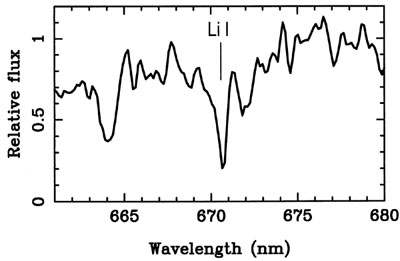
WHT+ISIS, INT+IDS Direct imaging searches for brown dwarfs and giant planets around stars explore a range of physical separations complementary to that of radial velocity measurements and provide key information on how substellar-mass companions are formed. Any companion uncovered by an imaging technique can be further investigated by spectroscopy, which allows information about its atmospheric conditions and evolutionary status to be obtained. Young, nearby, cool dwarf stars are ideal targets of searches for substellar-mass companions (brown dwarfs and giant planets) using direct imaging techniques, because (i) young substellar objects are considerably more luminous when undergoing the initial phases of gravitational contraction than at later stages; (ii) stars in the solar neighborhood (that is, within 50 pc of the Sun) allow the detection of faint companions at physical separations of several tens of astronomical units; and (iii) cool stars are among the least luminous stars, which favors full optimization of the dynamic range of current detectors to achieve detection of extremely faint companions by means of narrow-band imaging techniques at red wavelengths. Using X-ray emission as an indicator of youth, a number of late-type stars (K and M spectral classes) was selected in the solar neighbourhood, of which deep images were obtained. After several targets of the programme were observed, a very red companion to the high-proper-motion M-class dwarf star G 196-3 was discovered 16.2 arcsec away from the star. This red companion was called G 196-B. Further photometry and spectroscopy allowed the astronomers to constrain spectral classification and proper motions of both stars, coming to the conclusion that G 196-3 is a M2.5 star and G 196-3B is a L brown dwarf. From the comparison with other known brown dwarfs they derived a temperature of 1800±200 K. The observed optical and infrared colors present no strange anomaly that might be attributed to an unresolved less massive companion to G 196-3, and no indication of changes in the radial velocity is found beyond the uncertainties of the measurements determined with high-resolution spectra taken at the Isaac Newton Telescope over a time interval of several hours to days. This makes it very unlikely that the star is actually a close-contact binary. The spectral type combined with the observed fluxes indicate that the star is at a minimum distance of 15.4 pc. An upper limit to the age of G 196-3 can be imposed from comparison to the Hyades cluster (600 My), where the average chromospheric and coronal emission of M2-M3 stars is considerably lower than in G 196-3. This star appears to be substantially younger than the Hyades, and hence 300 My is adopted, an age intermediate between that of the Pleiades and Hyades, as a reasonable upper age limit. The lower age limit can be derived from observations of Li I at 670.8 nm. Lithium is a fragile element that burns efficiently in the interiors of fully convective stars over short time scales (a few tens of millions of years). Convection drains material from the stellar atmosphere into the innermost layers, where the temperature is high enough for Li burning to take place. There are several models in the literature that predict the Li depletion rate as function of mass for low-mass stars and give consistent results. A search was made for the Li I line in G 196-3, and an optical spectrum was obtained with the Intermediate Dispersion Spectrograph. An upper limit on the equivalent width of 0.005 nm was imposed, which gives a Li depletion factor larger than 1,000 with respect to its original abundance. This constrains the age of the star to be older than 20 My. All these considerations provide a most likely age for G 196-3 that locates the star in the pre-main sequence evolutionary phase and thus at a more luminous stage than expected for its main-sequence lifetime. According to the age range derived, the most probable distance from Earth to the system is 21±6 pc, the minimum value corresponding to the case of the primary star already on the main sequence and the maximum distance taking into account the youngest possible age. Assuming this distance interval, the luminosity of the companion G 196-3B can be estimated from the measured I and K magnitudes and the K bolometric correction as a function of the colour (I through K). The values obtained are log L/Lo = 4.1 when the oldest age (main sequence) is assumed and log L/Lo = 3.6 for the youngest age (Lo, Sun luminosity). The comparison of the optical and infrared magnitudes with the recent evolutionary tracks, which include dust condensation, allows the astronomers to conclude that the mass of G 196-3B is 25–10+15 Jupiter masses (MJup), where the upper and lower values result from the age limits discussed above. An independent confirmation of
the substellar nature of this faint companion was achieved with the detection
of the Li I resonance doublet at 670.8 nm. An intermediate-resolution optical
spectrum was obtained at the William Herschel Telescope using the ISIS
double-arm spectrograph. The equivalent width of the doublet is 0.5±0.1
nm that, using model atmospheres, gives an atmospheric abundance consistent
with no depletion at all of Li. The presence of Li, combined with the low
atmospheric temperature, rules out the possibility that the object is a
star. Any brown dwarf with a mass below 65 MJup should preserve
its initial Li content for its entire lifetime, and an object with such
a small mass as that of G 196-3B should necessarily show a high Li content.
Although in more massive substellar objects the presence of Li would help
to determine its evolutionary stage more precisely through the time dependence
of Li burning, for our object this detection provides a necessary check
of consistency.
The distance to the system implies a physical separation between the two components of more than 250 AU, being 350 AU at 21 pc. It could be even larger if the system were younger and therefore more distant from the Sun. This large distance and the high mass ratio of 16:1 between the two components favor the fragmentation of a collapsing cloud as the most plausible explanation for the formation of the system. The possibility cannot be excluded, however, that the accretion of matter in a protoplanetary disc may produce an object more massive than 15 MJup at such large distances. Accretion discs extending up to several hundred astronomical units are known to exist around several stars. Surveys similar to that conducted here will provide a statistically significant number of substellar-mass companions that can be used to test the proposed formation mechanisms and may well promote the development of new ideas, as occurred because of the recent findings of giant planets with highly eccentric orbits around solar-type stars. References:
|
| Top | Back |
|