THE FAINTEST
KUIPER BELT OBJECTS
INT+WFC
Starting in 1992, astronomers
have become aware of a vast population of small bodies orbiting the Sun
beyond Neptune. There are at least 70,000 "Trans-Neptunians" with diameters
larger than 100 km in the radial zone extending outwards from the orbit
of Neptune (at 30 AU) to 50 AU. There may be many more similar bodies beyond
50 AU, but these are presently beyond the limits of detection. This population
is generally referred to as the Kuiper Belt.
The Kuiper Belt holds significance
for the study of the planetary system on at least two levels. First, it
is likely that the Kuiper Belt objects are extremely primitive remnants
from the early accretion phases of the Solar System. The inner, dense parts
of the pre-planetary disk condensed into the major planets, probably within
a few millions to tens of millions of years. The outer parts were less
dense, and accretion progressed slowly. Evidently, a great many small objects
were formed. Second, it is widely believed that the Kuiper Belt is the
source of the short-period comets. It acts as a reservoir for these bodies
in the same way that the Oort Cloud acts as a reservoir for the long-period
comets.
Recently, two new Kuiper Belt
objects have been discovered, named 1997 UG25 and 1997 UF25, and they are
some of the faintest objects ever seen orbiting our Sun. One is estimated
to be 150 km across and the other 110 km. Both are about 45 times farther
from the Sun than Earth (4,200 million miles or 6,750 million kilometres),
and more remote than the planet Pluto.
Based on present ideas about how
Kuiper Belt objects formed, astronomers expected to be finding these faint
objects at even greater distances. Since they did not, those ideas may
need to be revised. It may be that the average size of the Kuiper Belt
objects is smaller the farther away they are, so the most distant ones
were too faint even for this survey. Or it might be that the objects actually
discovered mark the outer edge of the Kuiper Belt.
The discovery team used the prime
focus Wide-Field Camera at the Isaac Newton Telescope to image the sky
for 7 nights, searching a total area slightly smaller than that covered
by the full Moon. During each night they stared continuously at different
patches of sky for up to four hours at a time. In each patch of sky several
thousand distant stars and galaxies could be seen. However even these images
were not sensitive enough to record the Solar System objects the team were
seeking. So they combined the images by computer in a way that eliminated
all stars, galaxies and nearby asteroids and revealed only faint solar-system
objects at large distances from the Sun.
References:
-
E Fletcher, M Irwin, and A Fitzsimmons,
1998, "1997 UF25", MPEC 1998-G08.
-
E Fletcher, M Irwin, and A Fitzsimmons,
1998, "1997 UG25", MPEC 1998-G09.
 [ JPEG | TIFF ]
 |
 [ JPEG | TIFF ]
 |
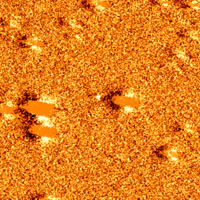
| Left: Discovery
image of 1997 UG25. The trans-neptunian object is the stellar-like object
in the centre of the image. 1997 UF25 was discovered in images obtained
on the 25th/26th October 1997. At a red magnitude of 25.0, it is so faint
that it was only discovered by co-adding roughly 20 images of the same
field. From observations over two nights, a distance of 44.9 AU was calculated.
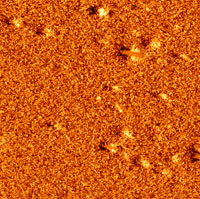
Right: Discovery image of 1997 UF25. Again, the trans-neptunian object
is the stellar-like object in the centre of the image. At a red magnitude
of 24.5, it was found in a similar manner to 1997 UF25. It may never be
seen again, but was at a distance of around 43.3 AU at discovery. |