DISCOVERY
OF THE THIRD MOST DISTANT QUASAR AND THE HIGHEST REDSHIFT RADIO AND X-RAY
SOURCE
INT+Prime Focus, WHT+ISIS
During an imaging survey of the
evolution of the space density of radio-loud quasars, a quasar at z=4.72
was discovered. This quasar, GB 1428+4217, is the third most distant quasar
and the highest redshift radio and X-ray source currently known. It has
a radio flux density at 5 GHz of 259 ± 31 mJy and an optical magnitude
of R ~ 20.9. The rest frame absolute UV magnitude is M (1450 Å) =
–26.7. Another radio-loud quasar was discovered during the same CCD imaging
survey, GB 1713+2148, with z = 4.01. Combined with earlier survey results,
these objects give a lower limit on the space density of quasars with radio
power P5 GHz > 5.8 × 1026 W Hz–1
sr–1 between z = 4 and z = 5 of 1.4 ± 0.9 × 10⁻¹⁰
Mpc–3.
 |
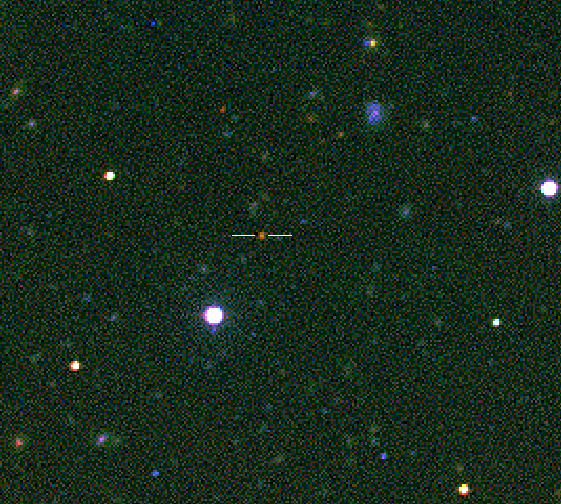
| B and R image of GB1428+4217
(the very red object in the center). GB1428+4217 is the third most distant
quasar and the highest redshift radio and X-ray source currently known.
This picture was taken using the Prime Focus camera at the INT. [ GIF
] |
References
-
A C Fabian et al, 1997, "The extreme
X-ray luminosity of the z=4.72 radio-loud quasar GB 1428+4217", MNRAS,
291,
L5.
-
I M Hook and R G McMahon, 1998, "Discovery
of radio-loud quasars with z=4.72 and z=4.01", MNRAS, 294,
L7.
|