OBSERVATIONAL
EVIDENCE THAT ELLIPTICAL GALAXIES ARE PRODUCED BY FUSION
INT+Prime Focus
It has been known since the 80's
that hidden behind the apparent simplicity and uniformity of elliptical
galaxies are some unusual properties. Almost half of the ellipticals which
have been studied show faint luminous arcs which are called shells. The
nucleus of between 20 and 30% of ellipticals rotate in the opposite or
orthogonal direction from the rest of the galaxy. An undetermined number
of ellipticals have rings or polar disks with stars, gas and dust. The
existence of such structure can only be understood as a result of accretion
or fusion processes between existing galaxies and not as a result of monolithic
collapse during the formation stage. In fact the presence of two counter
posed tidal tails is unequivocal evidence for the fusion of two disk galaxies.
The fact that the tails are diluted with time until they become unobservable
has made it difficult in the past to obtain fundamental proof of the origin
of ellipticals from the fusion of spiral galaxies.
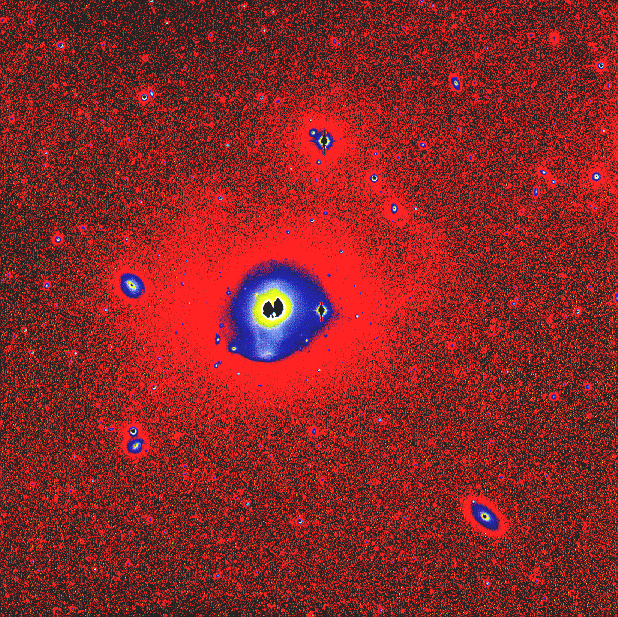
 |
CCD image of the peculiar
elliptical galaxy NGC 3656 (Arp 155) obtained in the R band with the INT.
The first of the two tails emerges to the west (right) and then curves
to the north (up). The three objects in line with the end of the tail are,
from south to north, a dwarf galaxy and two stars, the northernmost of
which hides a small galaxy in its halo. It is as yet unknown if the galaxies
are physically associated with the tail. The second tail emerges from the
east side of the galaxy and extends towards the north. [ GIF
] |
This proof has been obtained as
a result of observations with the INT of the peculiar elliptical galaxy
NGC 3656. This galaxy had been understood to be the result of a minor fusion
(an elliptical galaxy swallowing a smaller galaxy) due to the presence
of photometric shells and a nucleus which rotates orthogonally. The INT
data, after being treated with a special equalising process for the detector's
photometric response, have revealed an extensive luminous halo and two
tidal tails. Such tails are incompatible with minor fusion and suggest
that a major fusion has taken place between two galaxies with disks of
similar size in direct orbit.
References
-
M Balcells, 1997, "Two tails in NGC
3656 and the major merger origin of shell and minor-axis dust lane elliptical
galaxies", Astrophys J, 486, L87.