| |||
|

| Home > Public Information > Scientific Highlights > 1997 |
THE FIRST L-TYPE
BROWN DWARF
WHT+ISIS, INT+Prime Focus Since the discovery of the first brown dwarf in 1995 by the WHT, it has been proved that objects with masses between those of stars and planets can be formed in nature and several observations of brown dwarfs have been reported. To directly detect single brown dwarfs of known age, distance and metallicity, the ideal place to search is within young open clusters. Many brown dwarf surveys have been conducted in the Pleiades open cluster. This is because the Pleiades cluster is near enough that the lower main sequence is not beyond the limits of detection, but far enough away that the area of sky covered is not too large. The cluster is young enough so that any brown dwarfs will be relatively bright. The discovery of the first brown dwarfs in a small survey of the Pleiades suggests that a large number of very low mass objects may populate this cluster. With the aim of searching for new Pleiades brown dwarfs, a deep ITP CCD I,Z survey was performed covering 1 deg2 within the central region of the cluster. Over 50 faint (I =>17.5), very red (I–Z => 0.5) objects were detected down to I~22. Their location in the I–Z color diagram suggested cluster membership. According to current evolutionary models, they should have masses in the interval 30 – 80 MJup (1 MJup ~ 10–3 solar masses). The most secure Pleiades brown
dwarfs are those with kinematic information that supports cluster membership
and lithium detection that confirm their substellar status. After spectroscopic
observations, several candidates were confirmed as brown dwarfs, among
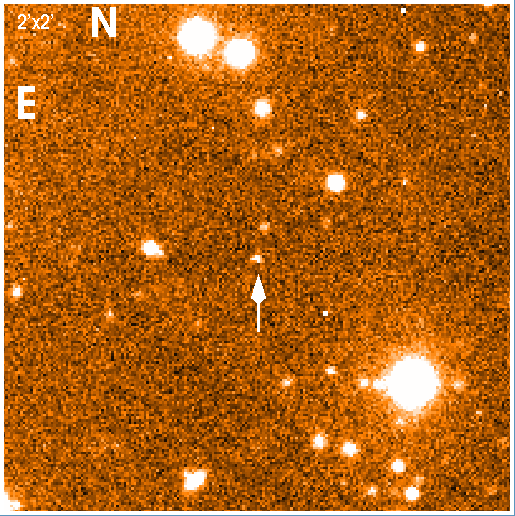
them, Roque 4 (45 MJup, I=19.75, M9 V) and Roque 25 (35 MJup,
I=21.17, early L), the coolest and faintest brown dwarfs ever observed.
Roque 25 is a benchmark brown dwarf in the Pleiades because it is the first
known one that belongs to the L-type class. The optical spectrum of Roque
25 is characterised by the following features: (1) the lack of strong molecular
absorption band heads in the range 640–760 nm, in particular, the strong
TiO bands starting at 705.0 nm are absent or extremely weak in Roque 25;
(2) the molecular systems of CaH, CrH, and FeH become as strong or stronger
than the systems of TiO and VO; (3) the atomic lines of KI and CsI that
are very strong in L-type objects are weaker in Roque 25.
Roque 25 provides evidence that the initial mass function extends down to about 0.035 solar masses and serves as a guide for future deep searches for even less massive young brown dwarfs. References
|
| Top | Back |
|