DETECTION OF
SPIRAL WAVES IN STELLAR ACCRETION DISC
INT+IDS
For the first time, astronomers
detected spiral structure in the disc of gas that surrounds one of the
stars in an interacting binary star system. The observed system is known
as IP Pegasi. IP Pegasi is an eclipsing dwarf nova, a subclass of cataclysmic
variables, consisting of a K5 secondary star of 0.5 solar masses losing
mass to a white dwarf of 1.0 solar masses in a 3.8-hour orbit. At semi-regular
intervals of about three months the system brightens by 2 magnitudes as
the mass transfer through the accretion disc suddenly increases.
The disc is smaller than the radius
of the Sun, so it is not possible to resolve it directly in any telescope.
The technique used involved measuring the velocity of the gas by looking
at the Doppler shift in its spectrum. As the stars revolve around each
other in their 3.8-hour orbit, the observers got successively different
views of the disc. By using a technique called "tomography", they were
able to reconstruct a picture of the flow pattern of the gas.
The results showed a two-armed
trailing spiral in the outer part of the disc. Such spirals are thought
to be created by tidal forces due to the gravitational pull of the normal
star. The formation of such spirals had been predicted, but this is the
first positive detection.
This discovery was made thanks
to observations carried out at the INT using Service time. The Service
programme at the ING telescopes is well suited for undertaking a quick
look at new cataclysmic variables or providing complementary emission-line
information on old ones. But the programme's main advantage is that it
offers the observers the opportunity of some flexibility over the predetermined
schedule to cover unexpected events such as nova outbursts. Indeed the
astronomers observed IP Pegasi while it was on the rise to outburst with
the Intermediate Dispersion Spectrograph (IDS) on the INT, which resulted
in the discovery of spiral structure in the binary's accretion disc.
 |
| A
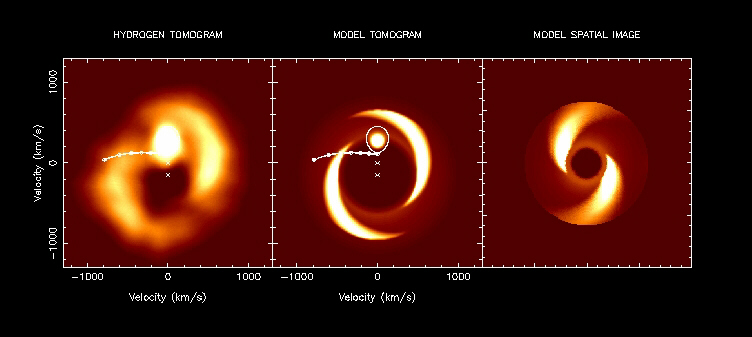
hot disk of gas surrounding a compact white dwarf star in the constellation
of Pegasus has recently been revealed to be imprinted with this dramatic
pattern. The white dwarf is part of the interacting binary star system
IP Pegasi and the disk of gas is an accretion disk formed of material lost
from a companion star and falling toward the white dwarf. The disk itself
is smaller than the Sun's diameter, so the spiral pattern can not be imaged
directly by telescopes. Instead, the spiralling disk of gas is mapped over
a series of observations using a spectroscopic technique known as Doppler
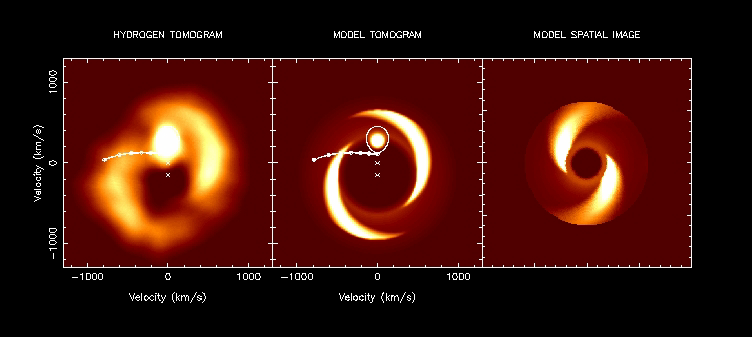
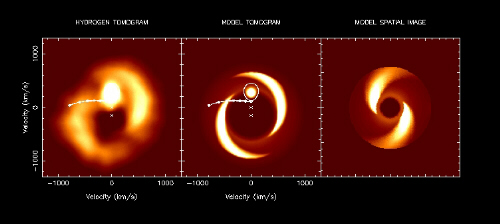
"tomography". The left panel above shows a tomogram, the directly measured
gas velocity map for the system. The relative brightness corresponds to
the intensity of light emitted by Hydrogen gas moving at the indicated
velocity. The position at the center of this panel represents the velocity
of the binary system's center of mass. In the middle panel, a simple model
velocity field consistent with the measurements is shown. At the right,
the calculated position map of the IP Pegasi accretion disk reveals a striking
two armed trailing spiral pattern [ JPG | BMP
]. |
References
-
E T Harlaftis and D Steeghs, 1997,
"Spiral Waves in a Solar-size Accretion Disc", Spectrum Newsletter,
13,
4.
-
D Steeghs et al, 1997, "Spiral structure
in the accretion disc of the binary IP Pegasi", MNRAS, 290,
L28.